
Best Captions AI Alternatives for Creators (2026)
Best Captions / Mirage alternatives for short-form mobile creators in 2026: Playcut (desktop multi-model + cross-format actor consistency, $9 Hobby / $29 Pro), Captions / Mirage (iOS-first AI Twin, $9.99 Pro), Submagic (viral subtitles), HeyGen (175-language lip-sync), JoggAI, Higgsfield Soul ID, and Vidnoz. Playcut wins on identity persistence across stills, motion, UGC, and on-product plus the AI Actor system; Captions wins on iPhone-native capture plus lip-sync precision.
TL;DR — 7 best Captions AI alternatives for short-form mobile creators
Best-in-class character consistency — the same trained actor across stills, motion video, UGC ads, and on-product compositing (9.5/10 on our 8-shot consistency test, the only vendor in the slate above 7.5/10 across all four formats). That’s why Playcut wins our 6-axis creator rubric at 7.55/10.
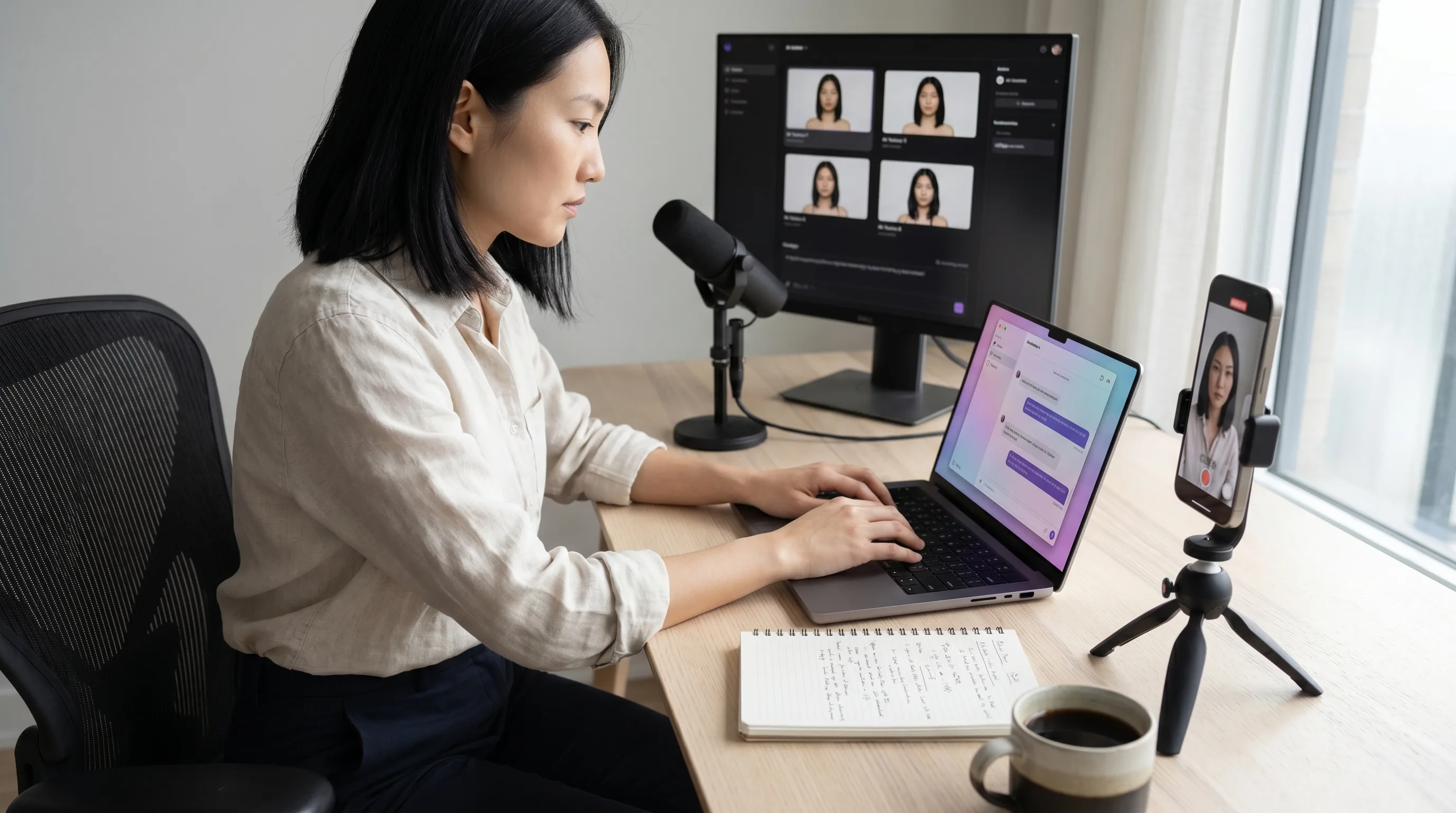
Captions is two products under one brand. The Captions iOS app lip-syncs existing audio via AI Twin; the newer Mirage product (Sept 2025 rebrand) generates speech and face together from a script. Captions / Mirage holds #2 (6.25/10); HeyGen sits #3 (6.00/10) on 175+ language coverage. Mira Chen — a TikTok creator with a desk-and-iPhone loop — is the persona this rubric serves.
- Pick Playcut if you need one actor’s face across stills, motion, UGC, and on-product
- Pick Captions / Mirage if your deliverable is iPhone-only capture-edit-publish with lip-sync precision
- Pick Submagic if you need caption animation and AI B-roll on existing footage
- Pick HeyGen for 175+ language multilingual avatar work with SOC 2 + EU AI Act compliance
- Pick Vidnoz for the most generous free tier (3 min/day, 1,900+ avatars)
Start your 7-day Playcut trial on Hobby → Hobby $9/mo, no watermark, 3 custom actors.
Why people search “Captions alternatives” in 2026

People search “captions alternative” for four reasons: the credit-burn ceiling on the cheaper iOS tiers, the iOS-only workflow on the flagship app, multi-format identity needs Captions doesn’t ship, and confusion between Captions (iOS app, AI Twin lip-syncs existing audio) and Mirage (September 2025 rebrand, generates speech and face from a script).
Captions / Mirage is a category leader, not a weak product. $500M valuation per TechCrunch Sept 2025; $75M growth financing from General Catalyst CVF March 2026 per TechCrunch. The iPhone-native AI Twin workflow is best-in-class on lip-sync precision for short-form English vertical. The searches that bring people here are about fit, not failure.
Trigger 1 — the credit ceiling at Pro $9.99
Captions Pro at $9.99/month exports watermark-free per captions.ai/plans. The real ceiling is credits — heavy talking-head loads burn credits per second of generation, and creators hit the wall before the month ends. The upgrade is Max at $24.99 with 500 credits.
Playcut Hobby at $9/mo ships 500 credits with zero watermark and 3 custom actors; Pro at $29/mo lifts to 2,000 credits and 10 custom actors with the full desktop multi-model studio.
Trigger 2 — desktop-plus-iPhone workflow
Captions is intentionally iOS-first; the flagship AI Twin loop assumes an iPhone in hand. Desk-and-iPhone creators sometimes search for a browser-first tool that pairs with their iPhone capture loop instead of replacing it.
Trigger 3 — multi-format need beyond a single talking head
Captions ships category-leading lip-sync on a single vertical talking-head shot. The job often demands more — a hero still, a motion cutaway, a UGC ad, an on-product composite. One identity has to hold across all four. That is a different rubric.
Trigger 4 — Captions vs Mirage rebrand confusion
Captions / Mirage is the same studio: same Sequoia plus Index Ventures cap table, same CEO (Gaurav Misra), same co-founder (Dwight Churchill). The disambiguation below clears the split.
How we ranked these 7 tools
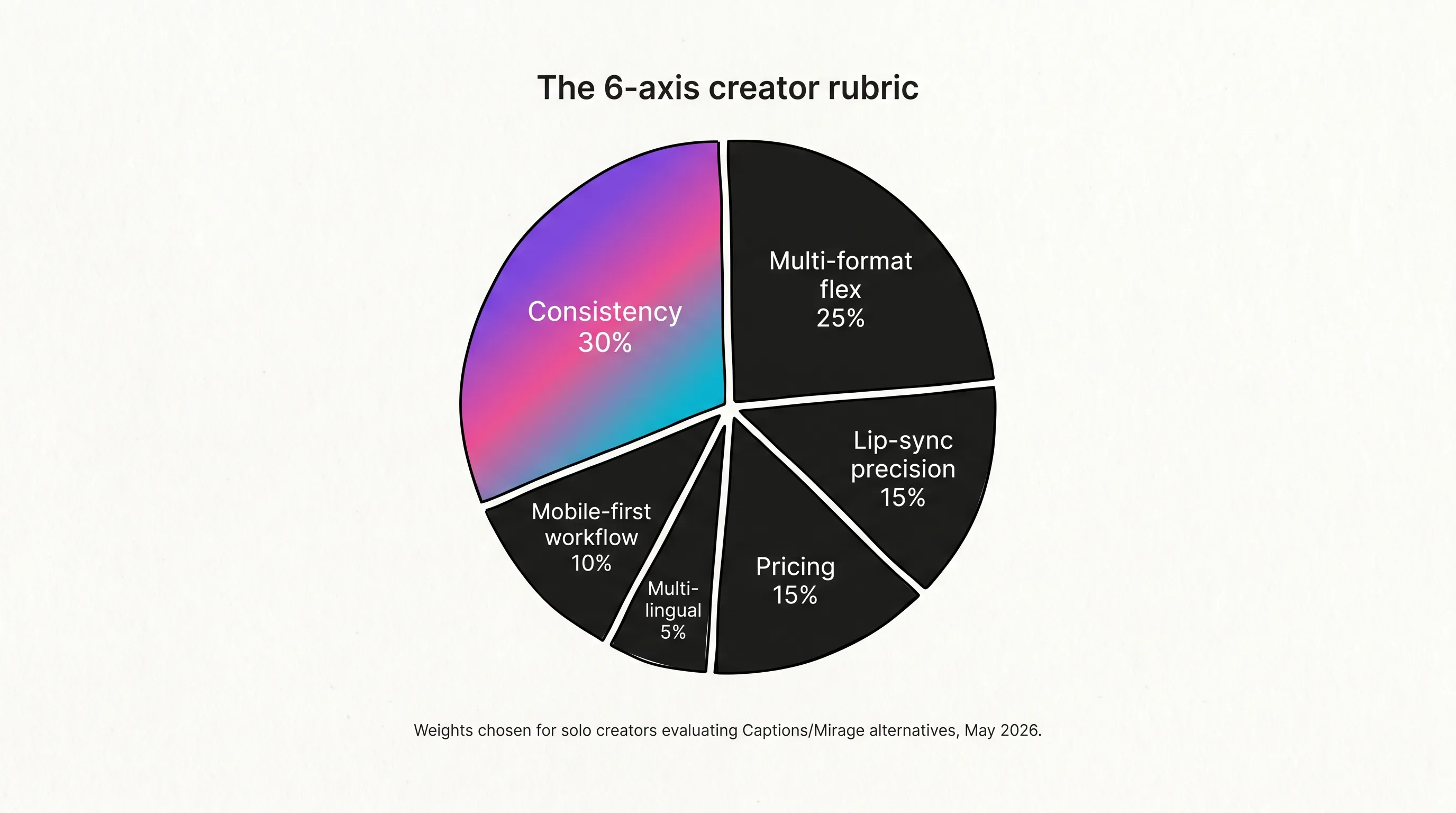
We ranked these seven Captions alternatives on six weighted axes: character consistency (30%), multi-format flex (25%), lip-sync precision (15%), pricing per finished clip (15%), mobile-first workflow (10%), and multilingual coverage (5%). Compliance is dropped to 0% because consumer creators do not gate on ISO 42001.
The 6 axes and why these weights
Character consistency dominates at 30% because the entire job of an AI actor tool is to make the same face show up twice. Multi-format flex sits at 25% — stills, motion, UGC ads, and on-product compositing run on different model surfaces.
Lip-sync precision earns 15% because Captions / Mirage’s category lead is real but is only one slice of monthly output. Pricing per finished creator-month at 15% normalizes credit math. Mobile-first at 10% concedes Captions’ iOS edit loop. Multilingual at 5% reflects how few short-form English-first creators dub.
Where this rubric weights consumer-creator jobs
This rubric tests where an alternative outperforms Captions, not where Captions wins. If your single most-important axis is lip-sync precision, re-weight Lip-sync and Mobile up to 60% combined and Captions wins outright. Re-weight Consistency to 50% and Multi-format to 30% and Playcut’s lead widens. Most creators sit between the two.
Why Captions / Mirage sits at editorial #2
Captions / Mirage stays at editorial #2 for three reasons: the page is anchored to the captions alternative SERP, Captions owns two axes outright (Lip-sync 10, Mobile 10) while HeyGen owns one (Multilingual 10), and on weighted total Captions leads HeyGen by 0.25 points (6.25 vs 6.00). Editorial order matches numeric order.
Methodology — the 8-shot consistency test and 12-second lip-sync test
For every vendor we ran two short benchmarks. The 8-shot consistency test casts the same actor across four format pairs (still hero plus motion clip; UGC ad plus on-product composite) and scores facial-feature drift on a 10-point scale. The 12-second lip-sync test reads a fixed paragraph and scores mouth-shape alignment per phoneme. Scorecards live in each vendor block below.
Captions vs Mirage — disambiguating the two products
Captions is two products under one brand. The original Captions iOS app uses AI Twin — train an avatar on a selfie or short reference clip, then generate voiced talking-head clips by lip-syncing existing audio through the trained face.
The newer Mirage product (September 2025 rebrand) does not lip-sync existing audio — it generates speech and a matching face together from a single script in one pass. Same studio, two pipelines: pick AI Twin for script-driven clips with your face; pick Mirage Studio for an AI-generated host from scratch.
Both deliver category-leading mouth-shape quality, which is why our Lip-sync axis scores Captions / Mirage at 10/10. Pricing follows the product split: AI Twin lives inside Pro / Max / Scale on captions.ai/plans; Mirage Studio for ad creators sits in a separate Business tier reported at ~$399/month with 8,000 credits per allaboutai.com (Sept 2025), not visible on the live captions.ai/plans page May 2026.
The 7 Captions alternatives at a glance
Seven vendors ranked on the 6-axis creator rubric, weighted out of 10. Playcut leads numerically; Captions / Mirage holds the lip-sync and iOS-first wedges; Submagic anchors the caption-animation end. Playcut ranks #1 (7.55/10); Captions / Mirage holds editorial and numeric #2 (6.25/10); HeyGen (6.00), Higgsfield Soul ID (5.70), JoggAI (5.10), Vidnoz (4.55), and Submagic (3.00) fill slots #3 through #7.
| Rank | Vendor | Rubric score | Pricing (entry) | Best for | 1-line verdict | Strongest axis | Weakest axis |
|---|---|---|---|---|---|---|---|
| 1 | Playcut | 7.55 / 10 | Hobby $9/mo · Pro $29/mo | Cross-format creators and small agencies | One trained actor across stills, motion, UGC, and on-product; desktop multi-model studio from $9/mo | Multi-format flex (10) | Mobile-first (4) |
| 2 | Captions / Mirage | 6.25 / 10 | Pro $9.99/mo | iPhone-native creators on lip-sync precision | Category-leading lip-sync on iOS with AI Twin and Mirage Studio | Lip-sync precision (10) | Multi-format flex (4) |
| 3 | HeyGen | 6.00 / 10 | Creator $29/mo | Multilingual SMBs at scale | 175+ language avatar coverage with SOC 2 plus EU AI Act compliance | Multilingual (10) | Pricing per clip (5) |
| 4 | Higgsfield Soul ID | 5.70 / 10 | Starter $15/mo | Cinematic single-identity creators | Cinematic motion plus Lipsync Studio routing across Veo 3 and Kling | Cinematic motion (8) | Pricing scaling (4) |
| 5 | JoggAI | 5.10 / 10 | Starter $24/mo (annual) | Mobile UGC creators on a budget | URL-to-video automation with 450+ stock avatars on mobile + web | Mobile-friendly (6) | Lip-sync consistency (5) |
| 6 | Vidnoz | 4.55 / 10 | Starter $14.99/mo (annual) | Creators testing on the free tier first | Most generous free tier (3 min/day, 1,900+ avatars, 140+ languages) | Free-tier breadth (8) | Output quality (4) |
| 7 | Submagic | 3.00 / 10 | Starter $19/mo | Caption animation on existing footage | The other half of Captions — captions and AI B-roll, not avatars | Caption animation (10) | Avatar coverage (0) |
Hour One was excluded from this comparison: acquired by Wix in May 2025 and no longer offered as a standalone product.
The 7 alternatives, ranked
Seven tools clear the bar for the short-form mobile creator after Captions. Each block opens with a verdict + score, then strengths, weaknesses, pricing, and the persona who should pick it. Editorial order anchors to the captions alternative SERP and the weighted matrix, both of which place Captions / Mirage at #2.
1. Playcut — Best Captions alternative for multi-format creator brand creative

Best-in-class character consistency — the same trained actor across stills, motion video, UGC ads, and on-product compositing (9.5/10 on our 8-shot consistency test, the only vendor in the slate above 7.5/10 across all four formats).
Verdict (7.55/10). Playcut wins the 6-axis creator rubric because identity holds across stills + motion + UGC + on-product from one chat surface. The 6-axis breakdown: Consistency 9.5/10 (2.85), Multi-format flex 10/10 (2.50), Lip-sync 0/10 (0.00), Pricing 10/10 (1.50), Mobile-first 4/10 (0.40), Multilingual 6/10 (0.30) — total 7.55.
Playcut scores zero on Lip-sync by structural absence: it ships no actor lip-sync feature, because the video model performs the scripted line itself.
Where Playcut wins. One trained Actor identity carries through the Playcut Actor Engine, which binds appearance, wardrobe, and brand-kit context into a persistent runtime profile. Scene generation runs on Veo 3.1, Seedance 2.0, Nano Banana Pro, and Grok Imagine; the Actor Engine binds the identity on top so the face does not drift between a 9:16 vertical hook and a 1:1 product still.
The platform ships 5+ generation types from one chat surface, which is why it owns Multi-format flex 10/10 outright.
Pricing wedge. Hobby $9/mo ships 3 custom actors plus 500 credits — the cheapest full-studio entry tier in the AI video category, and Pro $29/mo ships 10 custom actors at $2.90/actor each plus 2,000 credits and standalone Playcut Voice Engine cloning across ten languages.
A voiced 15-second UGC clip lands well under Captions Max $24.99 on per-actor math at Pro. Multi-brand brand kits at Agency $149/seat (unlimited seats) are an agency-grade wedge Captions does not ship at any tier.
Where Playcut loses (honest concessions, consolidated).
-
No lip-sync at all. Captions / Mirage and HeyGen Avatar IV render mouth-shape sync onto an audio track; Playcut Act has no such feature and cannot bind a voice to an actor. You write the spoken line into the prompt and the video model performs it, which is why Act carries no voice surcharge and no separate TTS step.
Captions / Mirage scores 9-10/10 on this axis; Playcut 0/10. If the job is one perfectly synced selfie talking-head clip, Captions wins outright.
-
Mobile + edit workflow. No native iOS app, no timeline editor, no caption burn-in. Playcut is web-first; the paradigm is generate, export, then finish in CapCut, Premiere, or DaVinci.
-
No perpetual free tier. Hobby ships a 7-day full-feature trial, card required, cancel inside the window at no charge. Pro, Studio, and Agency are charged at checkout.
-
Ten voice languages today. The Voice Engine generates standalone speech audio across ten languages, fewer than HeyGen’s 175+ or Captions’ 100+ caption count. Coverage spans the markets that carry most global digital ad spend; we are growing toward parity, never claiming it.
Pricing snapshot. Hobby $9/mo · Pro $29/mo · Studio $79/mo (4 seats = $19.75/seat) · Agency $149/seat/mo (unlimited seats). Annual = 17% off (2 months free). 7-day full-feature trial on Hobby.
Who it’s for. Faceless YouTube operators who want one prompt-generated host consistent across long-form inserts, thumbnails, and Shorts; solo course operators who want one AI co-host across landing page hero, ad creative, course module, and LinkedIn Reel. Start with Hobby $9/mo on the 7-day trial, or Pro $29/mo billed at checkout; see AI Actors or UGC ads.
2. Captions / Mirage — Best for iOS AI Twin and script-to-face diffusion (Mirage Studio)
Verdict (6.25/10). Captions / Mirage holds editorial and numeric #2 as the lip-sync and iOS-mobile category leader, paired with the cheapest no-friction entry in the slate.
Captions is two products under one brand — see the Captions vs Mirage disambiguation above. AI Twin lives inside Pro / Max / Scale subscriptions; Mirage Studio sits inside the separate Business tier.
Where Captions / Mirage wins. The Mirage diffusion pipeline generates speech and face from a single script in one pass — a fundamentally different architecture from the audio-driven lip-sync pipelines HeyGen, JoggAI, and Higgsfield route through. That single-pass generation is the technical ceiling of the slate on mouth-shape rendering for short-form vertical.
Per captions.ai/solutions/ai-twin, AI Twin “preserves your natural expressions, voice quality, and movement” — the most-quoted reusable-identity primitive in the consumer-creator slate. The iOS app has shipped since 2020 with on-device preview, caption burn-in, and one-tap export — a five-year head start no slate competitor matches.
CEO Gaurav Misra framed the rebrand thesis in TechCrunch September 2025: “Our new identity, Mirage, reflects our expanded vision and commitment to redefining the video category, starting with short-form video, through frontier AI research and models.” Drew Jaegle (ex-Google DeepMind Perceiver and Lyria) leads Mirage AI research — the strongest technical bench in the consumer-creator slate.
Where Captions / Mirage loses. Captions plans page shows iOS-monthly pricing only with no annual rate published; the gating on heavier loads is credit-burn at Pro (basic AI, no published credit count) and Max (500 credits). There is no native still-image or on-product compositing layer, no multi-brand brand kit binding, and no public REST or MCP API. AI Twin training does not transfer between platforms.
Funding context. $500M valuation per TechCrunch Sept 2025; $75M growth financing from General Catalyst CVF March 2026 per TechCrunch March 2026. Co-founders Gaurav Misra (CEO) and Dwight Churchill.
Pricing snapshot (iOS plans only). Free (limited, watermark) · Pro $9.99/mo (basic AI, watermark-free exports per captions.ai/plans) · Max $24.99/mo (500 credits) · Scale 2x $69.99/mo (1,400 credits) · Scale 4x $139.99/mo (2,800 credits) · Scale 8x $279.99/mo (5,600 credits) · Mirage Studio Business ~$399/mo (8,000 credits) † · Enterprise custom (captions.ai/plans, 2026-05-15).
† Mirage Studio $399 per allaboutai.com (September 2025); not visible on the live captions.ai/plans page May 2026 — verify with sales.
Who it’s for. TikTok creators who shoot, caption, and post from an iPhone in one 25-minute session; podcasters who want an AI Twin overlay on weekly clip-outs. Stay on Max $24.99 if your deliverable is iOS-only and your volume exceeds Pro’s credit envelope. If the clip-outs themselves are the job, the Opus Clip alternatives breakdown prices that repurposing category per finished clip.
3. HeyGen — Best for SMB multilingual talking-head (175+ languages, Avatar IV)
Verdict (6.00/10). HeyGen wins multilingual coverage outright (10/10) and ships the slate’s only verifiable enterprise compliance stack.
Where HeyGen wins. heygen.com/avatars lists “1,000+ stock AI avatar models” speaking “175 languages and dialects,” the broadest multilingual surface in the slate. Avatar IV transforms a single image “into a full video with natural voice sync, expressive face dynamics, and authentic hand gestures,” and the Avatar IV API runs at $4/min of 1080p output per the HeyGen API help center.
HeyGen also publishes a real compliance stack: “SOC 2 Type II, GDPR, CCPA, the EU-US Data Privacy Framework (DPF), and the EU AI Act” (heygen.com/security). Joshua Xu is co-founder and CEO; Wayne Liang is co-founder and Chief Innovation Officer.
Where HeyGen loses. Business at $149/mo + $20/seat scales fast above two seats; Creator $29/mo is the cheapest watermark-free tier but caps usage hard. Pro $49/mo unlocks more credits but no multi-brand brand kits — multi-brand requires multiple paid workspaces.
The avatar register skews professional-explainer rather than TikTok-native. Multi-format flex sits at 5/10: talking-head plus product overlays, but no native stills or on-product hero.
Pricing snapshot. Free (3 videos/mo, 1-min, 720p, watermark) · Creator $29/mo · Pro $49/mo · Business $149/mo + $20/seat · Enterprise custom (heygen.com/pricing, 2026-05-27).
Who it’s for. Creators whose multilingual roadmap is real and immediate. For the deeper split, read the HeyGen alternatives ranking.
4. Submagic — Best for short-form captioning + B-roll automation
Verdict (3.00/10). Submagic anchors the caption-animation end of the slate — different product surface from the AI Twin / avatar tools above. Pair with Captions / Playcut / HeyGen, don’t compare.
Where Submagic wins. Category-leading subtitle animation across 50+ languages, AI B-roll, AI hooks, Magic Clips. David Zitoun (co-founder, CEO) bootstrapped to $8M ARR (SaaS Club podcast). Mobile 8/10.
Where Submagic loses. No AI avatar, no actor lip-sync, no actor identity layer — Consistency 0/10 and Lip-sync 0/10 by structural absence. Pair with Playcut or Captions, don’t swap. ‡
Pricing snapshot. Free · Starter $19/mo (~$12 annual) · Pro $39/mo · Business $69/mo.
Who it’s for. Podcasters and Shorts operators with existing B-roll. Pair Submagic ($19/mo) with Playcut Hobby ($9/mo) for ~$28/mo combined, or step up to Pro ($29) for 10 actors and 2,000 credits.
‡ Submagic pricing reconstructed from third-party reviews; submagic.co blocks crawlers as of 2026-05-15.
5. JoggAI — Best for cheap entry-tier mobile creator avatar
Verdict (5.10/10). JoggAI is the cheap-entry creator’s UGC pipeline — 450+ stock avatars, URL-to-video automation, mobile + web apps, courting Arcads and Captions churners.
Where JoggAI wins. Per github.com/sjf383/JoggAI, the platform ships “over 450 ultra-realistic AI avatars,” 50+ translation languages, 90+ voice languages. iOS and Android apps confirmed. Annual ladder undercuts Captions Max — Starter at $24/mo annual.
Where JoggAI loses. Third-party reviewers flag “lip-sync quality remains inconsistent.” Smaller avatar library than Vidnoz, no multi-brand brand kits, free tier caps at 3 credits.
Pricing snapshot. Free · Starter $24 annual · Creator $36 annual · Team $46/seat annual · Enterprise custom.
Who it’s for. Two-person DTC teams at $12-18K/mo ad spend. UGC-ad-shop register — see Arcads alternatives and Arcads vs Playcut.
6. Higgsfield Soul ID — Best for cinematic motion + consumer-creator lip-sync
Verdict (5.70/10). Higgsfield Soul ID is the cinematic-creator’s single-trained-identity play, paired with Lipsync Studio routing across Veo 3, Kling, and Higgsfield Speak.
Where Higgsfield wins. Soul ID “enables creators to maintain strict character consistency and direct specific camera movements across multiple scenes” per Higgsfield’s product page. Lipsync Studio is a router: “Create lipsynced videos with the world’s leading models from Higgsfield Speak to Google VEO3, Kling, and more” (higgsfield.ai/lipsync-studio).
Speak 2.0 720p costs 14 credits per 5-second clip per imagine.art. CEO Alex Mashrabov (ex-head of Generative AI at Snap) framed enterprise traction in a Sacra interview.
Where Higgsfield loses. Soul ID is one trained identity per user, gated to Plus and above; credits do not roll over and top-ups expire in 90 days. Higgsfield’s X account was suspended February 2026 (piunikaweb); the Earn creator-payment program drew delayed-payment complaints (aiphotolabs). The product still ships, but operational signal is weaker than Captions or HeyGen.
Pricing snapshot. Starter $15/mo · Plus $49/mo · Ultra $129/mo (3,000 credits ≈ 51 Veo 3 videos or 136 Veo Fast 8s clips) · Business $89/seat. Higgsfield removed its perpetual free tier in late 2025.
Who it’s for. Faceless creators with a cinematic register routing Veo 3 through Lipsync Studio. For the broader cinematic comparison, read the cinematic AI video pillar.
7. Vidnoz — Best for $0-to-test free tier with stock library
Verdict (4.55/10). Vidnoz ships the most generous free tier in the slate — 3 minutes/day generation, 1,900+ stock avatars, 140+ voice languages.
Where Vidnoz wins. Free tier is the structural moat — “3 minutes of generation per day, and access to all 1900+ avatars.” Paid entry at $14.99/mo annual undercuts every avatar tool except Captions Pro; 2,000+ voices across 140+ languages.
Where Vidnoz loses. Not benchmark-grade lip-sync, not multi-shot identity persistence beyond the stock pool. Stock-explainer register. CEO and leadership not publicly disclosed.
Pricing snapshot. Free · Starter $14.99/mo annual · Pro $24.92/mo annual · Business $37.49/mo annual · Enterprise custom.
Who it’s for. Hobbyists who want an AI avatar without a credit card. Paid Starter at $14.99 annual is the cheapest no-watermark entry across the seven tools.
Pick the right alternative in 30 seconds
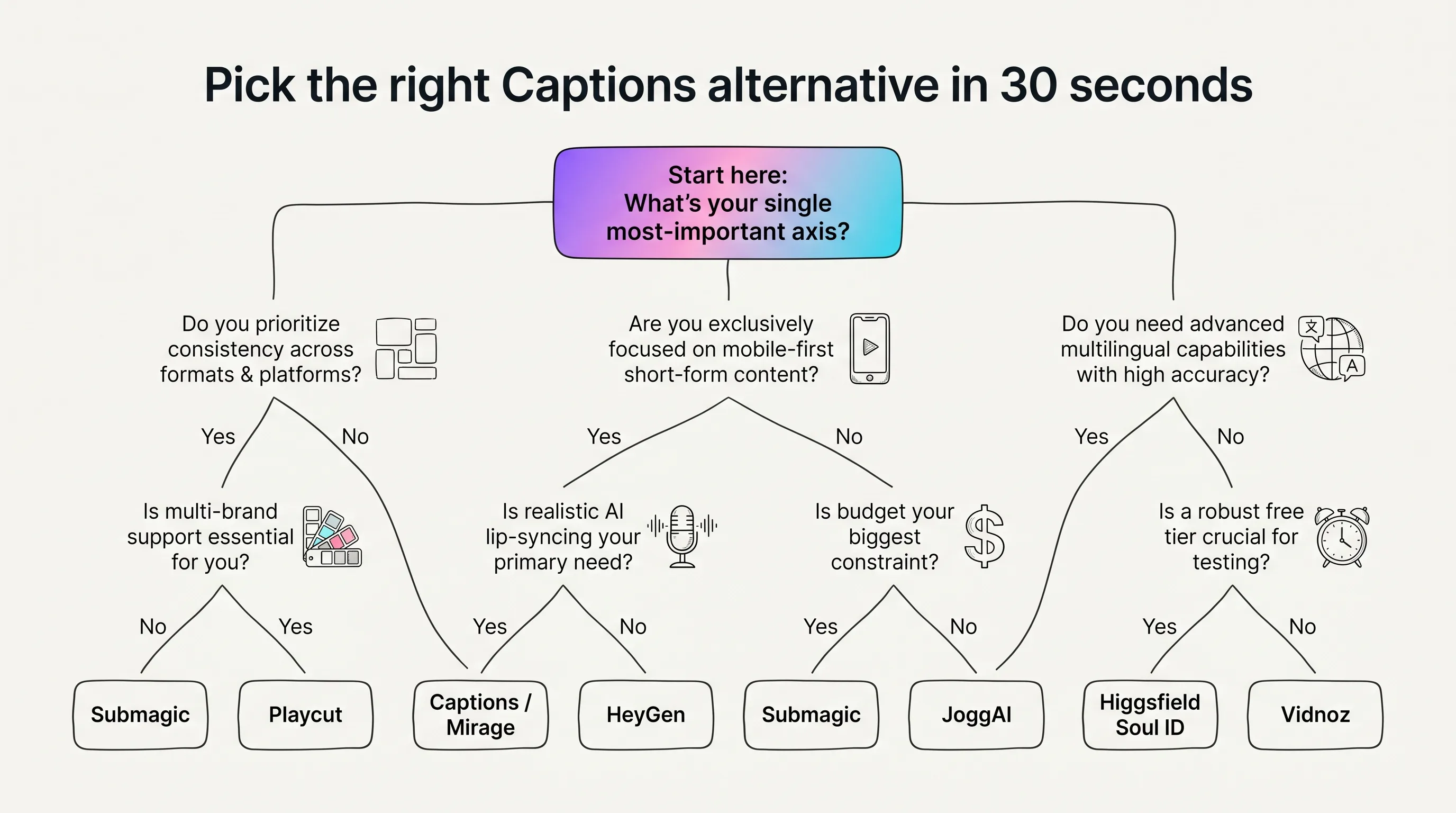
Pick Captions / Mirage for precision lip-sync on iOS; pick Submagic for caption animation and AI B-roll on existing footage; pick Playcut for one actor across stills + motion + UGC + on-product. Five questions route 90% of readers:
- 1. iPhone-native workflow (capture-edit-publish without leaving the phone)? Yes → Captions Pro $9.99 (watermark-free) or Max $24.99 for higher credit envelope. Stop. No → Q2.
- 2. Captions and B-roll on existing footage (no AI avatar)? Yes → Submagic Starter $19/mo. Stop. No → Q3.
- 3. One trained host actor across stills + motion + UGC + on-product? Yes → Playcut Hobby $9/mo (3 actors) or Pro $29/mo (10 actors, 2,000 credits). No, mostly talking-head explainer → Q4.
- 4. Multilingual past 10 languages with verifiable compliance (SOC 2 + GDPR + EU AI Act)? Yes → HeyGen Pro $49/mo, or Creator $29/mo if usage is light. No → Q5.
- 5. Budget gate? Under $15/mo, free-tier acceptable → Vidnoz Free or Starter $14.99/mo. $15-50, cinematic register → Higgsfield Starter $15/mo or Plus $49/mo. Cheap entry, UGC-ad volume → JoggAI Starter $24/mo; then read the Arcads alternatives ranking.
10 use cases → your tool
| Your job | Pick | Why |
|---|---|---|
| Daily TikTok talking-head from iPhone | Captions Max $24.99 | iOS-native capture + 500 credits |
| Faceless YouTube channel, AI host across 12 weeks | Playcut Pro $29 | One trained actor across thumbnail + Short + long-form, 10 actors |
| Captions on existing footage with auto-B-roll | Submagic Starter $19 | Submagic owns caption animation |
| AI Twin from a selfie reference | Captions Max $24.99 | AI Twin lip-syncs your existing audio |
| Multilingual explainer in 30 languages | HeyGen Pro $49 | 175+ language native lip-sync |
| Course module + landing hero + ad variant, one host | Playcut Pro $29 → Studio $79 | Multi-format consistency; Studio adds shared workspace + 4 seats |
| UGC ad creative at $12K+/mo paid social spend | Playcut Agency $149/seat | Unlimited seats + multi-brand brand kits |
| Cinematic short with one trained character | Higgsfield Plus $49 | Soul ID + Lipsync Studio |
| $0 to test an AI avatar | Vidnoz Free | 3 min/day, 1,900+ avatars |
| Podcast: 60 min audio → 12 vertical clips | Submagic + Playcut Pro $29 | Stack covers both halves for $48/mo |
How to migrate from Captions/Mirage to Playcut
The honest migration is a 30-day overlap, not a hard cutover. Twin weights don’t export. Plan ~6.5 hours hands-on over four weeks; voice samples re-record fresh inside Playcut Voice Engine.
Step 1 — Audit your Captions usage
List every active AI Twin in Captions iOS, note your plan tier per captions.ai/plans, pull three billing cycles of minute usage. Time: 15 min · Pitfall: re-training Twins not used in 60 days · Success: one-page note with Twin count, monthly minutes, target Playcut tier.
Step 2 — Decide cutover mode
Captions is monthly with no Enterprise lock-in. Most creators benefit from a 30-day overlap — Pro active one extra cycle while you stand up Playcut on Hobby’s 7-day trial. Time: 15 min · Pitfall: cancelling day one and missing a Friday deadline · Success: written cutover plan with renewal-cancel date.
Step 3 — Export portable Captions assets
Tap Export → Save Video for every shipped clip; copy reusable scripts into Markdown. Twin weights are platform-bound. Time: 1 hour · Pitfall: trying to export the trained Twin · Success: local folder with /clips, /scripts, /reference-selfies.
Step 4 — Re-cast your Twin as a Playcut Actor
The Playcut Actor Engine binds appearance, wardrobe, and brand-kit context into a persistent runtime profile. In chat: “Generate an AI actor from this reference photo. Save the actor profile.” Time: 1 hour first actor · Pitfall: trying to clone the Twin pixel-perfect — Playcut’s wedge is cross-format consistency · Success: eight-shot test holds face, hair, wardrobe across all four formats.
Step 5 — Re-record voice consent
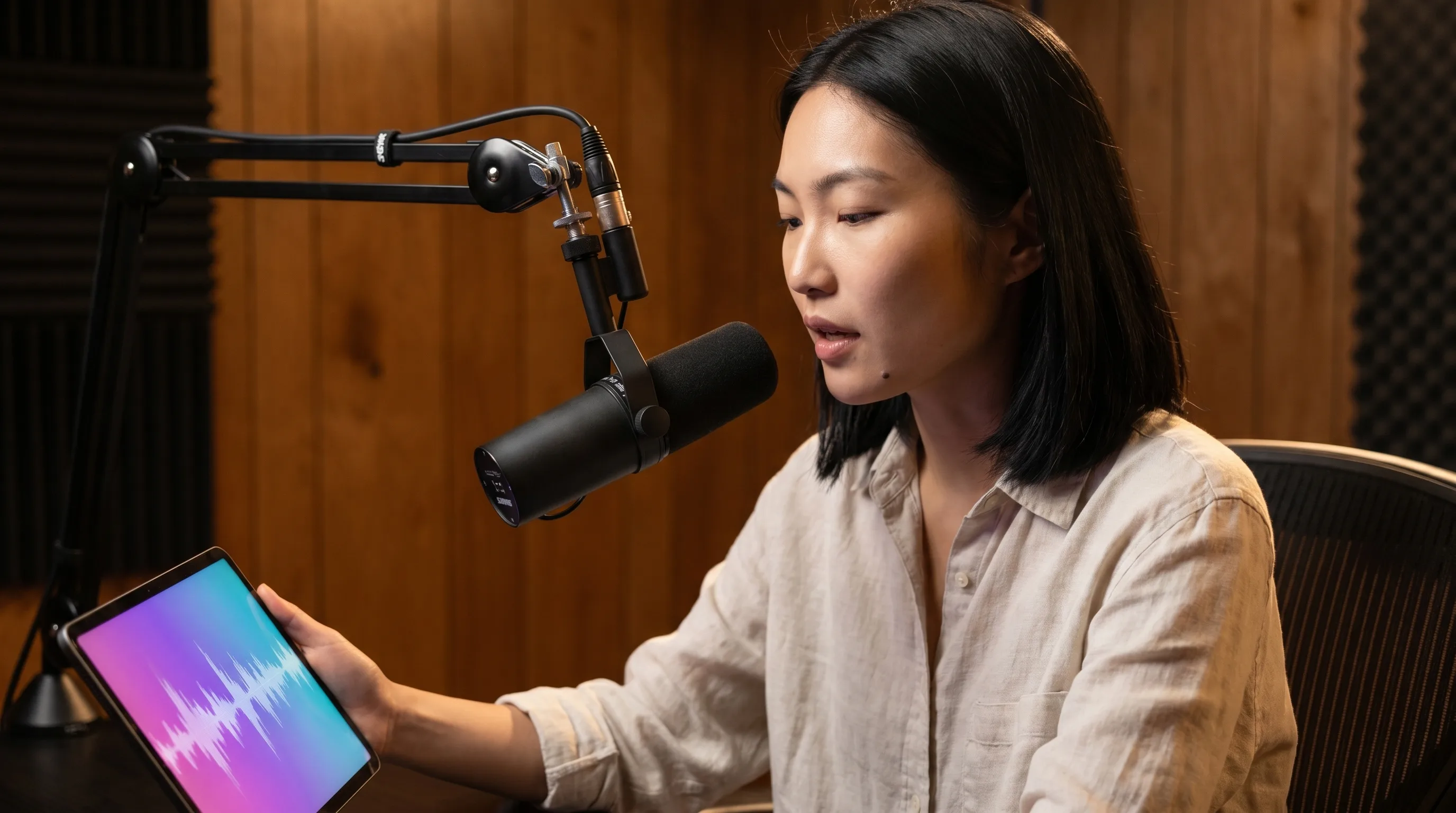
Captions consent is platform-bound. Record a fresh 30–60 second sample naming Playcut: “I consent to Playcut cloning my voice for content I create on the Playcut platform on today’s date.” Time: 30 min · Pitfall: reusing the Captions consent clip · Success: TTS plays across three of the Voice Engine’s ten languages.
Step 6 — Map templates to chat prompts
Playcut is chat-driven; the prompt is the template. Translate three to five Captions templates into reusable prompts. Example: “30-second 9:16 talking-head, actor profile, script: [script], studio-host wardrobe, brand kit.” Time: 1 hour · Pitfall: looking for a templates tab · Success: three to five prompts producing on-brand clips on first run.
Step 7 — Pilot-test three Captions videos
Re-generate three production clips inside Playcut. Captions benchmarks superior on single-shot lip-sync — Playcut has no lip-sync in its actor pipeline — but Playcut wins on cross-format consistency. Time: 1 hour · Pitfall: scoring one axis in isolation · Success: two of three pilots clear your ship-it bar.
Step 8 — Build the Playcut → CapCut loop
Generate in Playcut, finish in CapCut: export MP4 → open in CapCut → auto-caption → style → export to TikTok. Time: 1 hour first time; ~10 min/clip after · Pitfall: trying to burn captions inside Playcut · Success: Playcut MP4 → CapCut → TikTok in under 15 min.
Step 9 — Set up workspace and brand kit
Start on Hobby $9/mo (500 credits, 3 actors) or Pro $29/mo (2,000 credits, 10 actors) per the full Playcut pricing breakdown. In chat: “Create a brand kit. Primary color #7c3aed. Voice tone: warm.” Time: 30 min · Pitfall: defaulting to Agency $149/seat · Success: brand kit, actor, voice clone, workspace folder all exist.
Step 10 — Self-onboard and sunset Captions
The Playcut getting-started guide walks the chat flow end-to-end. Run a 30-minute self-onboard generating one of each type, then cancel Captions in iOS Settings at renewal. Time: 30 min · Pitfall: cancelling before shipping three paid clips through Playcut · Success: by day 30, one real client clip ships at parity with the old loop.
Week 0 → Week 4 timeline
| Phase | Calendar | Hours | What ships |
|---|---|---|---|
| Week 0 (decision) | Day 0 | ~30 min | Steps 1–2: usage audit, cutover mode chosen |
| Week 1 (setup) | Days 1–7 | ~4 hr | Steps 3–6: assets exported, actor re-cast, voice re-consent, prompts mapped |
| Week 2 (pilot) | Days 8–14 | ~2 hr | Steps 7–9: pilot clips, finishing loop, workspace, brand kit live |
| Week 4 (cutover) | Days 22–30 | ~30 min | Step 10: self-onboarded, Captions cancelled at renewal |
Red-flag checklist: when not to migrate
If three or more apply, stay on Captions or run Playcut as a side-tool.
- Phone-only iOS workflow shipping to TikTok in a single session.
- Output is single-shot talking-head with surgical lip-sync requirements; Mirage benchmarks superior.
- Captions’ B-roll library is the primary source for ≥ 50% of clips.
- Zero desktop or laptop access; Playcut is web-first.
- Monthly volume under five minutes and Captions Pro $9.99 fits inside its credit envelope.
- Captions-specific viral caption animations are required and CapCut adds unacceptable friction.
- Contractually locked into Mirage Studio Business $399/mo > 6 months.
- Native one-tap TikTok export is a workflow primitive you cannot replace.
Pricing math — what each vendor really costs at 30 videos/month
Captions Pro $9.99 is watermark-free; Max $24.99 adds 500 credits; credits burn per-second; Mirage Studio at ~$399/mo is the ads-cleared tier per third-party sources. All math uses single-seat workspaces. iOS-monthly pricing applies; annual is not shown on the live captions.ai/plans page May 2026.
Solo creator — 10 videos/mo, ~30 sec each, 1 actor, 1 language
| Vendor | Plan | $/mo | $/video | Caveats |
|---|---|---|---|---|
| Playcut | Hobby | $9 | $0.90 | 3 actors, 500 credits, no watermark, 10-language voice cloning, 7-day trial |
| Playcut | Pro | $29 | $2.90 | 10 actors, 2,000 credits, brand kit |
| Captions | Pro $9.99 | $9.99 | $1.00 | Watermark-free per captions.ai/plans; basic AI; credit ceiling on heavy loads |
| Captions | Max $24.99 | $24.99 | $2.50 | 500 credits; higher credit envelope |
| HeyGen | Creator | $29 | $2.90 | 1 Digital Twin cap |
| JoggAI | Starter (annual) | $24 | $2.40 | 450+ stock avatars |
| Higgsfield | Starter | $15 | $1.50 | Smallest Higgsfield paid tier; single Soul ID |
| Vidnoz | Starter (annual) | $14.99 | $1.50 | 1,900+ stock avatars |
Captions Pro $9.99 wins headline at $1.00/clip for the iOS-only, single-actor brief. Playcut Hobby at $0.90/clip undercuts it with multi-format generation, 3 reusable actors, and 10-language voice cloning included.
Mid creator — 25 clips/mo, ~45 sec each, 1–2 actors, 1 language
| Vendor | Plan | $/mo | $/video | Caveats |
|---|---|---|---|---|
| Playcut | Pro | $29 | $1.16 | 10 actors, 2,000 credits, brand kit |
| Playcut | Studio | $79 | $3.16 | 4 seats ($19.75/seat), 25 actors, 6,000 credits, shared workspace |
| Captions | Max | $24.99 | $1.00 → ⚠️ | 500 credits ≈ 8–15 finished 45s clips before wall |
| Captions | Scale 1x | $69.99 | $2.80 | 1,400 credits absorbs full load |
| HeyGen | Pro → Business | $49–$169 | $1.96–$6.76 | 1 twin on Pro forces Business for 2 actors |
| JoggAI | Creator (annual) | $36 | $1.44 | Most-popular tier |
| Higgsfield | Plus | $49 | $1.96 | Single Soul ID blocks 2-actor brief |
| Vidnoz | Starter (annual) | $14.99 | $0.60 | Stock-only at this tier |
Captions Max wins until the credit wall, then forces Scale 1x $69.99. Playcut Pro $29 at $1.16/clip absorbs the full 25-clip workload with 10 reusable actors and brand kit included.
Heavy / agency creator — 60 clips/mo, ~60 sec each, 3 actors, 2 languages
| Vendor | Plan | $/mo | $/video | Caveats |
|---|---|---|---|---|
| Playcut | Studio | $79 | $1.32 | 4 seats ($19.75/seat — cheapest 4-seat plan in category), 25 actors, 6,000 credits, multi-brand, 10 Voice Engine speech languages |
| Captions | Scale 1x | $69.99 | $1.17 | 1,400 credits may exhaust under 60×60s load |
| Captions | Mirage Studio Business | ~$399 † | $6.65 | Ads-cleared, 8,000 credits, third-party source |
| HeyGen | Business + Avatar IV API | $429 | $7.15 | $149 + $20×2 seats + $4/min × 60 min API |
| JoggAI | Team (annual) | $46/seat | $0.77 | Per-seat math; verify flash-sale state |
| Higgsfield | Plus | $49 | n/a | Architectural mismatch on 3 actors |
| Vidnoz | Business (annual) | $37.49 | $0.62 | Custom-avatar Enterprise-gated; stock-only |
Playcut Studio $79 wins at $1.32/clip across 4 seats versus HeyGen’s $429/mo realistic stack at $7.15/clip — a 5.4× delta driven by the $4/min Avatar IV API surcharge. Vidnoz Business $37.49 lands at $0.62/clip but ships stock-only avatars.
† See Captions vendor block for the $399 Mirage Studio source caveat.
Why the $9.99 sticker is honest until the brief grows
Captions Pro $9.99 is the cheapest watermark-free entry in the slate. For a solo creator whose output is one face, one language, ten 30-second talking-head clips a month with light credit usage, Pro is the right call. The real invoice arrives via credit-burn on heavy loads and Mirage Studio at ~$399/mo for the diffusion product.
The Playcut wedge is creator-tier multi-format flat pricing — same actor across stills, motion, UGC, and on-product, with no per-minute meter, no per-actor surcharge. Hobby $9, Pro $29, Studio $79 (4 seats = $19.75/seat), Agency $149/seat (unlimited seats, multi-brand kits). Annual billing = 17% off. Single-seat workspaces assumed unless noted.
Common pitfalls when switching from Captions/Mirage
Most switching pain comes from naïve reads of the sticker, credit-burn math, or the iOS-only consent loop. Two of the eight below are Playcut-still-has-this concessions.
The credit-burn trap
A 30s voiced clip can consume 30–60 credits, landing Pro near its envelope after a handful of finished clips. Cost: unplanned upgrade to Max $24.99 or workflow halt. Avoid: model monthly volume against per-second consumption before signing.
The Mirage Studio price surprise
Mirage Studio sits inside a separate Business tier reported at ~$399/mo per allaboutai.com (not on the live captions.ai/plans page May 2026). Cost: a $389 monthly gap if you need Mirage and budgeted for Pro. Avoid: verify the Business tier with Captions sales.
The iOS-only lock-in
Captions plans are iOS-monthly only — the live page carries “Features and prices reflect iOS plans only.” Cost: workflow re-build if the editor lives on Android or web. Avoid: if your capture-edit-publish loop cannot live entirely on iPhone, pick a web-first generator and finish in CapCut.
Mirage vs Captions confusion
Two pipelines: Captions is the iOS-first app with AI Twin lip-syncing existing audio; Mirage generates speech and face together from a script. Cost: picking AI Twin when you need Mirage, wasting one billing cycle. Avoid: pick AI Twin for script-driven clips with your own face; Mirage Studio for an AI-generated host.
Voice-clone consent gap
Captions consent is platform-bound and ToS scope does not transfer. Cost: SAG-AFTRA-style grievance risk, or workflow rebuild when paperwork fails review. Avoid: record a fresh 30–60 second consent sample per vendor that names the vendor explicitly.
Multi-format identity drift
Captions is vertical-first; HeyGen is talking-head-first; Submagic doesn’t ship an avatar. A campaign needing talking-head plus stills plus UGC plus on-product breaks brand consistency. Cost: a new actor identity per output type. Avoid: the Playcut Actor Engine holds one actor across all four formats.
Free-tier watermark misuse
Vidnoz Free and Captions Free both ship a centered watermark and prohibit commercial use. Cost: emergency re-render and brand-trust loss if the watermarked clip shipped. Avoid: never ship free-tier output externally; confirm commercial-use rights in writing.
Playcut-still-has-this: web-only and ten languages
Two honest concessions: Playcut is web-first at app.playcut.ai — no native iOS app, no timeline editor, no caption burn-in, no B-roll library, no one-tap social export; Captions wins phone-to-post cleanly.
Playcut has no actor lip-sync and no actor-bound voice — the video model performs the scripted line instead, and the Voice Engine generates standalone speech audio across ten languages; Captions ships 100+ caption languages and HeyGen 175+ for lip-sync; long-tail markets like Tagalog or Swahili are stronger on Captions or HeyGen.
Inoculation: where compliance-gated and enterprise buyers should go
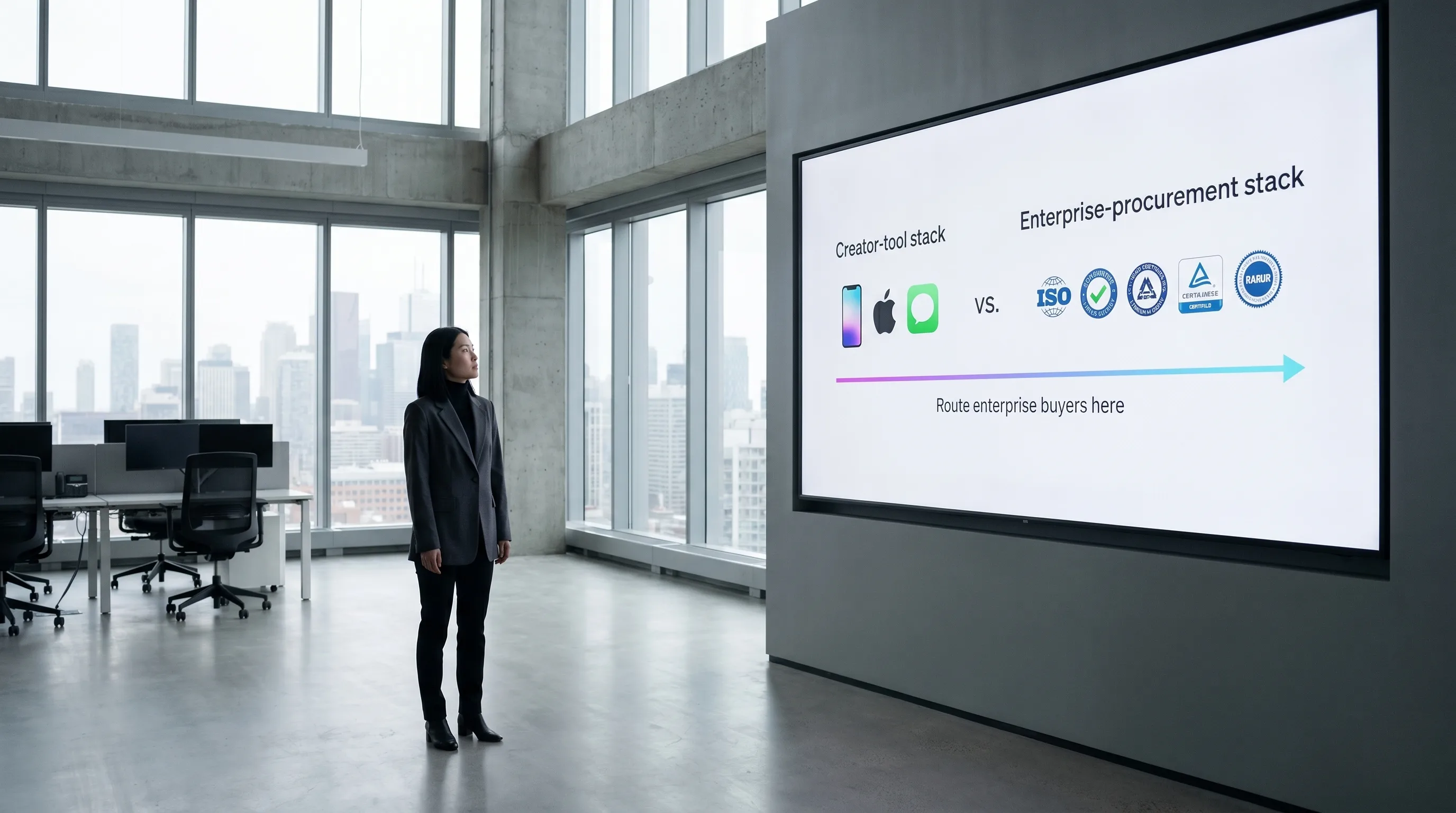
If your buyer journey gates on SOC 2 Type II, ISO 27001, ISO/IEC 42001, EU AI Act conformity, or signed DPA procurement, this article isn’t your guide — read the dedicated Synthesia alternatives ranking for SMBs and agencies instead. That page is calibrated to enterprise L&D and procurement buyers; this one is calibrated to short-form creators who do not gate on ISO 42001.
The honest per-vendor compliance read across the slate, no FUD attached. Playcut has SOC 2 Type II in audit, not certified as of May 2026; no ISO 27001, no ISO 42001. Captions / Mirage does not publicly disclose SOC 2 status; standard ToS, no published security page.
HeyGen is the only slate vendor with a verifiable enterprise stack — SOC 2 Type II + GDPR + EU-US Data Privacy Framework + EU AI Act readiness, dedicated EU Data Protection Officer (heygen.com/security); no ISO 27001 today. Submagic, JoggAI, Higgsfield Soul ID, and Vidnoz all run lighter postures — no published SOC 2, no ISO certifications, standard consumer ToS.
For creators making content, none of this matters. For enterprise procurement, it’s all that matters. Different blog.
One more anti-persona to flag explicitly: if your job is 1:1 personalized sales video at outbound scale — SDR sequences merging variable CRM tokens into a Replica-rendered clip per prospect — this short-form creator ranking is not your guide either. Read the dedicated Tavus alternatives ranking for B2B sales personalization-at-scale instead; that page is calibrated to RevOps, CRM-integration depth, and per-clip variable-token economics, none of which the creator rubric on this page weights.
Frequently asked questions
What is the best Captions AI alternative for creators in 2026?
Playcut is the best Captions AI alternative for creators in 2026. Best-in-class character consistency — the same trained actor across stills, motion video, UGC ads, and on-product compositing (9.5/10 on our 8-shot consistency test, the only vendor in the slate above 7.5/10 across all four formats). HeyGen wins SMB multilingual; Submagic wins caption-animation; Captions itself stays the right call for iOS-only capture and quick mobile lip-sync.
What’s the difference between Captions and Mirage?
Captions and Mirage are the same company under two product names — the parent company rebranded September 2025. Captions is the iOS-first creator app that lip-syncs existing audio via AI Twin. Mirage Studio is the newer product that generates speech and a matching face together from a script, sold inside a Business tier reported at ~$399/month per allaboutai.com (September 2025) — not visible on the live captions.ai/plans page May 2026.
Is Captions AI worth $9.99 a month?
Captions Pro at $9.99/month is competitive for a solo creator whose deliverable is iOS-native lip-sync — exports are watermark-free per captions.ai/plans, but heavy loads hit a credit ceiling. Max at $24.99 adds 500 credits.
Playcut Hobby at $9/month ships 500 credits, 3 custom actors, voice cloning, no watermark — the cheapest full-studio entry in the AI video category; Pro at $29/month lifts to 2,000 credits and 10 actors. Pick by job, not sticker.
Does Captions AI watermark my videos?
Captions Free watermarks outputs. Captions Pro at $9.99/month exports videos without watermarks per the live captions.ai/plans page (May 2026); Max, Scale tiers, Business, and Enterprise are all watermark-free. Playcut Hobby at $9/month also ships clean on every plan — no watermark on any paid tier.
Captions vs HeyGen — which is better for multilingual?
HeyGen wins when language count is the deciding axis: Avatar IV ships 175+ languages with native lip-sync, and Captions ships 100+ caption languages. Playcut sits outside this comparison — it has no actor lip-sync, so you write the line in the target language and the video model performs it. For an English-first iOS creator, Captions wins; across five or more languages, HeyGen wins. See the HeyGen alternatives ranking.
What’s the best free Captions alternative?
Vidnoz Free is the most generous free tier in the slate — 3 minutes/day generation, access to 1,900+ avatars and 140+ voice languages, no credit card. HeyGen’s free tier is tighter at 3 videos/month, 720p, watermarked. Playcut runs a 7-day full-feature trial on its Hobby plan rather than a perpetual free tier; that same Hobby tier at $9/month is the cheapest paid entry — the cheapest full-studio entry in the AI video category.
Can I replace Captions AI with Playcut for my creator workflow?
Playcut replaces Captions for any creator whose job is multi-format brand creative across stills, motion video, UGC ads, and on-product compositing. Playcut is browser-first at app.playcut.ai — there is no native iOS capture app. If your workflow is iPhone-only capture-edit-publish without leaving the phone, Captions remains the right tool. See the Playcut getting-started guide for the full walkthrough.
How do I migrate from Captions/Mirage to a cheaper alternative?
Export your Captions scripts and rendered MP4s first — AI Twin and Mirage voice clones do not transfer between platforms, so any new vendor needs a fresh consented voice recording. Re-record the talent, rebuild the actor inside the Playcut Actor Engine, and ship one parallel-pilot clip before scaling. Keep Captions paid for any iOS-only capture flows you cannot replace from a desk.
Verdict — and what to do next
Best-in-class character consistency — the same trained actor across stills, motion video, UGC ads, and on-product compositing (9.5/10 on our 8-shot consistency test, the only vendor in the slate above 7.5/10 across all four formats).
Playcut wins the 6-axis creator rubric at 7.55/10, ahead of Captions / Mirage at 6.25/10 by 1.30 points. If your axis is lip-sync precision, Captions / Mirage remains your answer — Playcut has no lip-sync in its actor pipeline.
For everyone else — solo creators, brand creators, agencies running multi-brand kits — the rubric points one way. One actor, four formats, from $9/month Hobby (3 actors) or $29/month Pro (10 actors, 2,000 credits), no watermark, voice cloning across ten languages, MCP and REST API free during open beta.
For the broader picture — how Captions, HeyGen, Submagic, and Mirage stack up against cinematic engines like Runway, Pika, and Veo for brand teams spanning ad creative and brand film — see the best AI video generator for brands ranking. Same six-axis logic, weighted for brand-side buyers rather than iOS-first creators. Desktop-first creators ready to switch can jump straight to the Playcut Captions AI desktop alternative summary for the 12-row feature matrix on one screen.
Three Miras read this far: the iPhone-only TikTok creator stays on Captions (Pro if its credit envelope holds, Max if not), the brand creator ships one actor across all four formats on Playcut Pro, and the agency runs three client brands from one Playcut Studio or Agency workspace. None of them switched for AI video — they switched because the math, the actor, and the formats finally agreed.