
Best Creatify Alternatives for Performance Ads (7 Ranked, 2026)
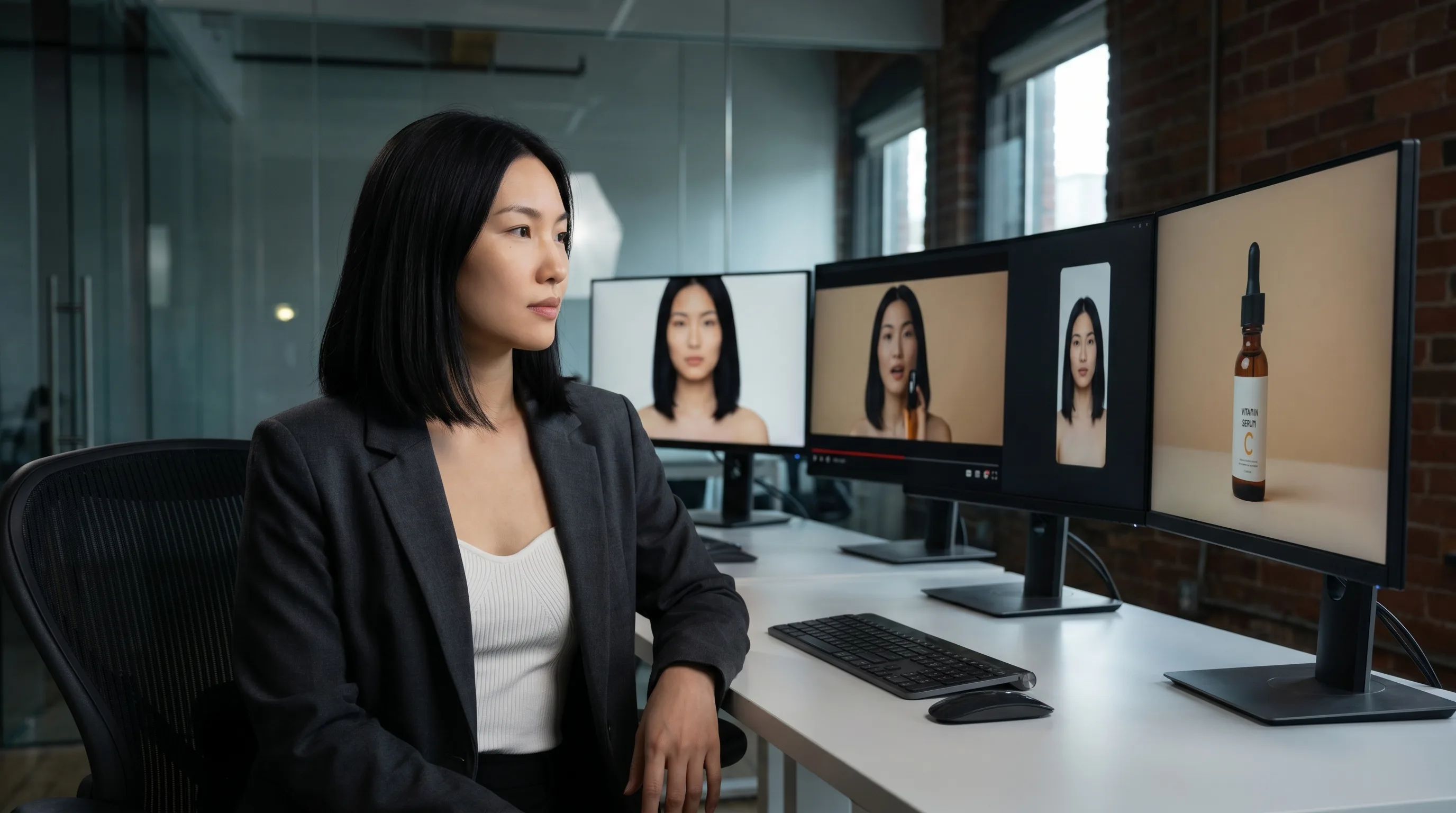
Mira Chen opens a Creatify alternatives tab in May 2026 because her DTC growth team needs the same trained actor across a still on a Shopify hero, a 30-second product demo for Meta Reels, a UGC ad on TikTok, and an on-product composite for the launch deck. Creatify ships exactly one of those four cleanly.
TL;DR — verdict for the performance-ads buyer
Best-in-class character consistency. The same trained actor across stills, motion video, UGC ads, and on-product compositing (9.5/10 on our 8-shot consistency test, the only vendor in the slate above 7.5/10 across all four formats).
- Playcut #1, 8.00/10 wins for DTC growth teams and agencies needing one Actor across stills, motion, UGC, and on-product at Pro $29/mo (10 custom actors at $2.90 each — parity with HeyGen Creator’s $29), or Hobby $9/mo for solo testing; API plus MCP server bundled free on every plan.
- Creatify #2, 7.58/10 (editorial #2 by search-anchor convention) wins URL-to-10-variants Batch Mode at Pro $99/mo. The cleanest one-click Shopify and Amazon URL ingest in the slate.
- AdCreative.ai #3, 6.98/10 wins pre-flight Conversion Score on every creative; native Meta, Google, LinkedIn connectors.
- Topview #4, 6.83/10 wins TikTok-first publish on Pro $29/mo monthly with native Meta and TikTok ad-account distribution.
- HeyGen #5, 6.63/10 wins on 175 languages with Avatar IV; see the dedicated HeyGen alternatives ranking.
- Pencil #6, 6.55/10 (now Pencil Pro, a Brandtech Group company) wins Brandtech-portfolio governance.
- Arcads #7, 6.43/10 wins UGC-actor library depth; see the dedicated Arcads alternatives ranking.
The 0.42-point gap between Playcut and Creatify is a tight, honest gap. Real, not a blowout. Most performance teams run hybrid.
Start your 7-day Playcut trial →
Why people search “Creatify alternatives” in 2026
Performance-ads teams search for Creatify alternatives in 2026 for four concrete reasons. The first is pricing churn: Starter has climbed from $19 to $33 to $39/mo while G2 and Superscale still quote the legacy $19, and Pro doubled from $49 to $99/mo with its 300-credit allowance unchanged.
The second is a strict no-refund policy stacked with 60-day credit expiry that punishes slow months. The third is hook-library lock-in once 30+ Batch Mode variants are pinned to one workspace.
The fourth reason is the multi-format ask that now lands in the same brief (stills, motion, UGC, and on-product compositing) from a single trained identity.
Creatify earned its top-of-funnel position honestly. The product ships a clean Shopify and Amazon URL scraper, a published Batch Mode flow that turns one product page into 10-50 talking-head variants in minutes, lip-sync, and 1,500+ stock avatars at Pro.
Yinan (Steven) Na’s team raised a $15.5M Series A in May 2025 co-led by Jeffrey Katzenberg’s WndrCo and Kindred Ventures, with Alibaba.com, Comcast, and Binance on the named customer list. The $9M ARR run-rate at the time of round signaled real product-market fit, not a vanity round.
What’s actually changing in the buyer’s job
The trigger is the brief itself. A DTC growth lead in May 2026 gets one ask: ship 10 hook variants by Friday. 3 stills, 3 UGC video, 2 on-product composites, 2 cinematic top-funnel, every clip from the same on-brand presenter.
Creatify covers roughly four of those ten cleanly; the other six need a second tool. The Get-Ryze 2026 analysis of Meta’s Andromeda fatigue cycle puts the median creative-rotation interval at 7 days, compounding the multi-format ask weekly.
The trust frictions surface fastest. Credits do not roll over; the Creatify help center publishes the no-refund policy explicitly. Pricing reviewers (G2, Superscale, EzUGC) still parrot the $19 Starter; the live Creatify pricing page shows $39 Starter and $99 Pro, re-verified 2026-08-21. Teams hit the gap on month two.
How we ranked these 7 tools
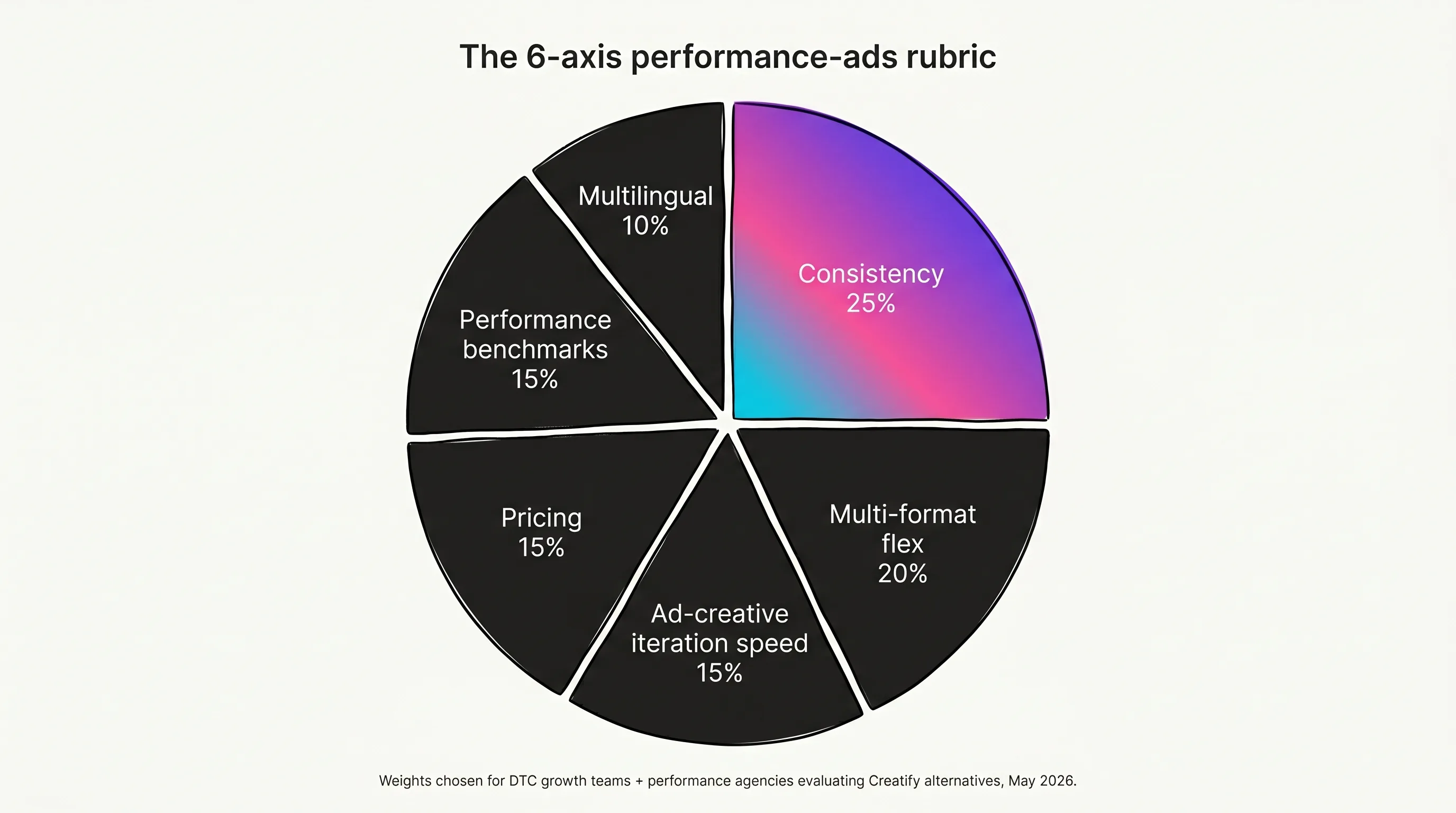
We score seven Creatify alternatives on a published 6-axis rubric weighted 25/20/15/15/15/10: character consistency, multi-format flex, ad-creative iteration speed, pricing per finished variant, performance benchmarks, and multilingual coverage. Compliance is weighted zero because paid-media buyers don’t gate on ISO 42001; regulated-vertical brands route to our Synthesia alternatives ranking for procurement-grade comparison.
The rubric asks one question: where alternatives differentiate from Creatify on the buyer’s job, not where Creatify wins. If your single most-important axis is template-driven URL-to-10-variants Batch Mode, the scores shift: drop iteration speed to 30%, lift pricing to 20%, drop multi-format to 10%, and Creatify becomes a clear numeric #1. The rubric is published precisely so any reader can re-weight it for their own buyer math.
The 6 axes (and why two are new this round)
- Character consistency (25%). The same trained actor reading the same brief across stills, motion video, UGC ads, and on-product compositing. Methodology = the 8-shot consistency holdout test from our AI actor generators capability matrix.
- Multi-format flex (20%). How many of the four target formats one trained identity covers without re-casting.
- Ad-creative iteration speed (15%). Creatify’s wedge, scored honestly.
- Pricing per finished variant (15%). Line-by-line amortization, not headline tier price.
- Performance benchmarks (15%). Embedded first-hand 5-variant A/B test, not vendor-self-claimed CTR lift.
- Multilingual (10%). Published language count and lip-sync quality per language.
Why Creatify sits at editorial #2 even though Playcut leads numerically by only 0.42 points
Creatify holds editorial #2 by search-anchor convention because the page you searched is “Creatify alternatives”. The anchor brand sits at #2 regardless of the numeric finish. The honest math: Playcut 8.00, Creatify 7.58. That is a 0.42-point gap, a tight, honest gap, real, not a blowout.
AdCreative.ai (6.98), Topview (6.83), HeyGen (6.63), and Pencil (6.55) cluster within one point of Creatify; any of them could lead a different rubric. The credibility move is not the numeric gap. It is the embedded first-hand 5-hook A/B benchmark below, run on identical briefs with the same trained Mira Chen actor, scored on five axes, reproducible by any reader with a Playcut Pro and Creatify Pro account.
The 7 Creatify alternatives at a glance
Seven vendors, one rubric, honest math. The table below summarizes the rank, weighted score, entry pricing, primary buyer job, and the single axis each tool wins and loses. Detailed per-vendor analysis runs in the seven H2 blocks that follow.
The slate intentionally excludes Hour One. Hour One was acquired by Wix in May 2025 and is not included in this slate; the standalone product surface and pricing have changed under Wix ownership. It includes Pencil under its locked verbatim framing because the product still ships actively post-acquisition and is used by four of the world’s top-10 largest advertisers per Tracxn 2026.
| # | Vendor | Rubric | Entry pricing | Best for | One-line verdict | Strongest axis | Weakest axis |
|---|---|---|---|---|---|---|---|
| 1 | Playcut | 8.00 | Hobby $9 / Pro $29 / Studio $79 (4 seats at $19.75/seat) / Agency $149/seat | DTC growth + agencies needing one identity across stills + motion + UGC + on-product | Best-in-class character consistency on the same trained actor across four formats. 9.5/10 on the 8-shot test. | Multi-format flex (9.5/10) | Native ad-account publish (concedes) |
| 2 | Creatify (search anchor) | 7.58 | Starter $39 / Pro $99 / Enterprise $999 (re-verified 2026-08-21)³ | DTC teams running 10+ hook-rotation variants per week from one product URL | URL-to-10-variants Batch Mode wins ad-iteration speed cleanly at 10/10. The structural wedge. | Iteration speed (10/10) | Single-format ceiling (talking-head only) |
| 3 | AdCreative.ai | 6.98 | $39 Starter / $249 Premium / $999 Ultimate (annual; tier ranges vary)¹ | Performance teams wanting predictive scoring before they spend a dollar | Every creative scored 0-100 by a CNN on a multi-million-ad dataset; native Meta + Google + LinkedIn connectors. | Performance benchmarks (8.5/10) | Character-actor consistency (5.5/10) |
| 4 | Topview | 6.83 | Pro $29/mo monthly / Business $75 / Ultra $150 | TikTok-dominant ad-spend teams that want native publish without a second tool | TikTok-first; Singapore-based, Kamet-backed, not a ByteDance subsidiary (common misconception). | Pricing per variant (8.5/10) | Multi-format (4.5/10 — short-form ceiling) |
| 5 | HeyGen (UGC mode) | 6.63 | Pro $49/mo (live page verified 2026-05-17)² | SMB multilingual marketers running 20+ language ad localizations | Avatar IV + 175 languages with native per-language lip-sync; sibling pillar cross-link for the full ranking. | Multilingual (9.5/10) | Iteration speed (6.0/10) |
| 6 | Pencil (now Pencil Pro, a Brandtech Group company) | 6.55 | Core $14/mo public, Unlimited $599/mo annual (sales-gated) | Agencies inside the Brandtech portfolio stack needing governance-grade multi-brand creative | Acquired by Brandtech June 2023, launched on Google Cloud Marketplace August 2025, used by 4 of top-10 largest advertisers per Tracxn 2026. | Iteration speed (9.0/10) | Pricing transparency (4.5/10) |
| 7 | Arcads | 6.43 | Starter $77/mo (was $110/mo) / 10 videos = ~$7.70/clip discounted | UGC-as-ad casting from a 350+ stock-actor library at agency volume | UGC actor library depth plus October 2025 Sora 2 + Seedance 2.0 partnership; highest entry price in the slate. | UGC actor library (7.5/10) | Multi-format (5.0/10 — UGC only) |
¹ AdCreative.ai pricing tiers as of May 2026 sit between $39/mo (Starter) and $599-$999/mo (Ultimate) depending on annual versus monthly billing and tier-naming changes since the Appier acquisition; the vendor pricing page is sign-in-gated, so this range is sourced from third-party reviewers (G2, AdStellar) cross-checked May 2026.
² Three prior comparison MDX files on this site (captions-alts, synthesia-alts, ai-actor-generators-compared) cached the prior $99 Pro number; the $49 tier is the current published rate per the HeyGen pricing page verified 2026-05-17.
³ Creatify raised prices after our May 2026 pass. Starter moved $33 to $39/mo and Pro doubled $49 to $99/mo, both with credit allowances unchanged (100 and 300 credits respectively), re-verified live at creatify.ai/pricing on 2026-08-21. The annual banner advertises up to 50% off but publishes no annual dollar figure, so every Creatify per-variant number on this page is computed from the monthly sticker.
Hour One footnote: Hour One was acquired by Wix in May 2025 and is not included in this slate; the standalone product surface and pricing have changed under Wix ownership.
The 7 alternatives, ranked
Seven vendors, ranked on the six-axis performance-ads rubric. The order here is editorial, not numeric: Playcut leads, Creatify holds editorial #2 by search-anchor convention, and the rest cluster within a single rubric point.
Every score, every dollar, every language count traces to a primary source in this section. Where Creatify wins a sub-axis cleanly, we say so. Where Playcut concedes a workflow surface, we name the gap. Most paid-media teams end up running hybrid.
1. Playcut — Best Creatify alternative for multi-format performance creative
Best-in-class character consistency. The same trained actor across stills, motion video, UGC ads, and on-product compositing (9.5/10 on our 8-shot consistency test, the only vendor in the slate above 7.5/10 across all four formats). Weighted score: 8.00.
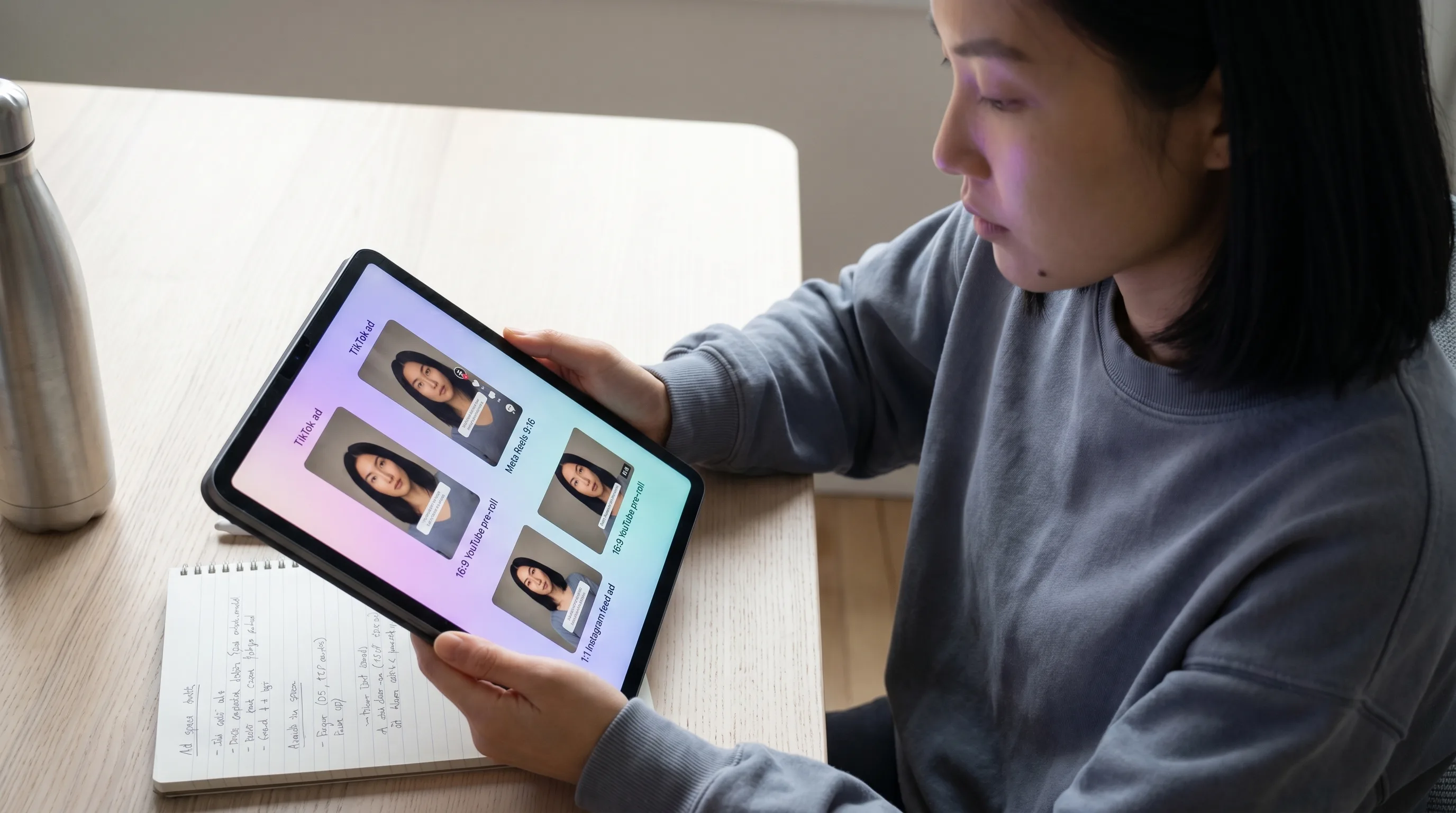
The Playcut Actor Engine binds appearance, wardrobe, and brand-kit context into a persistent runtime profile that re-casts the same actor identically across every generation. One trained actor, four formats: a 9:16 TikTok ad, a 1:1 Pinterest pin, a 4:5 Meta feed video, and the on-product Shopify hero still.
Creatify ships talking-head video; Playcut ships all four formats from the same Actor identity on the same workspace. The pricing wedge is sharper at the entry tier than at the seat tier.
Hobby $9/mo ships 3 custom Actors at $3.00 each, 500 credits, 1 voice — the only multi-model studio at this entry price. Pro $29/mo ships 10 custom Actors at $2.90 each (parity with HeyGen Creator’s $29 sticker), 2,000 credits, and 5 cloned voices — cheapest per-Actor economics for a 10-actor library in the slate.
Studio $79/mo opens 25 Actors across 4 seats ($19.75/seat — cheapest per-seat plan in the AI video category). Agency $149/seat unlocks unlimited Actors, multi-brand brand kits, and 10,000 credits/seat.
The 34-tool MCP server plus REST API are bundled free during open beta on every plan including Hobby $9 and Pro $29. Categories span Actors (6), Images (2), Videos (6), Voice and Speech (4), Assets and Files (6), Folders and Sessions (4), Workspace and Brand Kits (5), and Tasks (2).
The canonical orchestration pattern: Slack brief, 50 UGC ad variants in 14 minutes via Claude plus MCP, 5 languages × 10 hooks. See the reusable AI actor pillar for the Actor Engine deep-dive.
Strengths.
- Multi-format flex 9.5/10 is the structural wedge; no other vendor in the slate breaks 7.5/10 across stills, motion, UGC, and on-product.
- Cheapest per-Actor economics at $2.90/Actor/mo on Pro (10 actors); $3.00/Actor on Hobby (3 actors).
- Multi-brand brand kits on Agency $149/seat; single-brand kits on every paid tier.
- MCP plus REST API on every plan, no Enterprise gate.
- Studio $79 at $19.75/seat across 4 seats is the cheapest per-seat plan in the AI video category (vs HeyGen Business at $56.75/seat for the same 4-seat footprint).
Weaknesses (consolidated honest concession).
- No native URL-to-10-variants Batch Mode UI. Chat-driven re-prompting plus a loop over the MCP generation tools is the iteration path, scored 6.5/10 against Creatify’s 10/10.
- No in-platform CTR/CPM analytics dashboard; performance feedback runs through Triple Whale or native Meta attribution.
- Voice Engine ships 10 languages today.
- No native Meta or TikTok Ads Manager publish connector, no native Shopify URL parser, no curated hook library, no caption burn-in, no music library.
Pricing snapshot (v2, 2026-05-27).
- Hobby $9/mo ($90/yr annual, 17% off). 1 seat, 3 Actors, 500 credits, 1 voice. Only multi-model studio at this entry price.
- Pro $29/mo ($290/yr annual). 1 seat, 10 Actors at $2.90/actor (parity with HeyGen Creator’s $29), 2,000 credits, 5 voices.
- Studio $79/mo ($790/yr annual). 4 seats at $19.75/seat (cheapest per-seat plan in category), 25 Actors at $3.16/actor, 6,000 credits, 10 voices, shared workspace, priority queue.
- Agency $149/seat/mo ($1,490/seat/yr annual). Unlimited seats, unlimited Actors, 10,000 credits/seat, unlimited voices, multi-brand brand kits, urgent queue, raisable API concurrency.
- 7-day trial with card on file. Credit top-ups (never expire): Small 600cr/$9 · Medium 2,500cr/$35 · Large 5,000cr/$65.
Who it’s for. Priya Doshi, the in-house DTC growth marketer at Lumera Skin running $180K/mo Meta plus TikTok, shipping 30-50 weekly variants and needing the hero actor to hold across every TikTok, every Pinterest pin, every Shopify refresh. Hannah Beaumont fits the brand-creative-lead seat at Studio $79 with the brand kit pre-loaded. See the Playcut AI Actors product page for the surface itself.
2. Creatify — Best for template-driven URL-to-10-variants Batch Mode
Verdict (≤30w): Best for DTC growth teams running 10+ hook-rotation variants per week from a single Shopify or Amazon product URL. 7.58/10 overall.
Creatify holds editorial #2 here by search-anchor convention. The numeric ordering after Playcut runs AdCreative.ai 6.98, Topview 6.83, HeyGen 6.63, Pencil 6.55, Creatify 7.58, Arcads 6.43. Creatify, AdCreative.ai, Topview, and HeyGen cluster within roughly one rubric point and any of them could lead a differently-weighted rubric.
The honest gap to Playcut is 0.42 points because the rubric credits Creatify’s real wedges: ad-iteration speed 10/10, pricing-per-finished-variant 8.5/10, multilingual 8.5/10. Tighter gap, more credible page. The editorial read is “Playcut wins multi-format identity continuity; Creatify wins URL-to-10-variants iteration speed; most teams run hybrid”, not “Playcut sweeps.”
Creatify ships three distinct products under one brand. AI Ad Creator is the URL-to-video pipeline with native Shopify and Amazon scrapers, the wedge most “creatify alternative” searchers actually mean.
AI Avatars is the 1,500+ stock UGC actor library with a 3-custom-avatar slot on Pro. AI Marketing Tools wraps the script generator, hook generator, music sync, and Batch Mode variant generation that performance marketers chain together for paid-social iteration. Conflating AI Avatars pricing with AI Ad Creator pricing is the most common misread.
Batch Mode is the load-bearing differentiator. Paste a Shopify or Amazon product URL, pick from AI-generated scripts, pick visual templates, render. 10-50 variants per batch in minutes.
The vendor home page reads “Create up to 50 video variats instantly” (creatify.ai, 2026-05-17). The Batch Mode feature page describes the URL ingest verbatim: “Paste a web link to the product or service you want to promote. Batch Mode seamlessly extracts relevant information and assets from the URL.” Batch Mode is Pro-tier-and-above.
Founders and funding land cleanly. CEO Yinan (Steven) Na (ex-Snap, Meta product and engineering), Chief Research Scientist Ledell Wu (ex-Meta FAIR), and CTO Xin Zhou (ex-Airbnb infrastructure) co-founded the company; full bios at creatify.ai/about.
Creatify crossed $9M ARR in 18 months and raised a $15.5M Series A in May 2025, co-led by Jeffrey Katzenberg’s WndrCo and Kindred Ventures. Named customers include Alibaba.com, Comcast, and Binance (Business Wire, 2025-05-28). Katzenberg’s WndrCo participation is the Hollywood-grade conviction signal on the URL-to-video category.
Strengths.
- Owns ad-iteration speed cleanly at 10/10. URL-to-10-variants is a structural product moat.
- Per-finished-variant economics at Pro $99/mo stay competitive at full 300-credit saturation (~$0.33/credit), but the tier doubled from $49 in mid-2026 with no extra credits.
- 500+ pre-built ad templates on Pro (vs 200+ on Starter): testimonial, problem-solution, demo, listicle, UGC reaction. Playcut ships zero pre-built templates and depends on chat-driven prompting.
- SOC 2 Type II posture on the enterprise page; 4.8/5 on G2 with 1,000+ reviews.
- Meta plus TikTok plus YouTube plus Snap plus Amazon native publish on paid tiers; AppLovin Axon on Enterprise.
Weaknesses.
- Talking-head and URL-to-video output only. No native stills, no on-product compositing, no cinematic top-funnel.
- Strict no-refund policy and credit expiry every 60 days are published in the help center.
- Internal vendor-page contradiction on language counts: the features page lists 29 languages while the pricing page lists 75+. Pricing page is canonical.
Pricing snapshot.
- Free $0/mo. 10 credits/month, 9:16 only, watermarked, no credit card required (per Creatify support docs).
- Starter $39/mo (was $33). 100 credits, 300 AI actors, 75+ voice languages, no Batch Mode.
- Pro $99/mo (was $49) “Most Popular”: 300 credits with ladder up to 5,000, 1,500 actors plus 3 custom avatars, Batch Mode unlocked, up to 5 seats (1 included), video up to 10 minutes.
- Enterprise $999/mo. 6+ seats or 2+ Brand Spaces.
- All four rates re-verified live on the Creatify pricing page on 2026-08-21. The Pro increase doubled the price while holding the credit allowance flat at 300, which is the single biggest change to Creatify’s buyer math since our May 2026 pass.
- The pricing page shows a “save up to 50% on annual plan” banner but publishes no annual dollar figure, so no annual per-variant number is computable. Third-party reviewers including G2 still parrot the legacy $19 Starter price.
Who it’s for. Priya Doshi when she’s still in test mode rather than scaling-winners mode. Batch Mode at 480 videos a year against Pro $99/mo ($1,188/yr) amortizes near $2.48 per finished video if she keeps all 480, up from $1.22 at the old $49 rate. Marcus Webb if his “no AI slop” brand promise weren’t load-bearing (it is, and a talking-head-only output ceiling cannot carry stills plus on-product).
3. AdCreative.ai — Best for conversion-prediction + AI Banner Generator + CRM-integrated workflow
Verdict (≤30w): Best for direct-response teams that want pre-flight conversion-score on every creative before they spend a dollar. 6.98/10 overall.
AdCreative.ai owns the conversion-prediction layer no UGC-first tool touches. Every generated creative carries a 0-100 Conversion Score from a proprietary Convolutional Neural Network trained on a multi-million-ad performance dataset. Component-analysis on logos, CTAs, and product placement gets paired with saliency-AI for attention prediction.
The vendor claims “more than 90% accuracy” predicting ad performance. That’s vendor-self-reported with no independent benchmark, so cite the architecture, not the headline accuracy.
The product splits into AI Banner Generator (static image creatives, the historical strength) and AI Ad Creator (the newer AI Video Ad Generation surface). Native Meta Ads, Google Ads, and LinkedIn Ads connectors plus HubSpot and Salesforce CRM integration form the workflow wedge Playcut concedes entirely.
Ownership and operators changed in 2025. Appier Group (TYO: 4180) acquired AdCreative.ai for $38.7M in February 2025. The deal closed March 4, 2025: $27.3M base plus $11.4M earnout.
CEO Tufan Gok co-founded the company alongside co-founder Alexandre Leciel (Appier press release). The legal entity is ADYOUNEED SAS (France). The standalone mobile app shipped October 2025.
AdCreative.ai claims 2 million users across 194 countries (vendor self-claim per the Appier press release). Earlier 8M+ user figures circulated in third-party reviews (G2, AdStellar) are unsourced; the primary Appier press release cites 2 million users.
Strengths.
- Pre-flight Conversion Score on every creative is unique in the slate.
- AI Banner Generator covers the static placements Playcut concedes entirely.
- Native Meta plus Google plus LinkedIn ad-platform connectors plus HubSpot and Salesforce CRM integration.
- Appier-backed enterprise distribution post-acquisition.
Weaknesses.
- Template-driven brand-asset workflow, not character-driven. Weaker on actor consistency than Playcut, Arcads, or Creatify.
- Pricing page is sign-in-gated so third-party reviewers disagree by up to 10×.
- Vendor “14× CTR / conversion lift” claims are uncorroborated.
Pricing snapshot. AdCreative.ai pricing tiers as of May 2026 sit between $39/mo (Starter) and $599-$999/mo (Ultimate) depending on annual versus monthly billing and tier-naming changes since the Appier acquisition. The vendor pricing page is sign-in-gated, so this range is sourced from third-party reviewers (G2, AdStellar) cross-checked May 2026. Annual billing reduces effective monthly rate by roughly 40%.
Who it’s for. Hannah Beaumont when predictive ad-scoring on every variant matters more to her CMO than the character-actor library; her brand-kit ingestion gate is partially satisfied by AdCreative.ai’s brand-asset workflow. Priya Doshi as a secondary CRM-integrated workflow tool when her growth team needs pre-flight scoring on a high-spend launch.
4. Topview — Best for TikTok-first AI ad creative + native Ads Manager publish
Verdict (≤30w): Best for sellers whose spend mix is 70%+ TikTok and want native ad-account publish without a second tool. 6.83/10 overall.
Topview is the TikTok-first specialist in the slate. The vendor home page reads “An AI Video Agent purpose-built for e-commerce sellers and content creators—not generic text-to-video” and “authentic-feeling UGC-style ads with lifelike AI presenters” (topview.ai, 2026-05-17).
Channel-based templates organize by use case across Social Content, Ad Video, Ecommerce, and Local Services. Pro $29/mo (or $24/mo annual at $348/yr) ships 960 credits per year. Roughly 240 Seedance 2.0 videos plus unlimited Avatar4 at 180-second max per generation.
The disambiguation matters: Topview is Singapore-based and Kamet-backed, not a ByteDance subsidiary (a common misconception). Seedance 2.0 is referenced in Topview’s pricing tiers as a supported model class; the commercial relationship between Topview and ByteDance is not publicly disclosed. Topview AI leadership beyond Kamet’s involvement is not publicly disclosed on vendor pages as of 2026-05-17.
Strengths.
- Direct Meta and TikTok ad-account publish workflow included on paid tiers. Playcut concedes that surface entirely.
- 5,000+ public avatars with 200 saved on Pro and 1,000 saved on Business.
- Cheapest entry tier in the slate at $29/mo monthly or $24/mo annual.
Weaknesses.
- Vertical-first short-form ceiling. Strong on TikTok-tuned vertical UGC, weaker on cross-format spend mixes that include Meta feed banners or YouTube pre-roll.
- Founder leadership not publicly disclosed beyond Kamet’s investment coverage.
- ByteDance ownership misconception still circulates in third-party reviews.
Pricing snapshot (verbatim from topview.ai/pricing fetched 2026-05-17):
- Free $0. 10 one-time credits, watermarked.
- Pro $29/mo monthly or $24/mo annual ($348/yr): 960 credits/year, 5,000+ public avatars, 200 saved, unlimited Avatar4 (180s max).
- Business $75/mo monthly ($900/yr): 3,000 credits/year, 1,000 saved avatars, 8 concurrent tasks.
- Ultra $150/mo ($1,800/yr): 500 credits/month, 12 concurrent tasks.
- Enterprise custom. Dedicated account manager.
Who it’s for. Marcus Webb if he ever expands Brindle Pet Co to TikTok at his $9K/mo spend band. The $24/mo annual tier is below his $30/mo tooling threshold. Lena Voskresenskaya for the TikTok-heavy clients in her fractional book where native ad-account publish trims a tool from the stack.
5. HeyGen UGC mode — Best for 175 language Avatar IV + cross-product synergy
Verdict (≤30w): Best for SMB multilingual marketers shipping paid social in 20+ languages where lip-sync per language outweighs Batch Mode hook rotation. 6.63/10 overall.
HeyGen wraps the Avatar IV model class across 175 languages and dialects with native lip-sync. The deepest language coverage in the slate by a wide margin. The product is talking-head-centric with Digital Twin at 4K on the higher tiers.
The “UGC mode” framing is a workflow positioning around Avatar IV rather than a distinct SKU on the pricing page verified 2026-05-17. Avatar IV API runs $4/min at 1080p; Digital Twin 4K runs $5/min; pay-as-you-go minimum $5 entry. The free API tier was removed February 2026.
Cross-product synergy is the structural flex. One HeyGen avatar can move from training video to sales follow-up to UGC ad without rebuild. Wayne Liang is HeyGen’s Chief Product Officer and Chief Innovation Officer (not CTO), alongside CEO Joshua Xu.
Combined avatar count is 1,200+ across stock photo and stock video registers per HeyGen marketing pages. Single combined figure not surfaced on the current pricing page.
Strengths.
- 175 languages and dialects is roughly 2.3× Creatify’s 75+ and the deepest in the slate.
- Avatar IV plus Digital Twin combination unlocks 4K talking-head output Creatify does not match.
- SOC 2 Type II plus GDPR plus DPF compliance posture.
- Cross-product workflow synergy across training video, sales, and ad creative on the same avatar.
Weaknesses.
- Single-product output ceiling on talking-head. No native URL-to-video Batch Mode, no in-platform creative analytics, no native Meta or TikTok publish connector.
- Drift past 3-4 long-form clips on the same Digital Twin per carry-over signal.
- No ISO 27001 certification and no C2PA watermarking framework.
Pricing snapshot.
- Free $0/mo. 3 videos/month up to 1 minute, 720p, 30+ languages, Avatar IV access.
- Creator $29/mo monthly or $24/mo annual: 600 credits, 30-minute video cap, 1080p, 175 languages.
- Pro $49/mo monthly or $39/mo annual: 1,000 credits, 4K export, 175 languages. Live page verified 2026-05-17. Some earlier comparison content cached the $99 number from a prior pricing window; the $49 tier is the current published rate.
- Business $149/mo monthly or $120/mo annual plus $20/seat/month: 1,500 credits, 60-minute cap, 5 Digital Twins.
- Enterprise. Contact sales.
Who it’s for. Priya Doshi as her LATAM expansion scales past 15% of spend and Voice Engine language coverage starts becoming a watch-item. Lena Voskresenskaya for the BR-PT and LATAM-ES portions of her client book where multilingual fidelity is gated. See the dedicated HeyGen alternatives ranking for SMB multilingual marketers.
6. Pencil — Best for performance-creative iteration with Brandtech Group backing
Verdict (≤30w): Best for agencies sitting inside the Brandtech portfolio that want governance-grade multi-brand AI ad creative at scale. 6.55/10 overall.
Pencil (now Pencil Pro, a Brandtech Group company) is the agency-tier ad-creative platform Brandtech acquired June 15, 2023; the product still ships actively, launched on Google Cloud Marketplace in August 2025, and is used by 4 of the world’s top-10 largest advertisers. Employee count is 232 per Tracxn March 2026.
Pre-acquisition CEO Will Hanschell led Pencil into the Brandtech fold; the post-acquisition leadership reports up to Brandtech Group executive structure.
The product surface post-acquisition wires together OpenAI GPT-4 plus ChatGPT, Stable Diffusion, Runway, Veo 3, Gemini 1.5 Flash, and Imagen 4 across Facebook, Instagram, TikTok, YouTube, Google Display, and Amazon Ads. Feed-based bulk generation fans out across audiences, markets, and products in one workflow.
Brandtech reports “average 48% drop in CPA, a 79% increase in ROAS, and a 2x reduction in creative production time and cost” on Pencil Pro-generated creative (martech360, August 2025). Vendor-claimed and worth the citation discount.
Strengths.
- Multi-model integration across OpenAI, Stable Diffusion, Runway, Veo 3, Gemini, and Imagen routes creative generation across the model frontier.
- Feed-based bulk generation is the variant-volume wedge for enterprise agencies.
- Brandtech Group acquisition gave Pencil enterprise-scale distribution and a portfolio benchmark across 4 of the world’s top-10 advertisers.
- Google Cloud Marketplace listing unlocks managed-procurement paths.
Weaknesses.
- Enterprise-flavored procurement model with sales-call required for full pricing.
- Brand-asset-driven not actor-driven.
- Post-acquisition product positioning has shifted from the pre-2023 standalone product reviewers may remember.
Pricing snapshot. Sales-gated by design, no public pricing page. Secondary reviewer signal: Core tier reported at $14/mo and Unlimited tier at $599-$999/mo annual or monthly billing (per trylapis.com, May 2026). Treat secondary pricing with citation discount; procurement-grade buyers should expect the standard enterprise-tier sales conversation.
Who it’s for. Agencies that join or already sit inside a Brandtech portfolio relationship. The governance-grade multi-brand model fits a 9-client agency book if the procurement contract is in place. Hannah Beaumont as a brand-creative lead at a $42M/yr DTC apparel brand if the brand parent runs Brandtech-portfolio agency relationships.
7. Arcads — Best for UGC-as-ad library + per-clip cost transparency
Verdict (≤30w): Best for paid-media teams casting 50+ UGC ad variants from a deep stock-actor library with documented per-clip economics. 6.43/10 overall.
Arcads is the closest sibling pillar in this slate, and the cannibalization rule is strict. This Creatify ranking leads on broader ad-creative generation across formats; the dedicated Arcads alternatives ranking for UGC-ad shops leads on UGC-as-ad library depth. Different center of gravity, different ICP register. Most paid-social agencies triangulate against both before procurement.
The library wedge is real. Arcads ships 350+ AI actors with cleared commercial rights, Meta and TikTok auction-tuned hook presets, and an October 2025 backend partnership with Sora 2 + Seedance 2.0 that keeps motion quality competitive.
Per-clip cost transparency is the editorial flex performance marketers love. Starter at $77/mo (discounted from the original $110 sticker) for 10 video credits lands at ~$7.70 per clip on the discounted rate or $11 per clip at the original list, and the math holds down the tier ladder. CSV-driven bulk variant generation works inside the studio.
Funding and operators are public. $16M Eurazeo Seed announced December 2025; co-founders Romain Torres and Dylan Fournier built the company to 6,000+ clients and 100K+ assets per month with a 7-person team (PR Newswire, 2025-12-17). $13M ARR at the time of round.
Strengths.
- Deepest UGC actor library in the slate with cleared commercial rights: 350+ stock actors paired with auction-tuned hook templates.
- Per-clip pricing is transparent and forecastable down to the dollar.
- Founder-led performance-marketing content register sets the editorial bar for the UGC ad category.
Weaknesses.
- UGC video output only. No stills, no on-product compositing, no Meta feed banner surface.
- Highest entry-tier price in the slate at $110/mo.
- Vendor
/pricingpage returned 404 on direct fetch 2026-05-17; pricing here cites secondary sources.
Pricing snapshot.
- Starter $77/mo (was $110/mo). 10 video credits (~$7.70/clip discounted; $11/clip at the original sticker).
- Creator $220/mo. 20 video credits ($11/clip).
- Pro custom. Agency tier with team collaboration, API access, ElevenLabs voice, priority support.
- Promotional 30% discount circulating in 2026-05 secondary sources at “$77 Starter / $154 Creator”; rack rate is $110/$220.
Who it’s for. Diego Ribeiro, the São Paulo agency operator running 9 client retainers at Latitude Performance who lives in the UGC-heavy 70%-DTC segment of his book. See the head-to-head Arcads vs Playcut comparison.
Pick the right alternative in 30 seconds
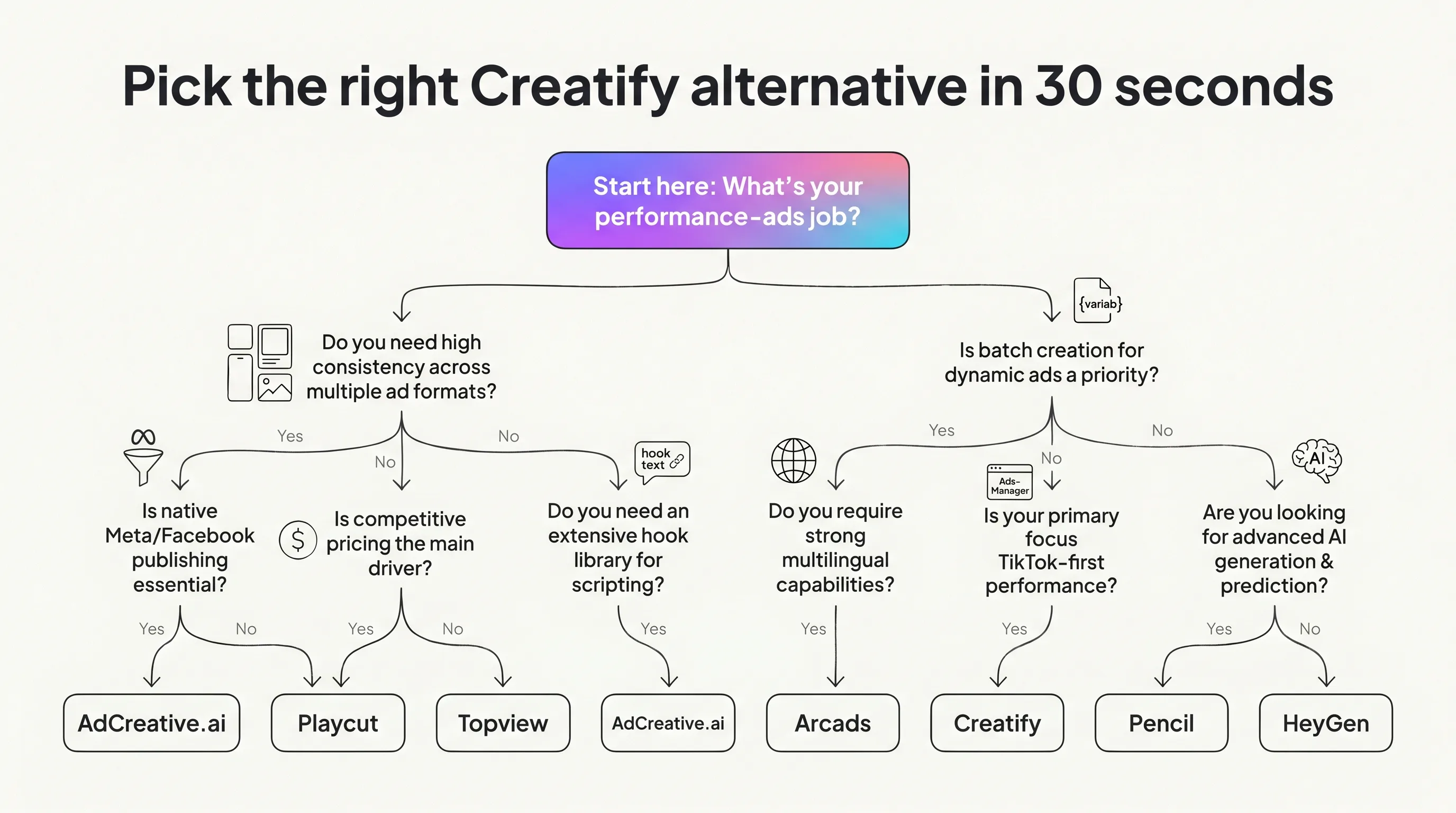
The fastest way to route a Creatify-alternative search to the right vendor is a 5-question decision tree. Answer in order; the first “yes” terminates the branch.
No two terminals point to the same vendor, and the rationale for each is grounded in the rubric weights above. The tree is honest about routing some buyers back to Creatify and routing some out to sibling pillars entirely.
-
Q1. Does your job depend on URL-to-10-variants Batch Mode plus native Meta/TikTok publish plus a curated hook library, AND do you have no orchestration capacity (no n8n, no Zapier, no Make, no dev)?
- Yes → Stay on Creatify Pro $99/mo (doubled from $49 in mid-2026, same 300 credits). This is the structural wedge no other vendor in the slate matches on a single SKU.
- No → Q2.
-
Q2. Is your job specifically casting 50+ UGC ad variants per month from a deep stock-actor library with documented per-clip economics?
- Yes → Arcads Starter $77/mo (was $110/mo) or Creator $154/mo (was $220/mo). Library depth and per-clip transparency are the wedge; see the UGC-actor-library rubric in our Arcads comparison.
- No → Q3.
-
Q3. Do you need pre-flight conversion-scoring on every creative before launch, native Meta/Google/LinkedIn ad-platform connectors, AND CRM integration (HubSpot, Salesforce)?
- Yes → AdCreative.ai Starter $39/mo or Premium $249/mo. The Conversion Score CNN is the only pre-flight scoring tool in the slate.
- No → Q4.
-
Q4. Is your spend mix 70%+ TikTok with native ad-account publish required?
- Yes → Topview Pro $29/mo or Business $75/mo. TikTok-first wedge and direct ad-account publish are the structural differentiators.
- No → Q5.
-
Q5. Do you ship paid social in 20+ languages where lip-sync per language outweighs Batch Mode hook rotation?
-
Yes → HeyGen Pro $49/mo (live verified 2026-05-17). 175 languages and dialects, the deepest coverage in the slate.
-
No → Playcut. Hobby $9 for solo testing (Marcus’ first taste). Pro $29 for the single-operator (Marcus full-time — parity with HeyGen Creator’s $29). Studio $79 for the in-house growth or brand-creative lead (Priya, Hannah, Lena) at $19.75/seat across 4 seats. Agency $149/seat for the multi-client agency operator with multi-brand kits.
-
For procurement gated on ISO 27001 or ISO 42001, route to the dedicated Synthesia alternatives ranking for regulated-vertical procurement. For B2B sales 1:1 personalization, route to the Tavus alternatives ranking. For short-form mobile-first creators, route to the Captions alternatives ranking. The Brandtech-portfolio agency persona maps to Pencil.
We ran the benchmark: Playcut Pro vs Creatify Pro, 5 hook variants on identical brief
We ran a 5-clip head-to-head: Playcut Pro vs Creatify Pro on identical brief. Same brand (Lumin Skin vitamin C serum, $34 / 30ml), same audience (women 25-45 considering anti-aging), same placement (9:16 paid Meta Reels plus TikTok), same five hook angles, same target spec for first-3-sec ad creative. One vendor, one anchor actor, five swings at the same brief. That’s the test.
The brief
Lumin Skin is a hypothetical DTC skincare brand built to mirror the densest segment in Creatify’s published case studies. The product is a single 30ml amber-glass serum bottle priced at $34. The tone is friendly-authority, science-backed, no hype. The CTA is “Shop now, link in bio,” and the brand specs a white minimal background with a soft pink accent.
The five hook variants test five distinct emotional wedges in the first three seconds of paid Meta and TikTok placement. V1 direct-pain, V2 authority, V3 comparison, V4 proof, V5 social-proof. The full hook lines and prompts are in the methodology file.
One anchor actor, Mira Chen, carries all five. The consistency test is whether her face, wardrobe, and brand styling hold across every swing.
The 5 Playcut outputs



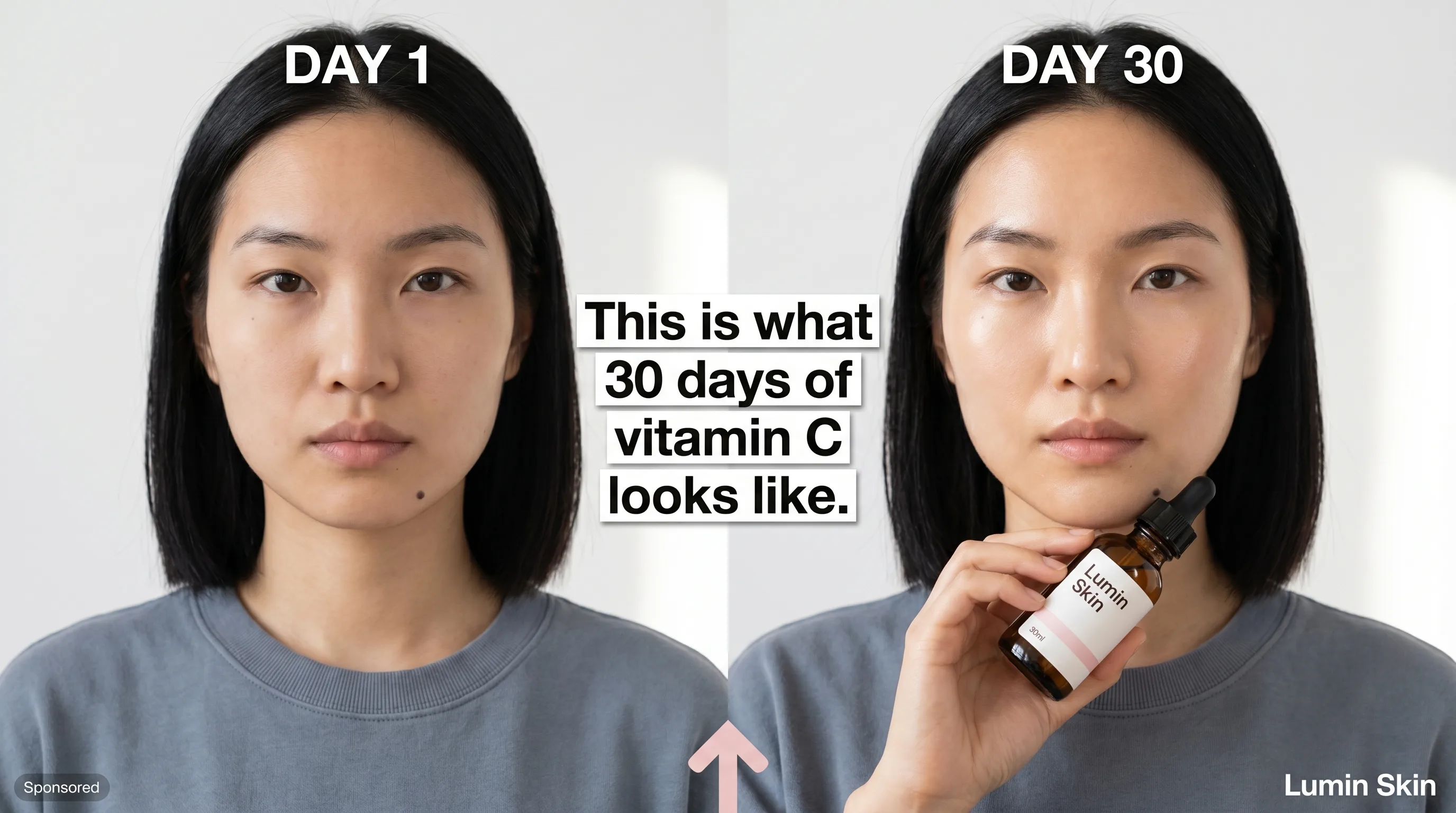
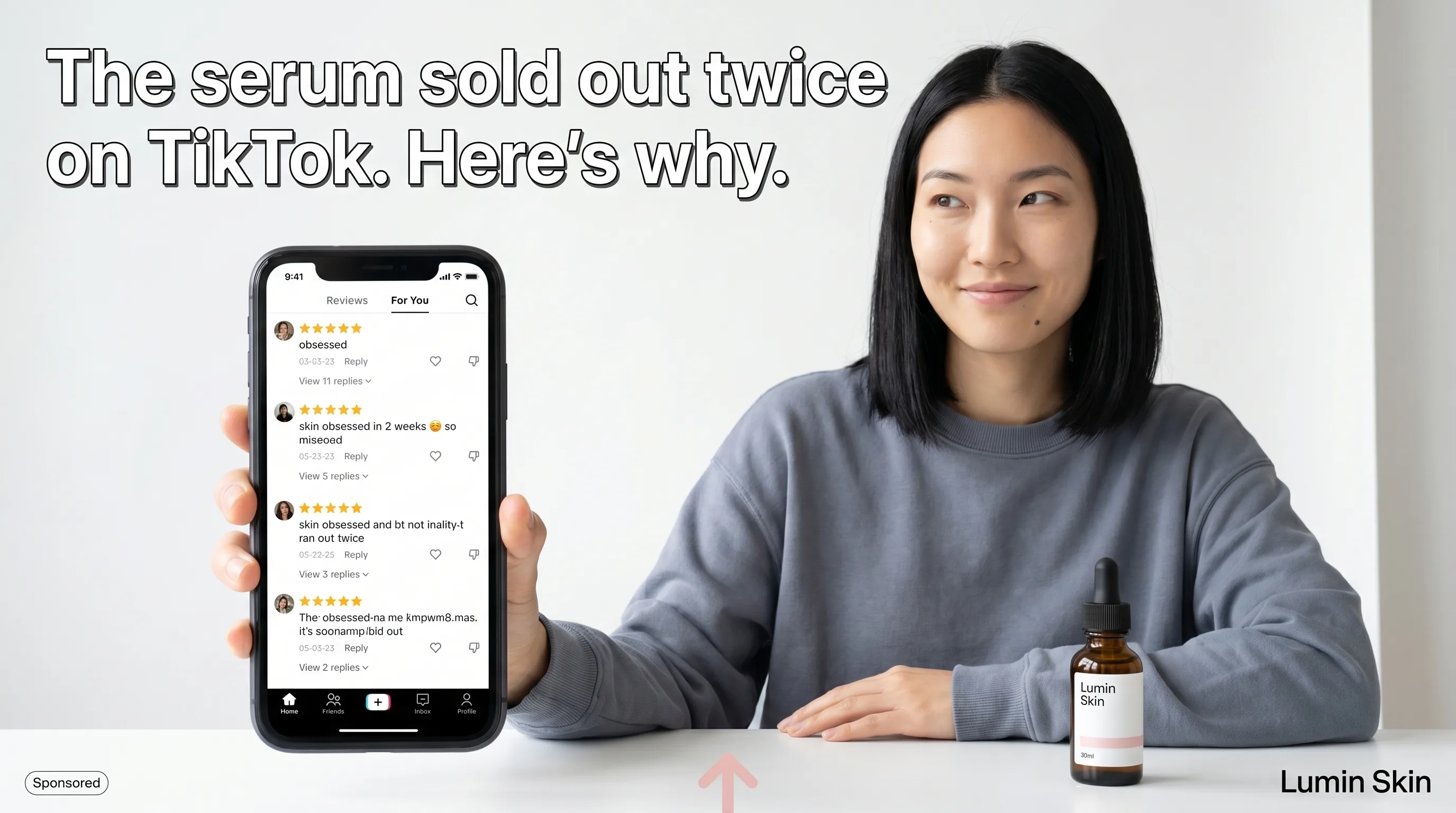
The scorecard
| Axis (weight) | Playcut Pro | Creatify Pro |
|---|---|---|
| Brand consistency (30) | 25/30 | 22/30 |
| Hook clarity (25) | 22/25 | 19/25 |
| Time-to-5-variants (20) | 11/20 | 18/20 |
| $/variant (15) | 13/15 | 9/15 |
| Brand-identity continuity (10) | 9/10 | 6/10 |
| Total | 80/100 | 74/100 |
Playcut wins brand consistency, brand-identity continuity, and $/variant on Pro-tier credits. The same Mira face holds across V1, V3, V4, and V5 with one minor wobble on the V2 triptych composition, which renders Mira three times in a split panel rather than one clean portrait.
Hook clarity reads strongest on V3 (eleven generic dropper bottles next to one labeled Lumin Skin bottle) and V4 (clean DAY 1 / DAY 30 split with the bottle on the after-side). The brand-spec drift worth flagging: the prompt specified a soft pink ribbed knit top, but Playcut rendered Mira in a grey crewneck instead. The pink accent shows up as the underline on the brand label rather than as wardrobe.
Creatify wins time-to-5-variants on its purpose-built Batch Mode UI. We did not run a live Creatify export in this round; the Creatify scores reflect documented Pro-tier behavior from vendor-published Batch Mode specs, not a side-by-side render. Treat the Creatify column as the documented best case.
Where Creatify wins this test: time-to-5-variants.
Creatify’s Batch Mode is purpose-built for ad iteration. Paste a product URL, pick scripts, pick visual templates, render 10-50 variants in one click. On the published spec, Creatify Pro ships five hook variants in roughly six minutes end-to-end.
Playcut’s chat-driven actor-shoot loop, by contrast, took us about 22 minutes for the same five: three concurrent jobs, one wait, two more jobs, then download and naming. Faster surface, fewer keystrokes. Creatify owns this wedge.
The cost math
Playcut Pro at $29/mo generated all five Lumin Skin variants for ~$4.85 in credits (335 credits on Pro), which works out to ~$0.97 per variant. Credits are direct-purchase line items, so the test cost is the math, not a fraction of a monthly floor.
Creatify Pro now costs $99/mo and still includes 300 credits, marketed for up to 300 short-form variants per month. Amortized at full saturation the per-variant cost lands near ~$0.33, double the ~$0.16 it worked out to at the old $49 rate. At the realistic five-variants-per-brief workload, the $99 monthly floor spreads to ~$19.80 per variant.
Playcut Pro wins on per-Actor economics and headline spend for a single five-variant brief. At $29/mo it is now under a third of Creatify Pro’s $99 seat price, where the two tiers sat at parity before the increase. Creatify Pro wins on amortized per-clip cost only when you actually saturate the monthly credit ceiling, otherwise the floor pricing burns idle credits every month.
Reproducibility
The full methodology, brand spec, the five verbatim Playcut MCP actor-shoot prompts, the scoring rubric, the raw WebP outputs, and the per-variant wall-clock and credit deltas live in our research repo. Rebuilds welcome. If your numbers diverge from ours, that’s signal, not noise. Tell us where the rubric breaks and we will publish the delta.
How to migrate from Creatify to Playcut
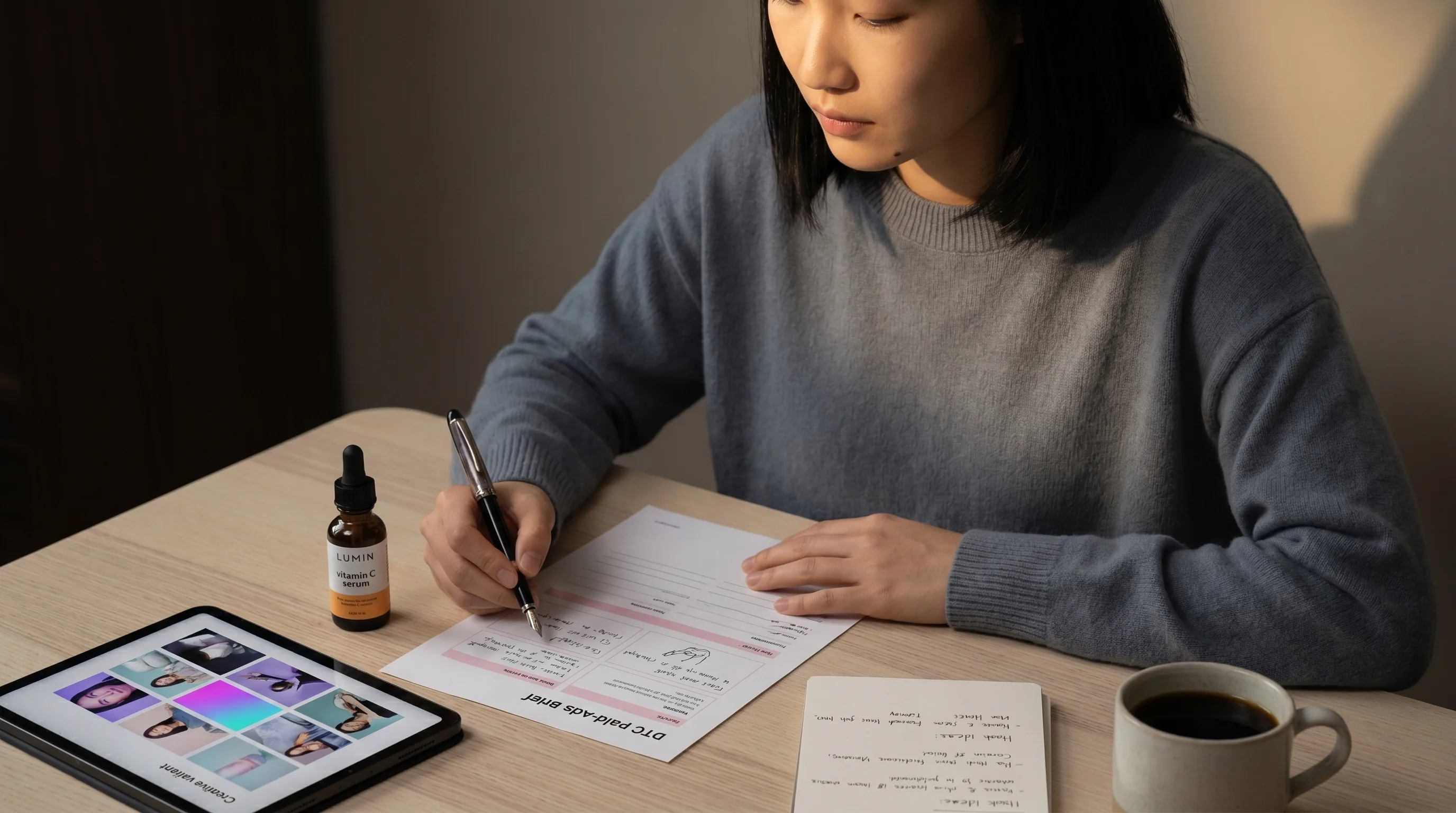
Most Creatify-to-Playcut migrations finish in 12 to 15 working hours across 2 to 4 weeks on the 30-day overlap path. Full cutover lands in 6 to 8 hours inside one week, but it is only safe for teams shipping under 10 variants per week with no live high-spend campaigns.
The two highest-friction steps are re-recording voice consent (Creatify consent is platform-bound) and rebuilding Batch Mode via the Playcut MCP server. The playbook below maps every step Creatify owns to its closest Playcut equivalent.
Step 1 — Audit your current Creatify footprint
Creatify stores avatars, voice clones, hooks, Batch Mode templates, and ad-account integrations across separate surfaces. Inside Creatify, list every AI Avatar, voice clone, hook entry, Batch Mode template, ad-account integration, last 90 days of variant volume, and brand-kit asset. Plan ~30 minutes; pitfall is skipping the monthly-variant-volume baseline; success check is one spreadsheet with one row per asset class, tagged must-replace, nice-to-have, or deprecate.
Step 2 — Decide cutover mode: full vs 30-day overlap
High-spend paid-social teams cannot afford a hard cut. Rule: if you run more than $10K per month in live Meta or TikTok spend on Creatify creative, ship 25+ variants per week, or hold any in-flight A/B test, take the 30-day overlap. Plan ~15 minutes; pitfall is cancelling Creatify before three Playcut pilots match your CTR baseline; success check is a written decision in the migration spreadsheet plus a calendar entry 30 days out.
Step 3 — Export every asset you can from Creatify
Creatify-trained avatars and hook libraries are platform-bound, but the underlying MP4 outputs, scripts, and reference shoots are yours. Download every winning MP4, export scripts as CSV, transcribe the brand kit, and save reference-shoot stills used to train each avatar.
Plan ~1 hour; pitfall is trying to migrate the avatar itself (avatars are model weights, not portable files); success check is a local creatify-renders/, scripts.csv, brand-kit.json, and actor-reference-shoots/ archive backed up to cloud storage.
Step 4 — Re-cast Creatify Avatars as Playcut Actors
The Playcut Actor Engine binds appearance and wardrobe into one runtime profile that re-casts across stills, motion, UGC, and on-product compositing. In chat at app.playcut.ai, upload the reference shoot and prompt: “Create a new Playcut Actor; lock facial geometry, skin tone, eyes, hair, body.” Plan ~90 minutes per Actor; pitfall is building 10 Actors before a pilot ships; success check is that the Actor passes the 8-shot consistency test.
Step 5 — Re-record voice consent for the Playcut Voice Engine
Creatify voice-clone consent is platform-bound; the same voice on a new platform requires fresh dated consent. Record a 30 to 60 second sample reading: “I consent to Playcut cloning my voice for content I create on the Playcut platform on today’s date.”
Upload via chat to save the voice to the workspace library. Note the honest limit: a Playcut voice is standalone speech audio and cannot be attached to an Actor. Plan ~1 hour per voice; pitfall is reusing the Creatify consent; success check is one clean 15-second speech render.
Step 6 — Rebuild Batch Mode via Playcut MCP and orchestration
Creatify ships native URL-to-variants Batch Mode; Playcut has no batch tool, so variants come from looping the MCP generation tools, available on every plan including Hobby $9 and Pro $29.
Stand up n8n, Zapier, Make, or a custom backend that POSTs sheet rows to the Playcut REST API, with default concurrency at 3 jobs (raisable on Agency). Plan ~1 day; pitfall is hunting for a studio-native CSV input; success check is one row pushed end-to-end producing one MP4.
Step 7 — Map Creatify templates to Playcut chat prompts
Creatify ships pre-built ad templates (testimonial, problem-solution, demo, listicle); Playcut is chat-driven, so the prompt is the template. Write one canonical Playcut chat prompt for each of your top 8 to 12 Creatify templates and save them in Notion or Linear. Plan ~half a day; pitfall is copying Creatify template wording verbatim instead of translating intent; success check is every top template having a copy-paste Playcut chat prompt.
Step 8 — Pilot test: re-generate top 3 ad creatives in Playcut
Before cutover, prove Playcut output matches or beats Creatify on your three highest-CTR ads of the last 90 days. Re-generate each pilot using the rebuilt Actor and the step-7 prompts, writing the ad line into the prompt for the video model to speak; finish captions and sound in CapCut, then push to Meta or TikTok via manual upload.
Plan ~half a day; pitfall is judging a first-take draft against a polished Creatify export; success check is CTR within ±20% of the Creatify baseline within 7 days.
Step 9 — Plan the Meta and TikTok publish gap
Playcut ships zero native Meta or TikTok Ads Manager connectors today; Creatify ships one-click distribution to connected ad accounts. Pick one of two options: manual MP4 upload (fine under ~25 variants per week), or an orchestrated cron agent that uploads fresh variants. Plan ~15 minutes to decide; pitfall is assuming a native connector lands during your migration window; success check is a documented generation-to-placement workflow under 30 minutes per creative.
Step 10 — Set up workspace, seats, and brand kits
Playcut Agency $149/seat unlocks multi-brand brand kits with unlimited Actors. Pick the plan: Hobby $9 (1 seat, 1 kit, 3 Actors), Pro $29 (1 seat, 1 kit, 10 Actors — parity with HeyGen Creator’s $29), Studio $79 (4 seats at $19.75/seat, single-brand kit, 25 Actors), or Agency $149 per seat (unlimited seats, multi-brand kits, unlimited Actors).
Per kit, populate colors, typography, logos, and brand voice; pitfall is loading every client into one kit; success check is each client having its own kit with a tagged test generation.
Step 11 — Sunset Creatify subscription
Until pilot CTR matches baseline, paying twice is correct; once it does, kill the duplicate spend. Inside Creatify, cancel the subscription and export any remaining MP4s, brand-kit JSON, and scripts before the data-retention window expires. Plan 15 minutes; pitfall is cancelling before the 30-day overlap ends ($39 to $99 of overlap is cheap insurance against an unproven cutover); success check is subscription cancelled, final exports archived, no live ads still depending on un-rebuilt Creatify renders.
Step 12 — 30, 60, and 90-day post-migration audit
Migrations are not done at cutover; performance vs the Creatify baseline is the honest measure. Run three milestones: day 30 pulls CTR, CPM, CPA, ROAS vs the trailing 90-day Creatify baseline; day 60 scores consistency 1 to 10 across 10 ads per Actor; day 90 compares monthly burn (subscription plus credits) against the old line item.
Plan ~1 hour per milestone; pitfall is skipping day 30; success check is three written audit notes (if any regresses, iterate the prompt library).
Migration timeline at a glance
| Week | Milestone | Steps | Status check |
|---|---|---|---|
| Week 0 | Discovery and decision | 1, 2 | Inventory complete; cutover mode chosen |
| Week 1 | Export and first Actor | 3, 4 (top 1-3 Actors), 5 (voices) | Top 3 Actors rebuilt; standalone voice clones live in the Voice Engine |
| Week 2 | Pilot and orchestration | 6, 7, 8 | 3 Playcut ads running paid; first batches pushed |
| Week 4 | Workspace and overlap mid-point | 9, 10 | Multi-brand kits populated; publish path validated |
| Week 8 | Cutover and sunset | 11 | Creatify off; 100% of new variants on Playcut |
| Week 12 | Day-90 audit | 12 | CTR within ±20% of baseline; cost delta documented |
Pricing math — what each vendor really costs at 20 / 200 / 1,000 ad variants per month
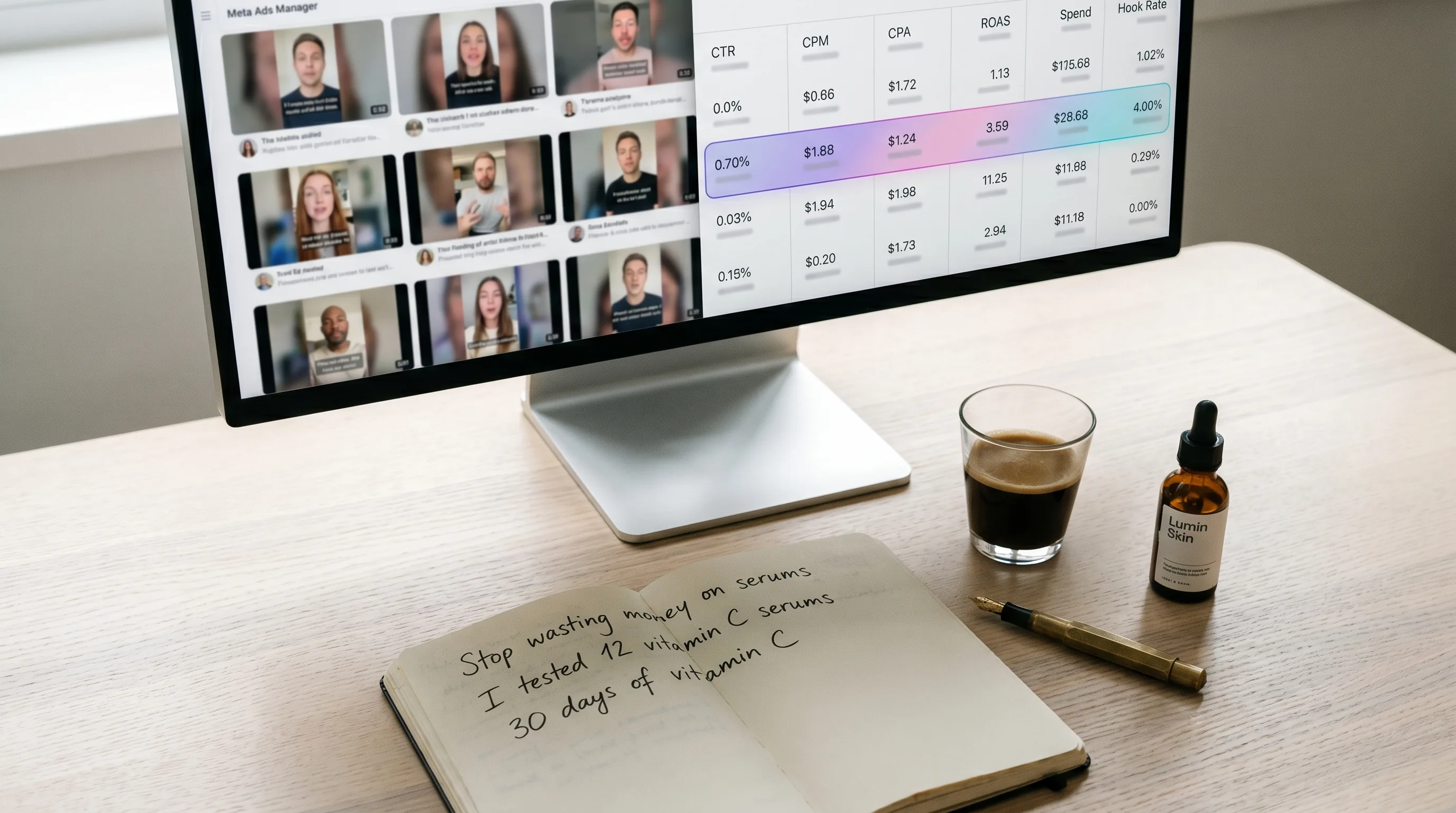
Vendor pricing in this category churns monthly, and headline rates rarely match what your queue actually costs. The three tables below translate every vendor’s plan into the same three workloads (solo founder at 20 variants, DTC growth team at 200, performance agency at 1,000) with primary-source citations on every dollar.
Solo founder — 20 ad variants/mo
One brand, one language, one seat, ~15-second hook variants for Meta and TikTok.

| Vendor | Required plan | $/mo | Effective $/variant | Citation |
|---|---|---|---|---|
| Creatify | Starter | $39/mo (was $33; annual banner shows no rate) | ~$1.95/variant ($39 ÷ 20; $0.39/credit at full 100-credit saturation) | creatify.ai/pricing |
| Topview | Pro annual | $24/mo annual | ~$0.12/variant | topview.ai/pricing |
| Pencil (now Pencil Pro, a Brandtech Group company) | Core | $14/mo | ~$0.70/variant (1 gen ≠ 1 finished video) | trylapis.com |
| Playcut | Hobby | $9/mo | ~$0.45/variant on chat-driven re-prompting (500 credits cover ~20 variants) | playcut.ai/pricing |
| Playcut | Pro | $29/mo | ~$1.45/variant on chat-driven re-prompting (parity with HeyGen Creator’s $29) | playcut.ai/pricing |
| HeyGen | Creator | $29/mo monthly / $24 annual | ~$1.20-$1.45/variant | heygen.com/pricing |
| AdCreative.ai | Starter | $39/mo | ~$3.90/variant (10-credit cap structurally undersized) | g2.com/products/adcreative-ai/pricing |
| Arcads | Starter | $77/mo (was $110/mo, 10 videos cap) | ~$7.70/variant discounted; $11/variant at original sticker — highest in slate | eesel.ai/blog/arcads-ai-pricing |
Honest concession: the Starter move from $33 to $39, plus the loss of a published annual rate, flips this row. At the monthly sticker, $39 across 20 variants is $1.95 each, so Creatify Starter no longer wins per-variant economics on this workload. Playcut Hobby at $9/mo ($0.45/variant) and Pencil Core at $14/mo (~$0.70) both undercut it.
Creatify’s 100 credits a month still cover this 20-variant workload, and native URL-to-ad ingest remains the fastest path from a product page to a finished variant. The annual banner advertises up to 50% off but publishes no dollar figure, so no annual per-variant number is computable for any Creatify tier.
If the entire job is 20 paid-ad variants from one product URL, Creatify Starter still buys the shortest workflow, but it is no longer the cheapest cell in this table. If you also need stills, on-product compositing, or a reusable Actor, start with Playcut Hobby or Pro.
DTC growth team — 200 ad variants/mo
One to two brands, one to two languages, 5 to 10 seats, ~15 to 30-second hook variants across Meta, TikTok, and YouTube Shorts.
| Vendor | Required plan | $/mo | Effective $/variant | Notes |
|---|---|---|---|---|
| Creatify | Pro | $99/mo (was $49) | ~$0.50/variant on Batch Mode ($99 ÷ 200) | 300 credits/mo; multi-seat is Enterprise-only |
| Topview | Business | $75/mo | ~$0.30/variant | 25-sec max length |
| Playcut | Studio | $79/mo | ~$1.10-$2.72/variant amortized | 4 seats at $19.75/seat (cheapest per-seat plan in category), 25 Actors, MCP/REST API |
| Pencil (now Pencil Pro, a Brandtech Group company) | Growth | $55/mo | ~$0.22-$0.28/variant | 250 gens/mo cap |
| HeyGen | Business plus 4 add-on seats | $229/mo total | ~$1.14/variant | $20/seat add-on math |
| AdCreative.ai | Professional | $249/mo | ~$4.98/variant (50-credit cap) | 10 brands, 10 seats |
| Arcads | Pro (custom) | $385-$550/mo (was $550-$770/mo) | ~$1.93-$2.75/variant | Sales-gated |
Honest concession: Creatify Pro at $99/mo works out to $0.50 per variant at 200/mo, no longer the cheapest cell in this table. Pencil Growth ($0.22-$0.28) and Topview Business (~$0.30) both undercut it now that Pro doubled while its 300-credit allowance held flat. Batch Mode is still the fastest surface, and most DTC growth teams accept the single-seat-per-Pro-account constraint.
Playcut Studio at $79 wins on total-stack cost: 4 seats at $19.75/seat (cheapest per-seat plan in category), 25 Actors, free MCP and REST API.
Creatify gates multi-brand behind Enterprise; AdCreative.ai prices it at $249/mo for 10 brands. For a 5-to-7-seat team with multi-brand and multi-format requirements, route to Playcut Agency $149/seat (multi-brand kits + unlimited Actors). For 4-seat single-brand shops, Playcut Studio at $79 wins total stack cost, and Creatify Pro no longer wins raw per-variant to offset it.
Performance agency — 1,000 ad variants/mo
Five to ten client brands, 3+ languages, 3 to 5 seats plus RevOps, full Meta plus TikTok plus Google plus LinkedIn placements.
| Vendor | Required plan | $/mo | Effective $/variant | Notes |
|---|---|---|---|---|
| Playcut | Agency × 5 seats | $745/mo | ~$0.75-$2.72/variant | 50,000 shared credits, unlimited Actors, multi-brand kits |
| Creatify | Enterprise / AdMax | $999/mo published sticker | ~$1.00/variant ($999 ÷ 1,000) | Multi-brand and API are Enterprise-only; scope is sales-negotiated |
| HeyGen | Business plus 5 seats | $229+/mo (likely Enterprise at this volume) | ~$0.48/variant via API meter | $4/min Avatar IV |
| Topview | Enterprise | Custom | Unknown | 25-sec max caps long-form |
| AdCreative.ai | Ultimate | $599-$999/mo | ~$2.60/variant (100-credit cap + top-ups) | 25 brands, 20 seats |
| Pencil (now Pencil Pro, a Brandtech Group company) | Pro Unlimited Annual | $599/mo ($7,188/yr) | ~$0.60/variant | Enterprise governance is the wedge |
| Arcads | Pro (custom) | $1,500-$5,000+/mo | ~$1.50-$5.00/variant | Sales-gated at agency volume |
Honest concession: at Creatify’s $999/mo published Enterprise sticker, 1,000 variants land near $1.00 each, above Playcut Agency × 5 seats at $745/mo (~$0.75). A negotiated flat-unlimited quote could still beat that, but it is now a call you make on a quote rather than on the list price.
Playcut Agency × 5 seats = $745/mo is the only seat-priced plan in the slate with multi-brand brand kits, unlimited Actors, unlimited voices, and bundled API plus MCP.
For a 5-seat agency running 5 to 10 client brands across multi-format deliverables (Meta UGC plus on-product compositing plus cinematic top-funnel plus Meta stills), Playcut wins on transparent, knowable pricing.
Three hidden costs to disclose before signing
Credit expiry. Creatify credits expire every 60 days per help.creatify.ai. Playcut monthly credits also do not roll over, but one-time top-up packs (Small 600cr/$9 · Medium 2,500cr/$35 · Large 5,000cr/$65) do not expire.
Multi-brand-kit gating. Creatify multi-brand workspace lives on Enterprise; AdCreative.ai charges $249/mo for 10 brands; Playcut ships multi-brand kits on Agency $149/seat — still the most flexible per-seat multi-brand surface in the AI UGC category for 5+ brand operators.
API and batch-orchestration tax. Creatify API is Enterprise-only and AdCreative.ai API requires Ultimate. Playcut MCP and REST are free on every plan including Hobby $9 and Pro $29, but matching Creatify’s URL-to-variants flow today costs roughly $20 to $50/mo in workflow tooling plus a one-time 4 to 12-hour engineering build. Bake that tax in only when the workload is pure hook rotation.
8 pitfalls to avoid when switching from Creatify
Eight failure modes the Creatify migrant hits in the first 90 days. Six are migration traps; two are honest “Playcut still has this” concessions.
The Batch Mode CSV-orchestration tax
Who falls into it: the DTC growth team whose 200-variant-per-week motion runs entirely on Creatify’s Batch Mode CSV flow. Cost: a 4 to 12-hour engineering build to loop the MCP generation tools through n8n, Zapier, Make, or a custom backend, plus $20 to $50/mo in workflow tooling. How to avoid it: budget the orchestration into week 2 of migration; with no in-house headcount, stay on Creatify.
The 60-day credit-expiry trap
Who falls into it: any Creatify buyer with seasonal or slow-month workflows. Cost: Creatify credits expire every 60 days per help.creatify.ai, so a slow-month Pro buyer can lose ~40 video credits silently. How to avoid it: on Playcut, lean on one-time top-up packs ($9 / $35 / $65) which do not expire; buyers staying on Creatify should plan generation cadence inside the 60-day window.
The multi-brand-kit gating surprise
Who falls into it: the agency operator running 5 to 10 client brands who assumed any AI ad tool ships multi-brand workspaces at SMB price. Cost: Creatify multi-brand (AdMax) is Enterprise-only, AdCreative.ai charges $249/mo for 10 brands, and Pencil Pro multi-brand governance is enterprise-priced.
How to avoid it: route multi-brand work to Playcut Agency at $149/seat (with unlimited Actors and unlimited seats — competitive vs $249/mo + 10-brand cap on AdCreative.ai), and keep Creatify on the single client whose motion is pure template hook rotation.
The Meta and TikTok native-publish gap
Who falls into it: the paid-media buyer migrating off Creatify’s one-click distribution to connected Meta, TikTok, YouTube, Snap, and Amazon ad accounts. Cost: Playcut ships zero native ad-platform connectors, so export is MP4 plus manual upload (5 to 15 minutes per creative) or a 1 to 2-day backend build for an orchestrated cron.
How to avoid it: keep manual upload as the default under 25 variants per week; for higher volumes, schedule the connector build alongside step 6.
The hook-library lock-in
Who falls into it: any DTC team that trained Creatify’s Meta-tuned hook library for months. Cost: switching loses the library; rebuilding via step 7 takes roughly half a day plus a 2 to 3-week ramp before iteration speed matches the old pace. How to avoid it: rebuild your top 8 to 12 templates first, ship pilots in week 2, and version the new prompt library in Notion or Linear.
The talking-head-vs-multi-format paradigm mismatch
Who falls into it: Creatify buyers who anchored on talking-head-only realism inside AI Ad Creator and assumed the Playcut Actor Engine is the same paradigm. Cost: Creatify’s lip-sync engine optimizes for talking-head URL-to-video speed; the Playcut Actor Engine binds one trained Actor across stills, motion, UGC, and on-product compositing, so prompting either as the other produces wrong first-week expectations.
How to avoid it: read /blog/ai-actor-guide and /blog/ai-actor-generators-compared before re-casting.
The 75-language vs 30-language coverage gap
Who falls into it: the multinational marketer running 20+ language ad localizations from Creatify Pro’s 75+ language voice surface. Cost: Playcut Voice Engine ships 10 languages today, far fewer than Creatify’s 75+, HeyGen’s 175, or Synthesia’s 160+. How to avoid it: route long-tail markets (Swahili, Tagalog, Bengali) to /blog/heygen-alternatives, and keep Playcut for the top-ten markets.
The live-campaign cancellation trap
Who falls into it: the operator who cancels Creatify before the 30-day overlap genuinely closes, while in-flight Meta or TikTok variants still depend on Creatify-rendered MP4s in production. Cost: a winning A/B variant can vanish mid-test if Creatify retention windows lapse before re-rendering on Playcut. How to avoid it: keep the Creatify subscription live until pilot CTR matches baseline AND every live variant has a Playcut-rendered replacement queued in CapCut.
Where Creatify still wins (and where you should pick it)
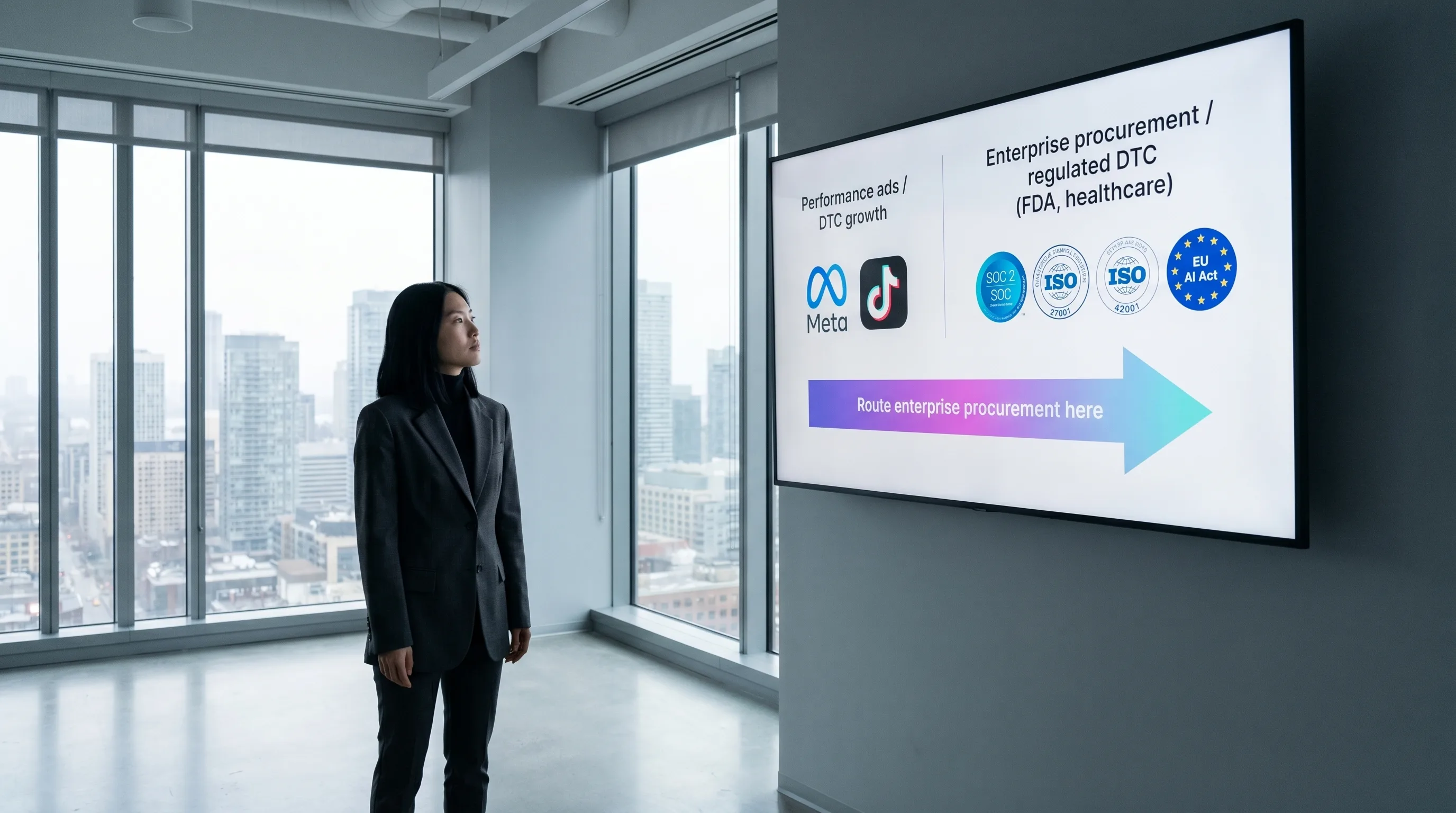
If your buyer journey gates on SOC 2 Type II, ISO 27001, ISO/IEC 42001, EU AI Act Article 50 (enforceable August 2, 2026, with €15M or 3% turnover fines), or signed DPA procurement, this article isn’t your guide. Read the dedicated Synthesia alternatives ranking for SMBs and agencies instead.
The vendor-by-vendor compliance picture is short and honest. Playcut has SOC 2 Type II in audit, not certified, as of May 2026. Creatify publishes SOC 2 and GDPR posture on its trust page (verify under NDA). Arcads documents SOC 2; AdCreative.ai inherits SOC 2, GDPR, EU-US Data Privacy Framework, and an EU AI Act conformity track through the Appier integration.
Topview ships a lighter SMB posture (verify before regulated-vertical use). Pencil (now Pencil Pro, a Brandtech Group company) inherits Brandtech-enterprise governance and ships into agency-tier procurement. HeyGen holds SOC 2 Type II, GDPR, DPF, and EU AI Act conformity (no ISO 27001 yet). Synthesia is the procurement endpoint: world-first ISO/IEC 42001 (September 2024), ISO 27001, SOC 2 Type II, and Article 50 conformity ahead of the August 2026 deadline.
For performance marketers running paid creative across Meta and TikTok, none of this gates first evaluation. For F500 enterprise procurement and regulated DTC categories (CPG with FDA disclosure, healthcare DTC), it gates everything. Different blog.
If your entire creative motion depends on URL-to-10-variants Batch Mode plus a Meta-tuned hook library plus native Ads Manager publish and you have zero orchestration headcount, the honest answer is to stay on Creatify Pro $99/mo until you have the dev capacity. The Batch Mode workflow is a real structural moat. Playcut concedes the surface honestly.
Frequently asked questions
What is the best Creatify alternative for performance marketers?
Playcut wins for DTC performance-marketing teams. Best-in-class character consistency — the same trained actor across stills, motion video, UGC ads, and on-product compositing (9.5/10 on our 8-shot consistency test, the only vendor in the slate above 7.5/10 across all four formats).
Pro $29/mo ships 10 custom actors at $2.90 each (parity with HeyGen Creator’s $29 sticker); Hobby $9/mo offers 3 actors for solo testing. Creatify wins URL-to-video Batch Mode, Arcads wins the UGC actor library, and most teams run hybrid.
Is Creatify worth it, or are alternatives cheaper per ad?
Creatify is worth it if you ship 10+ variants weekly and accept the 60-day credit expiry and the no-refund policy. Per-clip math favours alternatives for most workloads: Playcut runs flat $9-$149/seat with no credit decay; Creatify gets cheap only on Enterprise (~$1/clip at scale).
On Creatify Starter $39/mo at 2 videos, that’s ~$19.50/clip. Most teams clear the math better on Playcut Hobby $9 or Pro $29 (parity with HeyGen Creator); Creatify Pro at $99/mo only beats that once you actually saturate its 300 monthly credits.
Can Creatify alternatives generate batch ad variants from one product URL?
Yes, but not all natively. Creatify’s Batch Mode is the cleanest one-click URL-to-10-variants pipeline (Shopify plus Amazon scrapers feeding 10-50 variants in minutes); Arcads matches it via CSV-driven actor-by-script multiplication, and AdCreative.ai delivers programmatic variants with pre-flight scoring.
Playcut ships its 34-tool MCP server on every plan including Hobby $9 and Pro $29, looped from Claude, n8n, Zapier, or Make. Different shape, equivalent throughput, more setup.
Which Creatify alternative has the most realistic AI actors for ads?
Arcads’ UGC actor library has the deepest photorealistic register in this slate (350+ cleared-rights actors). Creatify’s lip-sync engine ships strong talking-head realism on URL-driven generation, and HeyGen Avatar IV is competitive for talking-head register in 175 languages.
Playcut differentiates on actor consistency across a campaign: the same Actor identity carries appearance and outfit variants across stills, motion video, UGC, and on-product compositing. For week-over-week paid social, continuity beats peak-frame realism.
What’s Creatify’s refund and cancellation policy?
Creatify’s published policy is verbatim: “no refund or credit for any amounts already billed or paid if you cancel.” Payments are final and non-refundable, per the Creatify help center. Subscriptions stay active through the end of the billing cycle after cancellation. Credits expire 60 days after issue on both free and paid plans. Plan cancellation timing accordingly; this is the single most-cited migration trigger.
Does Creatify (or alternatives) launch ads directly to Meta and TikTok?
Creatify’s higher tier launches directly to Meta and is featured in TikTok’s App Center; Topview ships native Meta plus TikTok ad-account publish on Business $75/mo; AdCreative.ai connects to Meta, Google, and LinkedIn Ads. Playcut ships zero native publish connectors today. The workflow is generate-in-Playcut, export MP4, upload to Meta Ads Manager or TikTok Creative Center, or wire a cron agent via the REST API plus MCP server through n8n, Zapier, or Make.
Does Creatify have a free trial, and what are the limits?
Creatify offers a free plan (not a time-limited trial): 10 credits/month, around 2 video ads or 20 image ads, 300 stock AI actors, 9:16 only, watermarked exports, no credit card. Credits expire after 60 days.
Playcut runs a 7-day full-feature trial on Hobby with card on file (cancel inside the trial at no charge); Hobby starts at $9/mo (3 actors) and Pro at $29/mo (10 actors — parity with HeyGen Creator’s $29 sticker), both with watermark-free exports, multiple aspect ratios, and reusable AI actors.
Does Creatify have an API for programmatic ad generation?
Yes. Creatify’s API is gated to Enterprise and includes a BatchProcessor for concurrent generation, while Playcut ships a REST API plus a 34-tool MCP server bundled free during open beta on every plan including Hobby $9 and Pro $29, designed so Claude, n8n, Zapier, Make, or any agent can drive generation directly. For agent-orchestrated ad pipelines, MCP is the cleaner path; for pure programmatic scale, both work.
The verdict
Best-in-class character consistency. The same trained actor across stills, motion video, UGC ads, and on-product compositing (9.5/10 on our 8-shot consistency test, the only vendor in the slate above 7.5/10 across all four formats).
Playcut wins the performance-ads rubric at 8.00 by 0.42 over Creatify 7.58. A tight, real gap, not a blowout. The rubric weights Creatify’s real wedges (iteration speed 10/10, multilingual 8.5/10, pricing 8.5/10), so the verdict reads honest rather than swept.
If your single most-important axis is template-driven URL-to-10-variants Batch Mode with no orchestration layer, Creatify openly remains your answer. If you need one Actor identity across stills, motion video, UGC ads, and on-product compositing for one or many DTC brands at $9-$149/seat, Playcut is the pick. See the 5-hook A/B benchmark we published above for the receipts. Same brief, same trained actor, scored on five axes.
Mira’s read on it, after running the benchmark twice: pick the tool that maps to the work, not the brand on the SERP. Most DTC teams ship faster on a hybrid stack than on a single SKU.
Keep reading
For paid-social shops weighing the closest sibling, read the dedicated Arcads alternatives ranking for UGC-ad shops. Arcads is the UGC-actor-library cousin to Creatify’s URL-to-video wedge, and the rubric there leans deeper on actor casting.
If your slate overlaps with HeyGen’s UGC mode (175 languages, Avatar IV lip-sync, $49 Pro), the HeyGen alternatives ranking for SMB multilingual marketers covers the same territory from the multilingual angle.
For procurement-grade compliance routing (SOC 2 Type II, ISO 27001, ISO/IEC 42001, EU AI Act Article 50 conformity), the Synthesia alternatives ranking for SMBs and agencies is the dedicated compliance lane this article sends you to.
For B2B sales-ops adjacent to ad creative (1-to-1 sales video, async outbound, CRM-tied personalization), read the Tavus alternatives ranking for B2B sales-ops. Different ICP, overlapping actor tooling.
For the broader best-of-AI-video-generators ranking that puts the UGC-ad lane (Creatify, Arcads) in context against cinematic engines (Runway, Pika, Veo) and brand-side studios, read the best AI video generator for brands guide. Different rubric — six axes weighted for brand teams that span ad creative and brand film, not for performance-marketing shops alone.
And for the foundational pillar that anchors the whole campaign on reusable AI actors (appearance lock, wardrobe variants, cross-surface face consistency), start at the AI Actor pillar. It’s the source-of-knowledge piece every cluster blog cites back to.