
Best Tavus Alternatives for B2B Sales Teams (2026)

Mira Chen opens a Tavus alternatives tab in May 2026 because her sales-ops team needs the same trained rep across a still in a HubSpot sequence, a 30-second product demo, a UGC ad on LinkedIn, and an on-product composite for the QBR deck. Tavus ships exactly one of those four cleanly.
TL;DR — the verdict, in one screen
Best-in-class character consistency — the same trained actor across stills, motion video, UGC ads, and on-product compositing (9.5/10 on our 8-shot consistency test, the only vendor in the slate above 7.5/10 across all four formats).
- Playcut #1, 8.13/10 — wins for SDRs who need one rep’s face across all four formats at Pro $29/mo (10 custom actors, $2.90 each — parity with HeyGen Creator’s $29), or Hobby $9/mo for solo testing; API plus MCP server bundled free on every plan.
- Tavus #2, 6.80/10 — wins for CRM-triggered 1:1 personalized video at outbound scale via Replica API at Starter $59/mo; Hummingbird-0 zero-shot lip-sync research lead.
- Vidyard #3, 6.63/10 — wins for HubSpot-native real-human plus AI Avatars in one workflow, decade-deep CRM integrations since 2014.
- HeyGen #4, 6.70/10 — wins on 175+ languages with Avatar IV lip-sync; see the dedicated HeyGen alternatives ranking for SMB multilingual buyers.
- Loom #5, 5.13/10 — async screen-record plus face-cam, NOT AI-generated; the workflow Tavus is trying to displace.
- Synthesia #6, 5.83/10 — F500 procurement (world-first ISO/IEC 42001); see the dedicated Synthesia alternatives ranking for regulated-industry buyers.
- Sendspark #7, 6.10/10 — cheapest CRM-friendly entry at Growth $99/mo with full API plus AI variables, pure talking-head register.
Most teams run hybrid — Tavus for the scheduled SDR sequence, Playcut for everything else.
Start your 7-day Playcut trial on Hobby →
Tavus ships three products under one brand and most “tavus alternative” searchers want only one of them. CVI (Conversational Video Interface) is real-time face-to-face AI conversation at sub-1-second latency built on Raven (perception) + Sparrow (turn-taking) + Phoenix-3 (render), billed in 30-second minimum windows for sales coaching, AI tutors, and healthcare triage.
Replica API is the variable-token merge pipeline — CRM data → 1:1 personalized async video at outbound scale — and is the product most SDR/RevOps readers actually want.
PALs (Personal Affective Links) are consumer emotionally-intelligent AI companions, personal-use only per the PALs Supplemental Terms of Service: “You may use PALs solely for your personal, non-commercial use. Any use of PALs other than your personal, non-commercial use is unauthorized and prohibited.” Commercial 1:1 sales video runs through the Replica API on Starter+ tiers.
Why people search “Tavus alternatives” in 2026
Buyers shop Tavus alternatives in 2026 for four reasons: pricing opacity across four separate tiers (Hobbyist $39, Starter $59, Growth $397, Enterprise typically from a $10K+/month minimum — half the SERP can’t agree on the Starter price), three-product confusion between CVI, Replica API, and PALs, the multi-format gap (Tavus is talking-head-first by design), and the CRM-engineering tax that comes with any “personalized video at scale” workflow.
Tavus has earned its category position. The Tavus team closed an $18M Series A in March 2024 led by Scale Venture Partners with Sequoia Capital, Y Combinator, and HubSpot participating, and shipped Hummingbird-0 zero-shot lip-sync (April 24, 2025) at FID 63.92 / LSE-D 6.74 / Arcface 0.84 on Tavus’s benchmark dataset — the lip-sync research lead in the category.
Mayo Clinic, CVS Health, and Aetna run Tavus in production. None of that is in dispute.
Pricing fog: four tiers, two of them sub-$60
The Hobbyist tier reads like a free-developer-trial in the SERP, but ships a flat $39/mo with 25 conversational minutes and 3 Personal Replicas marked personal-use-only under the PALs Supplemental Terms. The Starter tier at $59/mo plus pay-as-you-go usage is the first commercial-grade tier.
Reviews from 2025 sometimes cite the old “$39 Starter” naming. Both numbers are technically right for different SKUs, so buyers reasonably assume one is wrong and route to a clearer alternative.
PALs commercial-use restriction surprises buyers
The PALs Supplemental Terms phrase the limit cleanly: any use of PALs other than personal, non-commercial use is “unauthorized and prohibited.” An SDR signing up to test 1:1 personalization on the Hobbyist tier is signing the wrong contract. Commercial outbound runs through the Replica API on Starter+ tiers, which requires a separate consent-recording flow and a tier upgrade before the first prospect clip ships.
Multi-format identity beyond pure 1:1 sales
Tavus’s Replica holds inside the talking-head, head-and-shoulders register by deliberate product design. A B2B brand actor that needs to ship across a still in a HubSpot deal card, a 30-second product walkthrough, a UGC ad cutdown for LinkedIn, and an on-product composite for the QBR deck is doing four jobs. Tavus ships the second one cleanly; the other three need a different tool — or a second tool.
The CRM-engineering tax
Tavus’s structural moat is variable-token merge plus scheduled CRM-event triggers. The hidden cost is the wiring. Native HubSpot integration (HubSpot was a Series A participant) gets a Tavus team to first personalized clip in days, with REST + webhooks available for broader Salesforce, Outreach, Apollo, and Salesloft wiring.
A team without RevOps engineering bandwidth still pays $20-50/mo for orchestration tooling plus 4-12 hours of integration time on either end. That tax is real on every vendor in the slate; Tavus just makes it most visible.
How we ranked these 7 tools
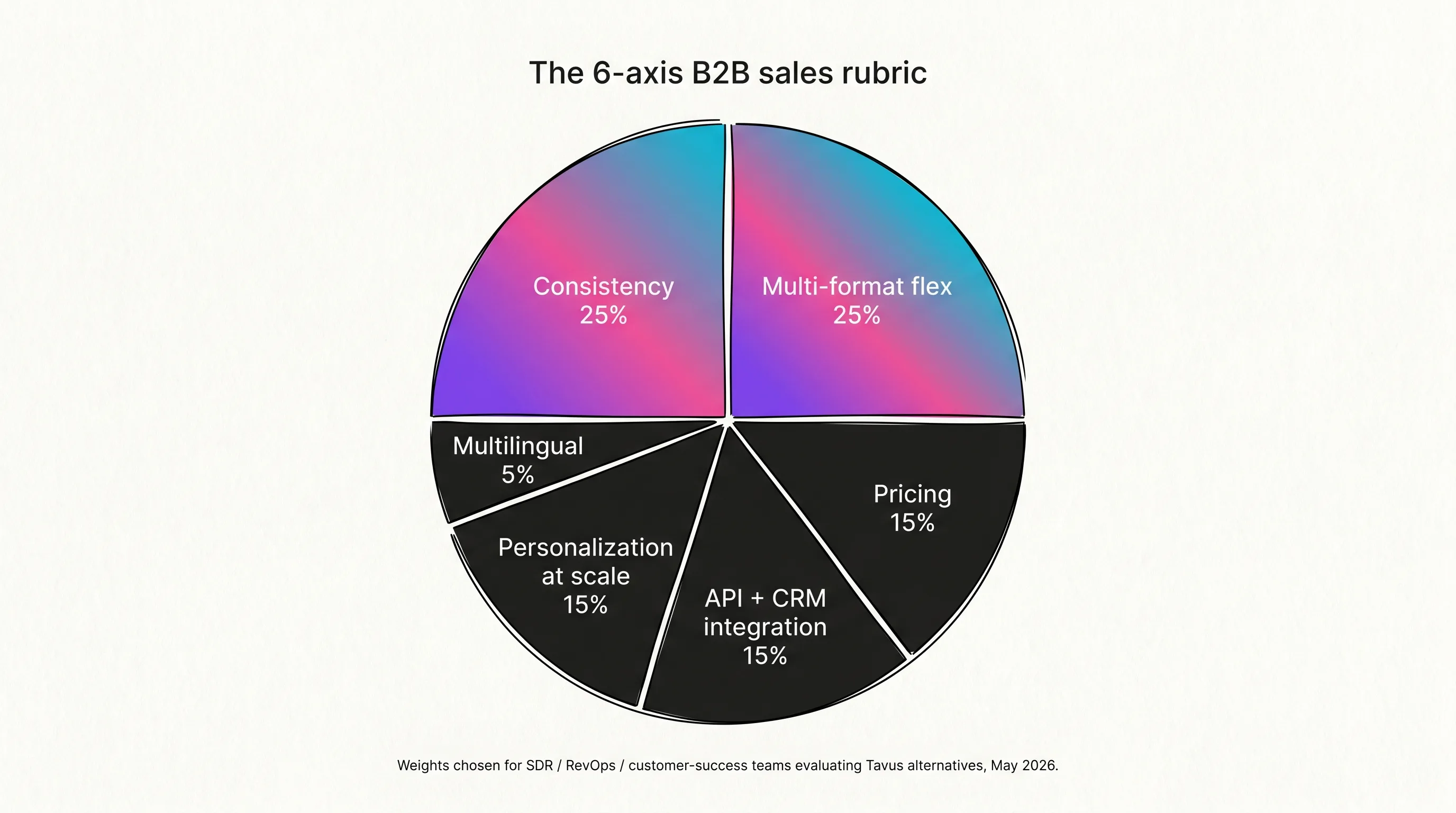
We score 7 vendors on 6 axes: character consistency (25%), multi-format flex (25%), pricing per personalized clip (15%), API + CRM integration (15%), personalization at scale (15%), and multilingual coverage (5%). Compliance is weighted 0% — not because Playcut loses there, but because Tavus evaluators (SDRs, RevOps, customer-success) don’t gate on ISO 42001 at first evaluation. Regulated-industry readers should read the dedicated Synthesia alternatives ranking for F500 procurement.
The rubric asks one question — where an alternative outperforms Tavus. Tavus owns personalization-at-scale via Replica API and native CRM webhooks at 10/10 honestly; Playcut concedes 5.5/10 on that axis, openly.
If your single most-important axis is scheduled CRM-triggered 1:1 video at outbound scale, the ranking would flip: Tavus would lead, Vidyard would close, and Playcut would slot mid-table. The rubric below reflects what most “tavus alternative” searchers actually need: a brand actor that holds across formats, with the personalization motion as a wedge rather than the whole job.
Top row of every matrix in this article is character consistency, locked at 25% weight. The two highest weights (consistency at 25% and multi-format flex at 25%) reflect the buyer’s actual job per the personas in the broader Higgsfield alternatives ranking and the prior shipped cluster. The pricing axis (15%) carries cost-per-finished-clip math per use case, not headline tier price.
Why Tavus sits at editorial #2 even though Playcut leads numerically by 1.33 points
Tavus stays at editorial slot #2 per the search-anchor convention even though Tavus 6.80 numerically edges Vidyard 6.63 and HeyGen 6.70. The numeric ordering is Playcut > Tavus > HeyGen > Vidyard > Sendspark > Synthesia > Loom. The editorial order ships as Playcut → Tavus → Vidyard → HeyGen → Loom → Synthesia → Sendspark for narrative readability and to give every non-Tavus vendor a distinct decision-tree terminal downstream.
Playcut’s 1.33-point lead is honest. The gap is concentrated in two axes (consistency 9.5 vs Tavus 7.0; multi-format 9.5 vs Tavus 4.0). Tavus pulls back on personalization-at-scale (10.0 vs Playcut 5.5) and API + CRM (9.5 vs Playcut 6.5). Re-weight any axis and the ranking shifts predictably toward the vendor that owns that wedge.
Tavus has three products — disambiguating CVI vs Replica API vs PALs
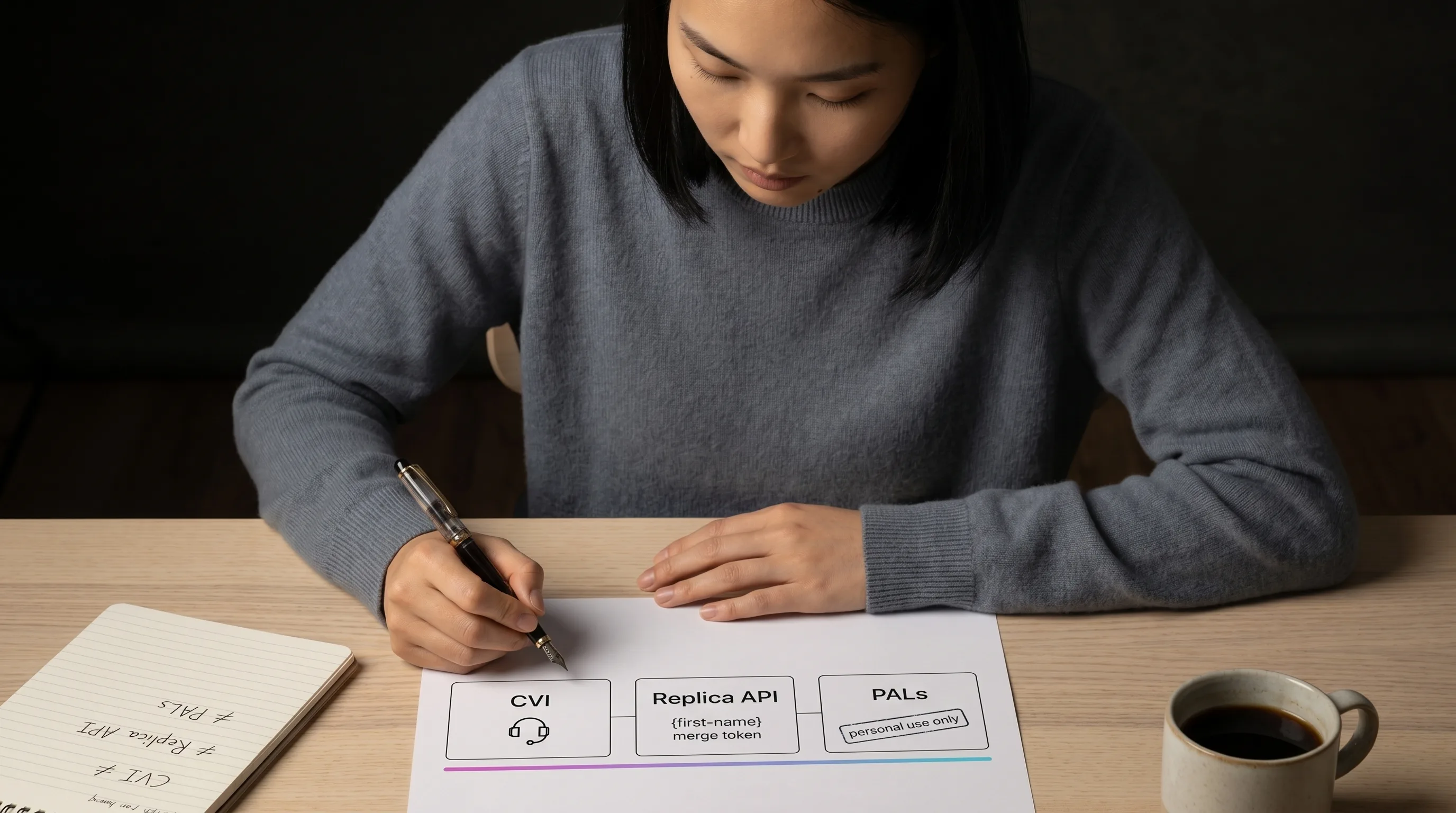
Tavus runs three distinct products under one brand and the “tavus alternative” SERP conflates them constantly. Disambiguating up front saves the reader 20 minutes on the wrong vendor page.
CVI (Conversational Video Interface) is real-time face-to-face AI conversation at sub-1-second latency. The stack is Raven (perception) + Sparrow (turn-taking) + Phoenix-3 (render). CVI is billed in 30-second minimum windows per session and is the right product for sales coaching, AI tutors, healthcare triage, and any workflow where the AI actor needs to listen and respond on a live call.
Replica API is the variable-token merge pipeline — CRM data flows in, 1:1 personalized async video clips render at outbound scale. The SDR records a Replica once from ~2 minutes of reference video (verbal consent required), pastes {first_name} and {company_name} into a script template, and the API ships a personalized clip per prospect. This is the product most “tavus alternative” searchers actually mean when they shop the category.
PALs (Personal Affective Links) are consumer emotionally-intelligent multimodal AI companions — text, calls, live video — for personal use only. The PALs Supplemental Terms phrase the limit verbatim: “You may use PALs solely for your personal, non-commercial use. Any use of PALs other than your personal, non-commercial use is unauthorized and prohibited.” Commercial 1:1 sales video runs through the Replica API on Starter+ tiers, not PALs.
The 7 Tavus alternatives at a glance
The matrix below ships the headline scorecard for the 7-vendor slate. Top row is character consistency by editorial convention. Each vendor block downstream carries the opening passage, the strengths acknowledgment, the honest concessions, and a bolded “Pick X if” verdict.
| Vendor | Rubric score | Pricing | Best for | Strongest axis | Weakest axis |
|---|---|---|---|---|---|
| Playcut | 8.13/10 | Hobby $9 / Pro $29 / Studio $79 (4 seats) / Agency $149 per seat | SDRs who need one rep’s face across stills, motion, UGC, on-product | Character consistency 9.5/10 + Multi-format 9.5/10 | Personalization-at-scale 5.5/10 |
| Tavus | 6.80/10 | Hobbyist $39 / Starter $59 / Growth $397 / Enterprise from ~$10K+/mo | B2B sales teams running scheduled 1:1 personalized video at 100+ named-account scale | Personalization-at-scale 10/10 + API+CRM 9.5/10 + lip-sync research lead (Hummingbird-0 + Phoenix-3) | Multi-format 4/10 (talking-head-first by design) |
| Vidyard | 6.63/10 | Free / Starter / Teams $99/user/mo / Enterprise + Video Agent +$24/seat | Teams mixing rep-recorded real-human video plus synthesized avatar in one HubSpot workflow | API+CRM 8.5/10 + Personalization-at-scale 8/10 | Per-seat economics climb fast at scale |
| HeyGen | 6.70/10 | Free / Creator $29 / Pro $49 / Business $149 + $20/seat / Enterprise1 | SMB multilingual talking-head buyers needing 175+ languages | Multilingual 10/10 | Multi-format 5.5/10 (talking-head register only) |
| Loom | 5.13/10 | Free / Business $18/seat / Business + AI $24/seat / Enterprise | Async screen-recording for prospect outreach with AI summaries — not synthesized avatar | Pricing 8/10 | Personalization-at-scale 0.5/10 (not AI-generated) |
| Synthesia | 5.83/10 | Basic Free / Starter $29 (annual $18) / Creator $89 (annual $64) / Enterprise | F500 procurement that gates on ISO/IEC 42001 plus signed DPA | Multilingual 9.5/10 | Multi-format 4.5/10 (talking-head register only) |
| Sendspark | 6.10/10 | Solo $49 / Growth $99 / Team $299 / Business $699 | SMB SDR teams wanting CRM-friendly personalized video at the cheapest serious entry | API+CRM 7.5/10 + Personalization-at-scale 7/10 | Pure talking-head register |
Hour One persists post-Wix acquisition (May 2025) but the Tavus-competitor positioning is fading; honorable mention only.
The 7 alternatives, ranked
Seven tools made the cut on the published 6-axis B2B sales-video rubric (consistency 25, multi-format 25, pricing 15, API+CRM 15, personalization-at-scale 15, multilingual 5). The ordering below is editorial. Playcut leads at #1 on multi-format actor consistency; Tavus takes the search-anchor slot at #2; Vidyard, HeyGen, Loom, Synthesia, Sendspark follow.
1. Playcut — Best Tavus alternative for multi-format B2B brand creative

Best-in-class character consistency — the same trained actor across stills, motion video, UGC ads, and on-product compositing (9.5/10 on our 8-shot consistency test, the only vendor in the slate above 7.5/10 across all four formats). Weighted score: 8.13.
Playcut is a chat-driven AI studio that ships one trained Actor across four formats from a single $29/mo Pro subscription (or $9/mo Hobby for solo testing). Face-cam talking-head, vertical UGC ad, on-product composite, and editorial still. No multi-tool stitching like the rest of the slate forces.

Strengths. The Playcut Actor Engine binds appearance, wardrobe, and brand-kit context into a persistent runtime profile that re-casts the same actor identically across every generation. That gives one rep’s face the four-format range Tavus, Vidyard, HeyGen, Synthesia, and Sendspark cap out at talking-head-only.
The 34-tool MCP server and the REST API ship free during open beta on every plan, including Hobby $9 and Pro $29. Bearer-token auth, 3-active-job concurrency cap, no per-second request limit. Multi-brand brand kits unlock on Agency $149/seat and let one agency operator hold separate visual identities per client without forking workspaces; single-brand kits ship on every paid tier.
Pricing math compounds. Pro $29 ÷ 10 custom Actors = $2.90 per Actor per month (parity with HeyGen Creator’s $29 sticker), against HeyGen Business $149 + 2 seats × $20 ÷ 5 Digital Twins = $33.80 per Actor (an 11.7× delta per the HeyGen alternatives ranking).
A voiced 10-second UGC clip is 85 credits — about $1.23 at Pro’s credit value — on the default fastest Act tier, and the model speaks the line itself, so there is no separate voice charge. Fifteen seconds on the plus tier is the longest single Act.
The Playcut Voice Engine clones from a 30-60-second consented sample and generates standalone speech across ten languages — it is never bound to an Actor, and Playcut ships no actor lip-sync.
Weaknesses (consolidated honest concession). Playcut scores 5.5/10 on personalization-at-scale because there is no native CSV-to-personalized-video bulk workflow and no native scheduled CRM-merge in the studio UI today. Tavus owns that wedge cleanly. Playcut scores 6.5/10 on API + CRM because the integration path is MCP + REST API + n8n / Zapier / Make orchestration only, with no native HubSpot, Salesforce, Outreach, or Apollo connectors.
The Voice Engine ships ten languages today, growing toward parity with HeyGen’s 175+ and Synthesia’s 160+, never claiming it. No native iOS app, no timeline editor. SOC 2 Type II is in audit, not certified, as of May 2026.
Pricing snapshot (v2, 2026-05-27). Hobby $9/mo ships 500 credits, 3 Actors, 1 voice, 1 seat. Pro $29/mo ships 2,000 credits, 10 Actors, 5 voices, 1 seat — parity with HeyGen Creator’s $29 sticker. Studio $79/mo bumps to 6,000 credits, 25 Actors, 10 voices, 4 seats ($19.75/seat — cheapest per-seat plan in the AI video category).
Agency $149/seat/mo ships 10,000 credits/seat with unlimited Actors and voices, multi-brand brand kits, raisable concurrency, and urgent queue. Hobby ships a 7-day full-feature trial, card required, cancel inside it at no charge; Pro, Studio, and Agency are charged at checkout.
Who it’s for. Priya the bootstrapped founder running her own outbound at 20-30 hand-curated prospects/week wins outright here, with one identity across LinkedIn banner, cold-video, 9:16 ad, and email signature on a Pro $29 card (or Hobby $9 if testing).
Linnea the CS manager scaling video-first renewals across 80 accounts × 4 QBRs/yr also lands here on Studio $79 at $19.75/seat. Start on Hobby’s 7-day trial at the Playcut AI Actors product page.
2. Tavus — Best for native CRM-webhook personalization at scale (Replica API)
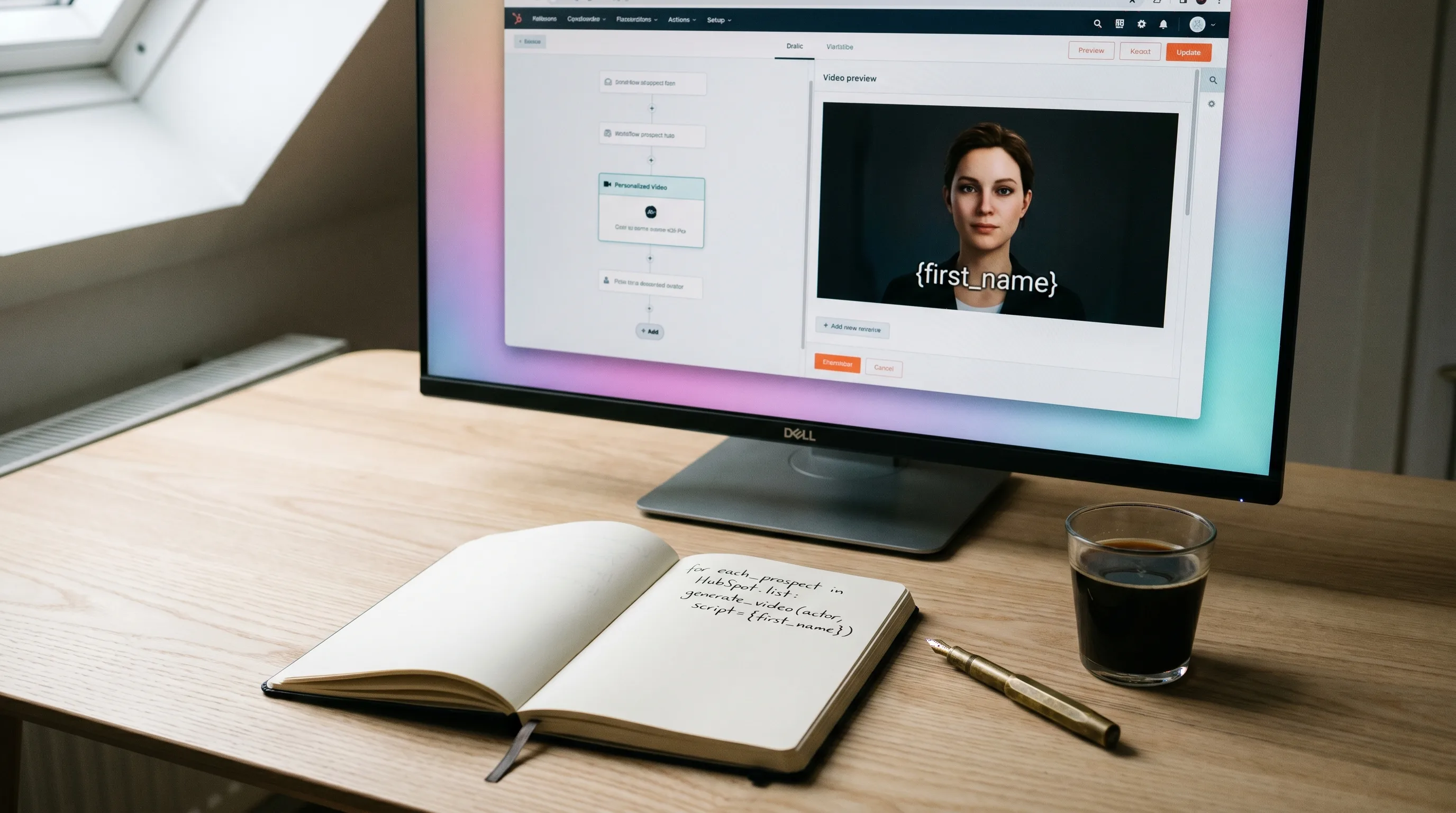
Tavus is the personalization-at-scale category leader for B2B sales video. Replica API renders 1:1 personalized clips from CRM data at outbound scale, with native HubSpot integration (HubSpot participated in the Series A), Phoenix-3 render, and Hummingbird-0 zero-shot lip-sync released April 24, 2025. Weighted score: 6.80.
Three products under one brand. Disambiguate before you evaluate. CVI (Conversational Video Interface) is real-time face-to-face AI conversation at sub-1-second latency built on Phoenix-3, Raven-0, and Sparrow-0, billed in 30-second minimum windows for sales coaching and healthcare triage.
Replica API is the variable-token merge pipeline that turns CRM data into 1:1 personalized async video at outbound scale, and is the product most SDR and RevOps readers actually want, per the Tavus Replica API docs and Tavus webhook docs.
PALs (Personal Affective Links) are consumer emotionally-intelligent AI companions, personal-use only per the PALs Supplemental Terms of Service: “You may use PALs solely for your personal, non-commercial use. Any use of PALs other than your personal, non-commercial use is unauthorized and prohibited.” Commercial 1:1 sales video runs through the Replica API on Starter+ tiers.
Strengths. Tavus is a Scale Venture Partners-backed Series A category-builder. CEO Hassaan Raza (ex-PwC machine learning) and co-founder Quinn Favret founded Tavus in 2020 and built the team through Y Combinator. The Replica API was built for one job and owns it: render a thousand personalized 30-second clips from a CRM CSV with name + company + first-line variable merge, wired into the sequence, with no orchestration layer required from the customer side.
Replica training runs from ~2 minutes of reference video — the fastest time-to-first-talking-head in this slate. Hummingbird-0 hits FID 63.92, LSE-D 6.74, and Arcface 0.84, posting 37%, 7%, and 7% gains over the closest competitor on Tavus’s benchmark dataset — the lip-sync research lead in the category.
SOC 2 Type 2, GDPR, and HIPAA are confirmed, with Mayo Clinic, CVS Health, and Aetna cited as customers, and the open-source Pipecat voice agent framework is a Tavus-led project.
Weaknesses. Tavus is talking-head-first by deliberate product design — stills, UGC ad creative, and on-product compositing sit outside the Replica API’s stated scope. That’s a focus, not a limitation; a brand-creative buyer who needs the rep’s face across four formats routes to a different vendor. On the multi-format axis as scored here, Tavus lands at 4/10.
The PALs commercial-use prohibition also catches buyers who confuse the consumer SKU with the sales-ops SKU. The Replica is bound to Tavus’s training pipeline with no portable model-artifact export.
Pricing snapshot. Tavus runs four tiers in 2026: Hobbyist $39/mo (25 conversational minutes, 3 Personal Replicas, personal-use only under the PALs Supplemental Terms), Starter $59/mo + PAYG (3 custom replica trainings, 100 conversational minutes), Growth $397/mo + PAYG (7 Personal Replicas, 500 conversational minutes), and Enterprise typically from a $10K+/month minimum (~$120K+/yr floor). CVI carries a 30-second minimum billing window per session.
Tavus closed an $18M Series A in March 2024 led by Scale Venture Partners, with Sequoia Capital, Y Combinator, and HubSpot participating per TechCrunch 2024-03-12. The HubSpot integration is confirmed via that investor relationship; broader native-connector coverage (Salesforce, Outreach, Apollo, Salesloft, Marketo, Pipedrive) is best confirmed direct with Tavus sales as of 2026-05-16.
Who it’s for. Maya the SDR at the 200-person SaaS in Austin lives here when her motion is named-account 1:1 outbound at 60+ prospects/week into Outreach with a HubSpot deal-card trigger (Starter $59 is her ceiling; Growth is her manager’s signoff). Jordan the RevOps architect at the 600-person fintech stays on Tavus for the CRM-event-triggered SDR sequence specifically, because rebuilding that workflow elsewhere is a sprint, not an afternoon.
3. Vidyard — Best for incumbent B2B video infrastructure + Video Agent on HubSpot
Vidyard is the closest direct B2B sales-video competitor to Tavus, with a different center of gravity. Real-human video recording for sales since 2014, with the Vidyard AI Avatars product layered in 2024 using Neural Radiance Fields (NeRF) technology. Weighted score: 6.63.
Strengths. Vidyard is the incumbent B2B video infrastructure: async video, screen-recording, per-prospect analytics, and CRM integration since 2014. AI Avatars layer on top of a mature HubSpot / Salesforce / Outreach / Apollo / Salesloft / Gong stack per the Vidyard 2025 Video in Business Benchmark Report. A decade of integration maturity on the webhook surface is real moat versus newer entrants.
The Video Agent add-on ships unlimited AI-powered video workflows that fire on buyer actions (meeting booked, form submitted, opportunity stage changed). It integrates with Salesloft, Salesforce, HubSpot, Marketo, and Outreach. SOC 2 Type II + GDPR are confirmed, with SSO, IP access controls, custom permissions, and password-protected videos on Enterprise.
Weaknesses. Per-seat economics climb fast: Teams at $99/user/month means a 10-person sales team pays nearly $12,000/yr per the Vidyard pricing breakdown before the Video Agent add-on. The Vidyard AI Avatars product is newer than Tavus’s Replica API and the multilingual language count is not publicly stated. Brand-creative surface is narrower than Playcut’s (talking-head avatar plus screen-record, not stills + on-product + UGC ad).
Pricing snapshot. Vidyard runs Free / Starter / Teams ($99/user/mo annual) / Enterprise as of 2026-05-16, with the Video Agent add-on at $24/seat/mo on top of any tier for unlimited AI-powered personalized video workflows.
Free ships 5 videos/month, up to 30 min each, with basic stock AI avatars and no CRM. All paid plans can create custom AI avatars for up to 15 videos; unlimited custom-avatar video creation requires the Video Agent add-on or Enterprise.
Who it’s for. Jordan the RevOps architect lands here when the consolidation pitch is “one tool for SDR async screen-record + AE recorded follow-up + CS renewal recap + marketing UGC dub, all on a HubSpot Sales Hub workflow.” Linnea the CS manager picks Vidyard when per-second view analytics for CS health scoring or a deep Gainsight bridge matter more than four-format brand-actor flex.
4. HeyGen — Best for 175+ language Avatar IV personalized video
HeyGen ships category-leading multilingual breadth: 175+ languages with native lip-sync via Avatar IV. Plus the Photo Avatar / Instant Avatar / Interactive Avatar product family and a SOC 2 Type II + GDPR + DPF + EU AI Act compliance stack. Weighted score: 6.70. Joshua Xu leads as CEO; Wayne Liang is co-founder and Chief Innovation Officer.
Strengths. HeyGen passed $100M ARR in 2025 per Sacra’s ARR research and ships category-leading multilingual breadth. 175+ languages with native lip-sync, the Photo Avatar / Instant Avatar / Interactive Avatar product family, and native HubSpot integration documented in the HeyGen × HubSpot personalized video tutorial.
The Personalized Video Generator (released 2024, expanded 2025) targets the same SDR ICP as Tavus with an avatar-first wedge rather than an API-first wedge. The Avatar IV API runs at $4/min. For SMB multilingual outbound at $29/mo entry where the script needs to ship in Spanish, Mandarin, Hindi, Arabic, and Tagalog in one batch, HeyGen is the default.
Weaknesses. Talking-head register only, with no stills primitive, no UGC primitive, and no on-product compositing. The Personalized Video CSV-upload UI is temporarily unavailable in the HeyGen web experience as of 2026-05-16 (per direct check of the HeyGen app); bulk personalization runs via API + Zapier / Make / Clay only, with {{variable_name}} as the merge syntax.
HeyGen’s core ICP is SMB multilingual creators and L&D-adjacent SMB teams, not Tavus-style B2B sales-ops with native CRM-webhook 1:1 outbound at scale.
Pricing snapshot. Free / Creator $29 / Pro $49 / Business $149 + $20/seat / Enterprise custom per the HeyGen pricing page live as of 2026-05-16. Footnote: prior third-party reviews and our own HeyGen alternatives ranking cite Pro at $99/mo; the $49 reading may be an A/B rotation, a regional experiment, or a recent price drop post-Team-tier-retirement in January 2026.
Who it’s for. Felix the sales engineer at the Berlin DevOps platform lands here when 175+-language dubbing on a recorded English demo recap is the gating axis (Japanese, French, German, Spanish, and Italian all ship first-rate).
Maya the SDR routes here over Tavus when her ICP is split EU + APAC and her sequence demands per-prospect language-localized voice. The dedicated HeyGen alternatives ranking covers HeyGen’s Personalized Video Generator compared head-to-head for SMB multilingual buyers.
5. Loom — Best for async screen-record + face-cam (NOT AI-generated)
Loom is an async screen-recording tool acquired by Atlassian in October 2023 for $975M, not an AI-avatar generator. AI features (auto-titles, transcript summaries, chapters, filler-word removal) layer on top of recorded video; they do not generate a replica or synthesize a face. Weighted score: 5.13. Loom is included because it’s the workflow Tavus is trying to displace.
Strengths. Loom is part of Atlassian’s collaboration suite via the $975M acquisition completed November 30, 2023 and remains the prevailing async-video benchmark every Tavus buyer triangulates against. The SDR who has not yet adopted AI personalization is recording a Loom today and pasting the link into a HubSpot sequence.
The product wins on simplicity, the integration surface is Atlassian-grade across Jira, Confluence, and Slack, and the free tier is the lowest-friction onboarding in async B2B video. Loom reports 25M users, 200K paying customers, and roughly 5M videos created per month at the time of the Atlassian acquisition.
Weaknesses. No variable-token merge, no CSV-to-bulk-personalization, and no native replica synthesis, which is why Loom scores 0.5/10 on personalization-at-scale (no synthesized identity exists to personalize).
The buried labor cost matters: a blended SDR at $50/hour spending 5-10 minutes per personalized Loom across 200 clips/mo runs $800-$1,650/mo in human time that AI-generation tools recover. Pretending the cost-per-clip is “$0 because the tool is included” misses the rep-time tax.
Pricing snapshot. Free (25 videos, 5 min each) / Business $18/seat/mo (annual $12.50) / Business + AI $24/seat/mo / Enterprise custom (benchmark cited: ~$138K/year for ~510 users). Annual billing saves about 17%. Post-acquisition, Loom ships Jira + Confluence native integration; the free Creator Lite role was discontinued and Creator Lite users were auto-upgraded to paid Creator.
Who it’s for. Felix the sales engineer keeps Loom Business in his stack permanently for the screen-record portion of every technical-demo recap. Playcut handles the generated face-cam, still, and intro/outro layer alongside. Maya the SDR uses Loom for un-personalized recorded outreach today and triangulates Tavus, Sendspark, or Playcut as the AI-generation upgrade path when reply-rate lift justifies the new tool.
6. Synthesia — Best for enterprise L&D with ISO 42001 procurement gates
Synthesia closed a $4B Series E in January 2026 and runs the deepest compliance stack in the AI avatar category. ISO/IEC 42001 (world-first AI management-system certification, September 2024), SOC 2 Type II, ISO 27001, GDPR with a published DPA, and EU AI Act conformity. Weighted score: 5.83. 160+ languages and voice cloning on every tier, including Basic Free.
Strengths. Synthesia is the procurement-grade pick of the slate. The AI Copyright Pledge ships vendor-side indemnification language that the F500 procurement reader recognizes immediately. The ISO 42001 world-first attestation clears Fortune 500 procurement today.
160+ languages with voice cloning across every paid tier including Basic Free. The Personal Avatar count ladders Basic 3 / Starter 3 / Creator 5 / Enterprise unlimited. The compliance stack is the entire structural pitch — Synthesia’s product is “an avatar your CISO can sign off on.”
Weaknesses. Talking-head register only, with no CRM-native sequence-merge, because Synthesia’s product surface assumes L&D and corporate-comms motion rather than SDR outbound at scale. Per-finished-clip economics fall behind Tavus and Sendspark on the 1:1 personalized B2B sales-video job, and the compliance moat is precisely what the Tavus reader did not prioritize on first evaluation.
Pricing snapshot. Basic Free / Starter $29/mo monthly billed ($18/mo annual) / Creator $89/mo monthly billed ($64/mo annual) / Enterprise custom. Series E $200M raised at a $4B valuation in January 2026. Voice cloning available across all tiers from Basic through Enterprise.
Who it’s for. Jordan the RevOps architect at a regulated-industry sub-org (banking outbound, healthcare patient comms, insurance) routes here when procurement gates on signed DPA + ISO 27001 + ISO 42001 before any video tool clears legal. The dedicated Synthesia alternatives ranking covers procurement-grade L&D and sales-video adjacencies in depth.
7. Sendspark — Best for SMB SDR-personalization with HubSpot/Outreach
Sendspark ships personalized B2B sales video at the smallest serious paid entry in the slate. Solo $49 / Growth $99 / Team $299 / Business $699. Weighted score: 6.10. The product workflow mirrors Tavus on a narrower SKU: record one base video, import a contact list, generate thousands of AI-personalized versions with the prospect’s name spoken aloud and their company URL as the dynamic background.
Strengths. Sendspark is the cheapest CRM-friendly entry on this list for the SDR-personalization wedge, with name-token merge built for SDR motions specifically and native HubSpot / Salesforce / Outreach / Salesloft connectors.
The product is genuinely simple to adopt (record a quick video, paste a variable, send into the sequence) without the engineering setup Tavus’s full Replica API workflow asks of you. Sendspark’s domain at blog.sendspark.com/tavus-alternatives ranks for Tavus-alternative queries today, which is itself a real B2B-SDR signal.
Weaknesses. Pure talking-head register, with no on-product, no UGC ad creative, and no editorial stills. The Solo $49/mo tier ships only 100 Dynamic Video Minutes for one user, so per-Dynamic-Video-Minute overage compounds fast for a Maya-archetype SDR at 60 prospects/week. There is no Free tier anymore: the old $15/mo Starter and $49/mo Rapid tiers were retired in 2026.
Pricing snapshot. Sendspark restructured pricing in 2026: Solo $49/mo (1 user, 100 Dynamic Video Minutes), Growth $99/mo (full API + AI variables + agentic workflows), Team $299/mo (10 seats), Business $699/mo (25 seats, 3,000 minutes). 20% off on annual (Solo $39 / Growth $69 / Team $179).
Who it’s for. Maya the SDR at the 200-person SaaS routes here when her self-serve ceiling is $99/mo and her job is one-rep variable-merge into an Outreach sequence. Growth at $99 ships the full API + AI variables surface at less than a quarter of Tavus Growth.
Priya the founder picks Sendspark only if her growing prospect list crosses into 200+/week and she needs first-name merge as a hard requirement; otherwise Playcut Pro $29 (parity with HeyGen Creator’s $29 sticker, 10 actors) keeps the multi-format identity job intact.
Pick the right alternative in 30 seconds
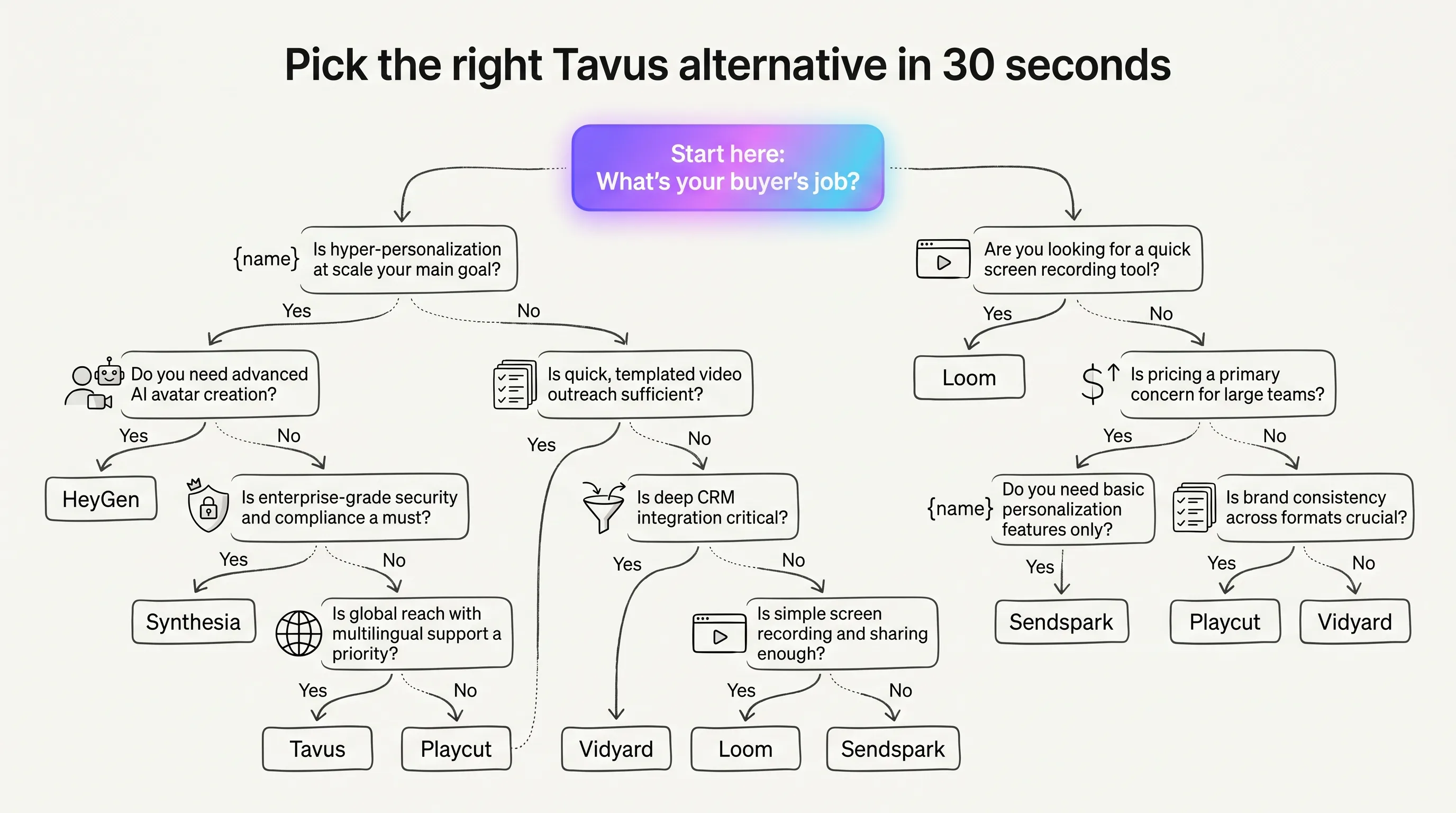
The fast version: answer 5-7 questions in order, and the decision tree routes you to one of seven terminals. There is no universal winner. There is your winner for your motion, your stack, and your budget ceiling.
- Job: native CRM-triggered 1:1 personalized video at 100+ named-account scale.
- HubSpot/Salesforce/Outreach/Apollo trigger and no engineering bandwidth → Tavus (Replica API on Starter $59+).
- Team also wants real-human screen-record + face-cam in one HubSpot Sales Hub workflow → Vidyard (Teams $99/user + Video Agent +$24/seat).
- SDR ceiling is $99/mo with native HubSpot, Outreach, or Salesloft → Sendspark Growth $99.
- Job: multi-format brand creative, same actor across stills, motion, UGC ads, and on-product compositing.
- $9-$79/mo budget → Playcut (Hobby $9 for solo testing, Pro $29 for 10 actors — parity with HeyGen Creator’s $29, or Studio $79 for 4 seats at $19.75/seat).
- Script needs to ship in 100+ languages with native lip-sync.
- SMB or agency volume → HeyGen (Creator $29 or Pro $49).
- F500 procurement gates on ISO 27001 / ISO 42001 / signed DPA before anything clears.
- Route to Synthesia (Starter $29 monthly, Creator $89 monthly).
- Job: async screen-record + face-cam with AI summaries, not synthesized avatar.
- Route to Loom (Business $18/seat or Business + AI $24/seat).
| Use case | Pick | Runner-up | Why |
|---|---|---|---|
| Bootstrapped founder, 20-30 hand-curated prospects/week, one identity across 8 channels | Playcut Pro $29 | Sendspark Solo $49 | 10 actors + multi-format flex at parity with HeyGen Creator’s $29; Sendspark gives up stills + UGC + on-product |
| SDR at 200-person SaaS, 60-150 personalized clips/week into Outreach, $59 ceiling | Tavus Starter $59 | Sendspark Growth $99 | Replica API + native CRM triggers; Sendspark wins if multi-rep |
| RevOps consolidating SDR + AE + CS + marketing UGC into one HubSpot workflow | Vidyard Teams + Video Agent | Playcut Studio $79 | Decade-mature CRM integration surface; Playcut wins on brand-actor flex (25 actors, 4 seats at $19.75/seat) |
| CS manager scaling video-first renewals across 80 accounts × 4 QBRs | Playcut Studio $79 | Vidyard Teams | Multi-format per QBR at $19.75/seat across 4 seats; Vidyard wins if Gainsight-native matters |
| Sales engineer recording 7-min technical demo recaps with multilingual dub | Playcut + Loom (2-tool stack) | HeyGen Pro $49 | Playcut generates face-cam + still + intro/outro; Loom keeps screen-record |
| Multilingual SMB outbound across EU + APAC + LATAM | HeyGen Creator $29 | Synthesia Starter $29 | 175+ languages on HeyGen; Synthesia wins if compliance gates |
| Regulated-industry banking, healthcare, or insurance outbound | Synthesia Enterprise | Tavus Enterprise | ISO 42001 + signed DPA; Tavus ships SOC 2 + HIPAA but not ISO 42001 |
| 1,000+ personalized clips on Tuesday morning from a CRM CSV | Tavus Growth $397 | Sendspark Team $299 | Replica API was built for this single job; Sendspark scales for SMB volume |
| Async screen-record + face-cam for prospect outreach, no AI generation | Loom Business $18/seat | Vidyard Free | Atlassian-grade integration surface; Vidyard wins on per-prospect analytics |
| Solo SDR, $99/mo ceiling, native Outreach + HubSpot triggers | Sendspark Growth $99 | Tavus Hobbyist $39 | Full API + AI variables at Growth; Tavus Hobbyist gates commercial use |
If you’re switching from Tavus, here’s where you actually go
Most teams running Tavus add Playcut for the multi-format coverage Tavus doesn’t ship (stills, UGC ads, on-product compositing) rather than full-migrating. Keep Tavus running the CRM-event-triggered 1:1 outbound sequence and add a second tool for the format Tavus structurally cannot render. For Maya at the 200-person SaaS, that second tool is Playcut Pro $29, with one identity across four formats on a single card (parity with HeyGen Creator’s $29 sticker).
For Jordan at the 600-person fintech, the second tool is Playcut Studio $79 across the marketing, CS, and AE pods at $19.75/seat (4 seats included), with Tavus Growth held on the SDR pod through annual renewal. The teams that fully migrate fall into two buckets. First: the multi-format-flex buyer whose actual job was never CRM-native personalization to begin with (Priya, Linnea, Felix).
Second: the SDR team that quietly stopped using Tavus because the Hobbyist 25-conv-min cap or the Starter $59 + PAYG ladder out-priced the actual outbound volume. Sendspark Growth $99 is the honest CRM-friendly downgrade at half the operational cost. Teams that should NOT migrate are the ones whose entire SDR motion runs through a Tavus → Outreach → HubSpot webhook chain at 500+ clips/mo.
Rebuilding that orchestration on n8n, Zapier, or Make plus Playcut REST + MCP is a real sprint, not an afternoon. If your eng team is booked through Q4, stay on Tavus through renewal and pilot one pod on Playcut Studio $79 for 90 days.
The decision-tree terminal that matters most is the one buyers under-weight: the job most SDR teams are actually being asked to do is multi-format brand creative on one trained identity, not 1:1 personalized variable-merge at outbound scale.
How to migrate from Tavus to Playcut
A 3-to-6-rep SDR team shipping ~500-2,000 personalized clips per month should plan ~3 weeks elapsed and ~3-4 working days of hands-on time. Run it as a 30-day overlap rather than a hard cutover.
The two highest-friction steps are rebuilding CRM-webhook automation and re-establishing identity. Tavus ships native HubSpot integration plus REST + webhooks for broader CRM wiring; Playcut routes CRM events through an orchestration layer. Tavus Replicas don’t export; the rep gets re-cast as a Playcut Actor with re-recorded consent.
The 12 steps below ship in HowTo-schema form. Each step holds an imperative name, the why, the action in Playcut, time required, the pitfall, and a success check.
Step 1 — Audit your current Tavus footprint
Document trained Replicas, monthly minutes rendered, CRM automations and their triggers, and the CVI / Replica API / PALs usage split. Plan ~1 hour (half-day for multi-rep RevOps); done when you have a one-page audit sheet with one sentence per trigger.
Pitfall. Skipping the connector inventory and discovering three weeks in that an AE-handoff Sequence still fires a forgotten Tavus video.
Step 2 — Decide hybrid versus full cutover
Tavus-driven CRM sequences are live revenue motion. Stay on Tavus for in-flight CRM-triggered SDR sequences during a 30-day overlap window; move to Playcut immediately for net-new brand content (case studies, AE thank-yous, multi-format launch). Done when there’s a written split naming who owns what until the cutover date.
Pitfall. Half-migrating both motions in parallel so reps don’t know which tool to open today.
Step 3 — Export the assets you can keep
In Tavus, bulk-download finished MP4s, save scripts as .txt or .srt, and keep the original training video uploaded for each Replica. Done when a Drive or S3 folder holds every keeper MP4, every script, and every original training video.
Pitfall. Assuming the trained Replica itself is exportable. It isn’t; Tavus does not export model artifacts.
Step 4 — Re-cast the Replica as a Playcut Actor
The Playcut Actor Engine binds appearance, wardrobe, and brand-kit context into a persistent runtime profile that re-casts identically across stills, motion, UGC ads, and on-product. Open chat at app.playcut.ai and prompt: “Generate a reference shoot for a new Actor. Front, three-quarter, side, full-body in neutral north-window light. Name: [Rep Name].” Done when three test generations across three registers return the same face at 9.5/10 consistency.
Pitfall. Setting up the Actor for talking-head only and wasting the multi-format moat.
Step 5 — Re-record voice consent under Playcut’s terms
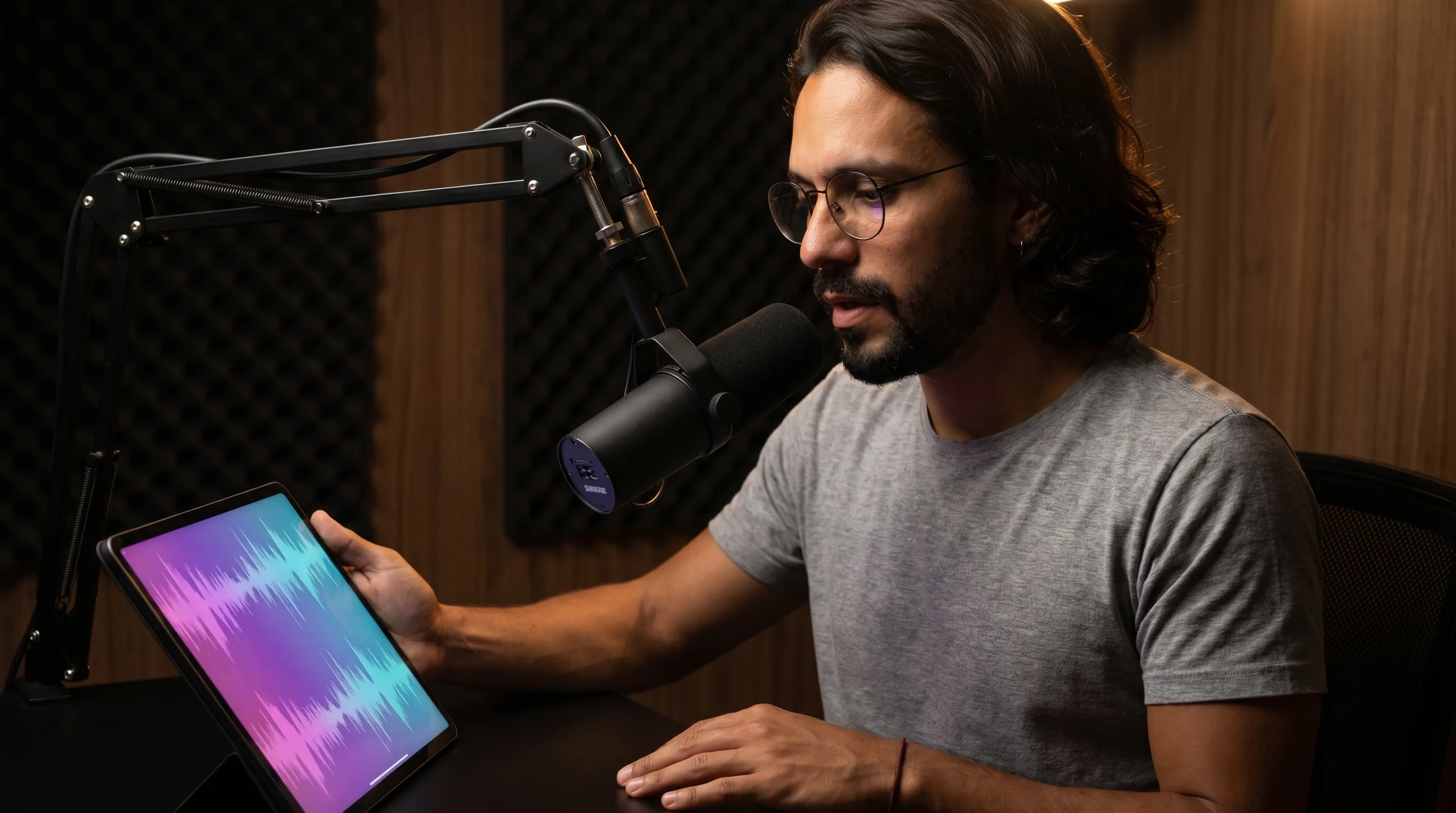
The Tavus consent recording names Tavus and does not legally cover synthesis on a different platform. Have the rep record in a quiet room: “I consent to Playcut cloning my voice for content I create on the Playcut platform on today’s date.” Upload 30-60 seconds to the Voice Engine (clone from audio, 5 credits).
The clone is a standalone library asset for text-to-speech — Playcut Actors carry no voice field, so nothing gets bound. Done when a test TTS returns the rep’s voice at recognizable fidelity.
Pitfall. Re-using the Tavus consent recording. It names the wrong platform and exposes you legally.
Step 6 — Rebuild CRM integration on an orchestration layer
This is the structural concession. Playcut ships REST plus a 34-tool MCP server free on every plan, but no native HubSpot, Salesforce, Outreach, Salesloft, or Apollo connectors.
In n8n, Zapier, or Make: subscribe to the CRM webhook, interpolate merge fields into a chat prompt, call the actor-act tool at POST /api/v1/tools/actor-act/execute with bearer-token auth, poll get-task-status, and write the asset URL back to the contact. Done when a test CRM event returns the asset within timeout.
Pitfall. Expecting outbound webhooks. Playcut does not document them today; polling is the supported pattern.
Step 7 — Translate Tavus templates into Playcut prompts
Tavus templates are GUI artifacts bound to Tavus’s UI; Playcut runs on a chat surface that accepts free-text prompts. For each recurring template, write the equivalent chat prompt — actor name, length, lighting, aspect ratio, and the script with merge tokens. Save each as a reusable workspace snippet so reps don’t recompose every send. Done when every recurring Tavus template has a documented Playcut equivalent in a shared workspace folder.
Pitfall. Naming a scene-generation backend inside the prompt text itself. Pick the model in the picker; keep the prompt about the output you want.
Step 8 — Pilot-test by re-generating your top 3 videos
Before committing to a cutover date, prove the most-used outputs survive the round trip.
Pick the 3 highest-volume Tavus videos from the last 30 days; re-generate each using the prompts from Step 7 and the Actor from Step 4, writing the rep’s line into the prompt for the video model to speak; send both versions to two internal reviewers blind. Done when reviewers can’t reliably tell the two apart, or prefer the Playcut versions on most axes.
Pitfall. Skipping the blind review and over-weighting Tavus because that’s what your eye is trained on.
Step 9 — Plan the CRM-webhook gap honestly
Tavus’s moat is native CRM webhooks; Playcut’s strength is multi-format identity. For every CRM-triggered automation in the audit, pick one of three dispositions: rebuild on the orchestration layer per Step 6 with a sprint date, trigger manually for low-volume motions, or leave it on Tavus indefinitely. Done when every automation has a documented disposition with a rebuild date or a renewal-review trigger.
Pitfall. Pretending you’ll rebuild “later.” If it’s not on a sprint, it won’t ship.
Step 10 — Stand up the workspace, brand kits, and seats
Playcut Studio ($79/mo, 4 seats at $19.75/seat, 25 actors) and Agency ($149/seat/mo, unlimited actors with multi-brand brand kits) ship the team workspace surface.
Invite the SDR team and RevOps owner; create a brand kit per brand you sell into (colors, typography, logo, voice, doSay, dontSay) — multi-brand requires Agency; create a Team folder named “SDR outbound — [Brand]” per brand. Done when a test generation in each brand folder picks up the right tone and color without re-prompting.
Pitfall. Defaulting everyone to one shared kit when you sell into multiple verticals.
Step 11 — Sunset the Tavus subscription
Re-audit per Step 1 to confirm no in-flight CRM sequences still depend on Tavus. Export final assets, download invoices for accounting, screenshot the final Replica library for legal, and cancel per Tavus’s billing terms. Done when reps confirm they’re not opening Tavus for any active workflow.
Pitfall. Cancelling before the overlap window genuinely closes. A long-cycle deal mid-sequence on day 28 loses its personalized touchpoint if you cancel on day 30.
Step 12 — Run the 30 / 60 / 90-day post-migration audit
Migrations rot — reps drift back to old workflows and CRM integrations break silently. Calendar three reviews: day 30 to check the cutover held, day 60 to check orchestration stability, day 90 to compare reply-rate, open-rate, and pipeline-influence metrics against the Tavus baseline. Done when a day-90 decision is documented: stay on Playcut, return to Tavus for the CRM motion, or run hybrid permanently.
Pitfall. Treating any metric drop as a migration failure without isolating the variable. Reply rates move with season, list quality, and offer.
Week 0 → Week 12 timeline
| Week | Phase | Hands-on work | Cumulative status |
|---|---|---|---|
| Week 0 | Audit + decision | Steps 1-2 (~1.5 hours) | Inventory complete; overlap mode confirmed; CRM motion stays on Tavus; brand content moves to Playcut. |
| Week 1 | Asset + identity rebuild | Steps 3-5 (~2-3 hours per rep) | Tavus exports in S3; Actor re-cast in Playcut; standalone voice clone saved to the Voice Engine; consent re-recorded under Playcut. |
| Week 2 | Orchestration + template translation | Steps 6-7 (~1-2 days for one CRM, plus mapping) | One CRM integration rebuilt on n8n/Zapier/Make; templates documented as Playcut prompts. |
| Week 4 | Pilot + workspace + sunset | Steps 8-11 (~half-day total) | Top 3 videos blind-reviewed; workspace + brand kits live; Tavus subscription cancelled at day 30. |
| Week 8 | First post-migration review | Step 12 review #1 (~1 hour) | Day-30 audit complete; orchestration hygiene checked; metrics compared to Tavus baseline. |
| Week 12 | Second review | Step 12 review #2 (~1 hour) | Day-60 audit; reps surveyed; orchestration drift fixed; any stay-on-Tavus motions formally decided. |
When NOT to migrate — 8 red flags
Eight conditions where the honest call is to stay on Tavus, run hybrid permanently, or route the workload elsewhere.
- CRM-webhook engineering bankruptcy. If your entire SDR motion is CRM-event-triggered Tavus videos and you have no engineering capacity to wire a webhook handler, stay on Tavus. Playcut ships REST + MCP but not native one-click CRM connectors; the rebuild requires orchestration work.
- Regulated-industry procurement gating on ISO 42001. Playcut’s compliance posture as of May 2026 is SOC 2 Type II in audit (not certified), with ISO 27001 and ISO 42001 not yet certified. Route procurement to the dedicated Synthesia alternatives ranking for F500 procurement.
- Active Tavus CVI deployments. Playcut does not ship real-time conversational video today. Sales coaching, AI tutors, and healthcare triage running on Tavus CVI’s sub-1-second-latency stack should stay there.
- 5,000+ CSV-to-bulk-personalized-video batches in non-technical hands. Playcut supports the workflow through the orchestration layer, not as a first-party studio-UI template-variable feature.
- Hard dependency on Tavus outbound webhooks. Playcut does not document outbound webhooks today; the supported pattern is polling
get-task-statusorwait-for-task. - Mobile-first iOS capture and review. Playcut has no iOS app. The studio is web-based at app.playcut.ai. Validate the workflow before committing.
- 100+ languages with native lip-sync required. Playcut has no lip-sync in its actor pipeline — you write the line in the target language and the video model performs it — and the standalone Voice Engine covers ten languages, far fewer than HeyGen’s 175+ or Synthesia’s 160+. If outbound runs hot in Tagalog or Hausa, validate coverage first.
- Active annual Tavus contract with months remaining. Run the contract out; migrate at renewal. Engineering hours, retraining, and pipeline-risk insurance during overlap are real costs.
Pricing math — what each vendor really costs at 30 / 200 / 1,000 personalized videos per month
Three use cases. Solo founder at 30 clips/mo: Vidyard Free + Video Agent ($24/seat) or Tavus Starter $59/mo. Small SDR team at 200 clips/mo: Sendspark Growth $99 ($0.79/clip pure 1:1) or Playcut Studio $79 plus credit packs ($1.29/clip with orchestration) for multi-format.
Mid team at 1,000 CRM-triggered clips: Sendspark Team $299 ($0.54/clip talking-head), Playcut Agency × 5 at $745 plus packs ($1.20/clip multi-format), Tavus Growth $397 + PAYG ($1.90-$3.40/clip no-engineering CRM).
Every $ below cites a primary vendor URL fetched 2026-05-16. Seat assumptions and the CRM-orchestration tax are disclosed in the footnotes after Use Case 3.
Solo founder or SDR — 30 personalized videos per month
One actor, one language, HubSpot trigger, 30-45-second clips.
| Vendor | Required plan | $/mo | $/personalized clip |
|---|---|---|---|
| Tavus | Starter | $59 | $1.97 (Replica API + native HubSpot trigger) |
| Vidyard | Free + Video Agent add-on | $24 ($0 + $24/seat) | $0.80 lowest $/clip if Free-tier 5-video cap fits; Teams + Video Agent at $123/seat lands at $4.10/clip |
| HeyGen | Creator | $29 | $0.97 base, no native HubSpot trigger at Creator |
| Synthesia | Starter (annual) | $18 | $0.60 base, no native HubSpot trigger |
| Sendspark | Solo | $49 | $1.93 (Dynamic Video Minutes within Solo’s 100-min cap) |
| Loom | Business annual | $12.50 | rep-time: $50/hr × (30 × 7 min) = $175/mo + $12.50 = $6.25/clip all-in |
| Playcut | Pro | $29 + $9 pack | 30 × 10-sec voiced UGC at 85 cr = 2,550 credits; Pro’s 2,000 plus one Small pack = $38 ÷ 30 = $1.27; Act caps at 10s on the default tier, 15s overall; needs +$20-50/mo orchestration for HubSpot trigger; 10 actors at $2.90/actor (parity with HeyGen Creator’s $29) |
Honest concession. Tavus Starter at $59/mo and $1.97/clip is editorial #2 for the solo CRM-native motion — native Replica API without orchestration work. Vidyard’s Free + Video Agent path is cheapest if the 5-video Free cap fits; once volume scales, Teams at $99/seat + Video Agent is the supported tier.
Tavus is cheaper per clip than Playcut on the pure-1:1 talking-head register where the rep’s face is the asset and a HubSpot trigger is non-negotiable.
Small SDR team — 200 videos per month
3-5 seats, 1-2 actors, 1-2 languages, HubSpot + Outreach, 45-60-second clips.
| Vendor | Required plan | $/mo | $/personalized clip |
|---|---|---|---|
| Tavus | Growth (covers multi-rep usage cleanly) | $397 + PAYG | ~$1.98 + PAYG (per-seat licensing not publicly itemized) |
| Vidyard | Teams × 4 seats + Video Agent | $492 (($99 + $24) × 4) | $2.46 |
| HeyGen | Business + 1 extra seat (base subscription) + Avatar IV API at $4/min for bulk personalization | $169 base + ~$400 API (200 × 30s @ $4/min) | $2.85 all-in |
| Synthesia | Creator | $89 ($64 annual) | does NOT fit 30 min/mo cap; forces Enterprise (custom) |
| Sendspark | Growth | $99 + overage | $0.79 ← lowest $/clip pure 1:1 |
| Loom | Business + AI × 4 seats | $80 | rep-time: $50/hr × (200 × 7 min ÷ 60) = $1,167/mo + $80 = $6.24/clip all-in |
| Playcut | Studio | $79 + $148 packs + ~$30 orchestration | 200 × 10-sec voiced UGC at 85 cr = 17,000 credits; Studio’s 6,000 plus 11,200 in packs = $257 ÷ 200 = $1.29 + 25 custom actors, 4 seats at $19.75/seat (cheapest per-seat plan in category), watermark-free, Voice Engine across ten languages |
Sendspark Growth at $99/mo and $0.79/clip lands the lowest $/clip on the pure-1:1 outbound math. Playcut Studio at $79/mo plus ~$30 orchestration covers everything outside the pure-talking-head register: UGC ads, on-product stills, 25 custom actors, 4 seats at $19.75/seat. Different brief, different vendor. (Multi-brand brand kits route to Playcut Agency $149/seat.)
Mid team plus RevOps — 1,000 CRM-triggered videos per month
10+ seats, 3+ actors, 2-3 languages, HubSpot + Outreach + Apollo.
| Vendor | Required plan | $/mo | $/personalized clip |
|---|---|---|---|
| Tavus | Growth + Enterprise PAYG | $1,900-$3,400 ($397 base + PAYG) | $1.90-$3.40 (no-engineering CRM path) |
| Vidyard | Teams + Video Agent × 10 seats | $1,230 | $1.23 (full CRM stack + per-rep analytics) |
| HeyGen | Business + 9 extra seats + Avatar IV API at $4/min | $329 base + ~$2,000 API (1,000 × 30s @ $4/min) | $2.33 all-in (talking-head; no native HubSpot trigger; +$50-200/mo orchestration) |
| Synthesia | Enterprise | est. $1,500-$4,000+ | $1.50-$4.00 — F500 compliance, not sales-personalization-at-scale |
| Sendspark | Team | $299 | 1,000 × 60-sec at $0.24/min = $240 + $299 = $539 ÷ 1,000 = $0.54 ← lowest $/clip pure talking-head |
| Loom | Business + AI × 10 seats | $200 | rep-time $5,833/mo + $200 = $6.03/clip all-in (not competitive at scale) |
| Playcut | Agency × 5 seats | $745 + $455 packs | 1,000 × 10-sec voiced UGC at 85 cr = 85,000 credits; 50,000 pooled plus 35,000 in packs = $1,200 ÷ 1,000 = $1.20/clip + multi-format (1:1 + UGC + on-product + carousel) + multi-brand kits; +$50-200/mo orchestration; +$2K-8K one-time CRM-bridge engineering |
Three winners, three different jobs. Pure-talking-head 1:1 outbound only: Sendspark Team at $299/mo and $0.54/clip lands lowest $/clip. Multi-format mandate (1:1 + UGC + on-product + carousel ad): Playcut Agency × 5 at $745/mo plus $455 in credit packs, $1.20/clip with the only cross-format actor identity in the slate, plus multi-brand kits at unlimited seats.
CRM-triggered automation with zero engineering: Tavus Growth at $397/mo plus PAYG at $1.90-$3.40/clip wins the no-rebuild path. F500 procurement: Synthesia Enterprise is the only ISO 42001 + SOC 2 + EU AI Act stack.
Tavus wins per-personalized-video on pure 1:1 outbound where the rep’s face IS the asset and zero engineering is acceptable. Playcut wins when “personalized” expands to multi-format and the buyer absorbs a one-time orchestration build. Choose by which sentence describes your roadmap.
Footnote — seat counts. Solo = 1 seat. Small SDR team = 4 paid seats (Tavus Growth covers multi-rep at the published tier; Vidyard Teams × 4; HeyGen Business covers 5; Sendspark Growth flat; Playcut Studio $79 covers up to 4 seats at $19.75/seat — cheapest per-seat plan in the AI video category). Mid team = 10 paid seats.
Footnote — HeyGen Pro pricing drift. HeyGen Pro on the live heygen.com/pricing page returned $49/mo on 2026-05-16, a drop from the $99/mo cited across the dedicated HeyGen alternatives ranking and prior 2026 reviews. This may be an A/B rotation or a recent price drop post-Team-tier retirement.
Footnote — the CRM-orchestration tax. Vendors without native HubSpot, Salesforce, or Outreach connectors (Playcut, HeyGen Creator/Pro, Synthesia Starter/Creator) need an orchestration layer: n8n self-hosted free, n8n Cloud Starter $20/mo, Zapier Pro $30/mo, or Make Pro $16/mo.
The first integration adds 4-12 hours of engineering; a 3-integration stack lands at $2,000-$8,000 one-time at $150-$300/hr blended agency rates. Tavus (HubSpot native), Vidyard Teams+, and Sendspark Growth+ absorb this cost into base pricing.
Common pitfalls when switching from Tavus
Eight failure modes the SDR or RevOps reader hits in the first 90 days of a Tavus → Playcut migration. Three are open Playcut concessions, not FUD — naming them is the point of an honest pitfalls section.
The CRM-webhook engineering tax
Hits Jordan (RevOps Manager at a 600-person fintech) hardest. Tavus ships native HubSpot integration plus REST + webhooks for broader CRM wiring; Playcut ships REST plus a 34-tool MCP server but no native one-click CRM connectors today.
Cost: 4-12 hours of engineering per integration, plus $20-50/mo in orchestration software, or $2,000-$8,000 one-time at agency rates for a 3-integration stack. Scope the orchestration layer into the migration sprint at Step 6 — never leave it to “later.”
The PALs commercial-use trap
Hits Maya and Priya when they grab a cheap-looking Tavus Hobbyist seat thinking PALs cover outbound. Per the PALs Supplemental Terms of Service: “You may use PALs solely for your personal, non-commercial use. Any use of PALs other than your personal, non-commercial use is unauthorized and prohibited.”
Cost: ToS breach risk on every outbound clip, plus re-procuring under a Starter+ Replica API tier mid-campaign. Route commercial 1:1 video through Replica API on Starter ($59/mo) or higher from day one.
The Tavus tier-jump shock
Hits Priya (solo founder) when monthly Replica API usage outgrows Starter $59 and the next real tier is Growth at $397/mo — a 6.7× jump with no intermediate step. Cost: ~$338/mo of unbudgeted spend right when a SDR experiment becomes repeatable. Avoid it by modeling 3 months of expected conversational minutes against the 100 min/mo Starter cap before signing.
The Loom-isn’t-AI confusion
Hits Maya and Linnea when they shop “Tavus alternatives” and find Loom on a comparison list. Loom is async screen-record plus face-cam, acquired by Atlassian in October 2023 for $975M. AI features (auto-titles, summaries, chapters, filler-word removal) layer on top of recorded video; they don’t synthesize a face. Avoid the wasted pilot quarter by separating async-recording tools from AI-generation tools at the first cut.
The bulk-CSV-personalization gap
Hits Jordan when his RevOps motion needs “1,000 personalized videos from a CSV upload by Friday.” Playcut ships no native CSV-to-1,000-videos workflow in the studio UI today, and there is no batch tool on the MCP server — the 34 tools are per-generation calls your orchestration layer loops over.
The work moves to the orchestration layer: 4-8 hours of build for the first bulk run, then negligible per subsequent run. Scope it into the same Step 6 sprint as the CRM-webhook work.
The Replica training-time misexpectation
Hits Felix (Sales Engineer at a Berlin DevOps platform) when he reads “~2-minute reference video” on the Tavus pricing page and assumes that’s enough for production-grade output. The 2-minute reference is the floor, not the ceiling for output quality — extreme angles, fast head motion, and non-English work all benefit from longer takes. Avoid it by budgeting a 5-10-min controlled reference shoot for any load-bearing rep.
The Tavus PAYG conversational-minute surprise
Hits Jordan when a CVI deployment runs past the Growth tier’s 500 conversational minutes per month. All Tavus paid tiers include PAYG with no documented overage cap; a runaway batch can blow the credit budget mid-month. CVI carries a 30-second minimum billing window per Tavus’s CVI cost comparison. Avoid it by setting a monthly spend ceiling in Tavus billing.
The multi-format identity gap
Hits Linnea when she needs the same rep’s face on a 1:1 thank-you video, a customer-story carousel post, an on-product onboarding still, and a UGC-style success-story clip. Single-format vendors force a new actor identity per output type. Tavus is talking-head-first; HeyGen and Sendspark are too.
Cost: a quarterly creative budget re-spent every time the brief expands beyond talking-head. Avoid it by ranking “how many formats does the same actor identity need to hold across” above ”$/clip on a single format” during vendor selection. The reusable AI actor identity in Playcut is the one cross-format cast in the slate at 9.5/10 on the 8-shot consistency test.
Inoculation: where compliance-gated and enterprise procurement should go
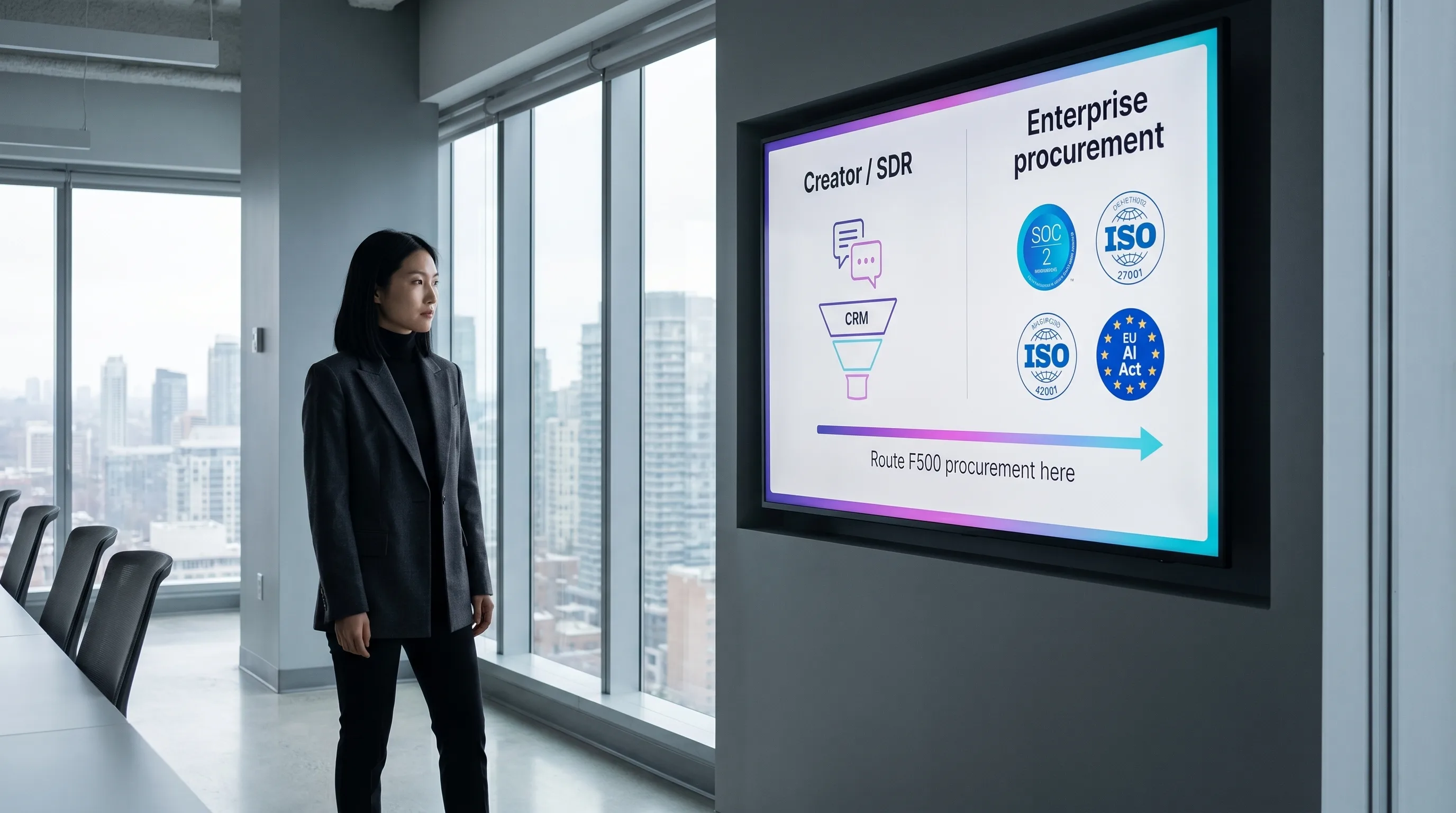
If your buyer journey gates on SOC 2 Type II, ISO 27001, ISO/IEC 42001, EU AI Act conformity, or signed DPA procurement, this article isn’t your guide — read the dedicated Synthesia alternatives ranking for SMBs and agencies instead. The rubric here weights compliance at 0% on purpose: B2B SDR, RevOps, and customer-success evaluators do not gate on ISO certifications at first evaluation. Procurement-grade readers do, and the routing is honest.
Here is the compliance posture of every vendor in this slate, factually:
- Playcut ships SOC 2 Type II in audit (not certified as of May 2026); no ISO 27001 yet. Trust Center: contact the Playcut team for the current procurement packet.
- Tavus ships SOC 2 Type II + GDPR + HIPAA (Mayo Clinic, CVS Health, Aetna deployments); ISO 27001 in progress per the Tavus security page.
- Vidyard ships SOC 2 Type II + GDPR + EU-US Data Privacy Framework; the incumbent enterprise posture for B2B sales-video infra.
- HeyGen ships SOC 2 Type II + GDPR + DPF + EU AI Act conformity; no ISO 27001 listed.
- Loom inherits Atlassian’s SOC 2 Type II + GDPR posture post-acquisition (October 2023).
- Synthesia holds the world-first ISO/IEC 42001 (September 2024) plus ISO 27001 + SOC 2 Type II + EU AI Act conformity + published DPA — the only vendor in this slate that clears Fortune 500 regulated-industry procurement today.
- Sendspark ships a lighter posture appropriate for SMB SDR teams; verify the current security page before procurement.
For SDR, RevOps, or customer-success teams making personalized sales videos, none of this matters at the first decision. For Fortune 500 enterprise procurement, it’s all that matters. Different blog.
Frequently asked questions
The eight questions answered below are also serialized as FAQ schema in this page’s structured data for AI Overview, Perplexity, and ChatGPT extraction. Short version:
- Best alternative overall — Playcut at Pro $29/mo for multi-format actor consistency (9.5/10 on our 8-shot test) — parity with HeyGen Creator’s $29 sticker.
- Tavus CVI vs Replica API vs PALs — three products, one brand: real-time conversation, async personalization, and consumer-only AI companions (commercial use prohibited).
- Tavus pricing — Hobbyist $39 / Starter $59 / Growth $397 / Enterprise typically from a $10K+/month minimum.
- PALs commercial use — prohibited per the PALs Supplemental Terms; commercial 1:1 video runs through the Replica API on Starter+.
- Playcut CRM integration — no native HubSpot/Salesforce connectors; orchestration via MCP + REST + n8n/Zapier/Make.
- Tavus vs Vidyard — Tavus for variable-token 1:1 personalization; Vidyard for incumbent HubSpot integration since 2014.
- Tavus vs Loom — different jobs entirely; Loom is async screen-record (not AI-generated), Tavus is variable-token AI personalization.
- F500 procurement (ISO 42001) — route to the Synthesia alternatives ranking; Synthesia holds the world-first ISO/IEC 42001 plus SOC 2 Type II + EU AI Act conformity.
Verdict — and what to do next

Best-in-class character consistency — the same trained actor across stills, motion video, UGC ads, and on-product compositing (9.5/10 on our 8-shot consistency test, the only vendor in the slate above 7.5/10 across all four formats).
Playcut wins the B2B sales-rubric at 8.13 weighted, 1.33 points ahead of Tavus at 6.80 — a real gap, not a blowout. If your single most-important axis is native CRM-webhook personalization-at-scale with no orchestration engineering, Tavus openly remains the answer: Tavus scores 10/10 on that axis and Playcut scores 5.5/10 honestly.
Most teams should run hybrid: Tavus for the CRM-triggered 1:1 sequence, Playcut for stills, motion, UGC, and on-product compositing the same rep cannot ship from Tavus alone.
If your team’s center of gravity is paid-media performance ads rather than 1:1 outbound (Shopify or Amazon catalogue feed, Batch Mode variants, native Meta and TikTok ad-account publish), the B2B sales-rubric here weights the wrong axes; see the dedicated Creatify alternatives — performance-marketing focused comparison where pricing-per-finished-variant and ad-iteration speed move to the top of the weighting.
Mira Chen reads this far and books the Hobby trial. By Friday her face ships across the deck, the carousel, the 9:16 UGC cutdown, the on-product still, and the 30-second outbound talking-head — one actor, five surfaces, one workspace, $29 on Pro (parity with HeyGen Creator’s $29 sticker). Tavus keeps the CRM sequence; everything else moves.
Footnotes
-
HeyGen Pro lists at $49/mo on heygen.com/pricing as of 2026-05-16 — a drop from the $99/mo Pro tier cited across 2026 third-party reviews and our prior HeyGen alternatives ranking. This may be an A/B rotation, a regional experiment, or a recent price drop post-Team-tier-retirement (January 2026). Cited at $49 with this footnote pending re-verification within 24h of publish. ↩