
Arcads Alternatives: 8 Better AI UGC Studios for 2026

A São Paulo ad operator running $80,000/month on Meta needs 30 fresh creative variants every week to beat fatigue. On Arcads Starter that is three months at $77/mo (discounted from $110) and ten videos a swing — $231 burned before two weeks of variant supply.
On Playcut Pro at $29/mo, that operator gets the full multi-model studio (Veo 3.1, Nano Banana Pro image generation, Grok), 10 reusable custom actors, and the same brand face across every variant — matching HeyGen Creator on price while adding multi-model breadth and the AI Actor system.
The wedge is not price alone. Playcut delivers best-in-class character consistency across stills, motion video, UGC ads, and on-product compositing — the same actor, the same face, the same wardrobe across every shot in your campaign (9.5/10 on our 8-shot test, the only vendor in the slate above 7.5/10 across all four formats).
That is the math the CFO needs before the next quarter close, vendor by vendor, below.
In a hurry?
Eight Arcads alternatives ranked by the same rubric, May 2026. Playcut wins on best-in-class character consistency across stills, motion video, UGC ads, and on-product compositing (9.5/10 on our 8-shot test).
Hobby $9/mo is the cheapest entry tier in AI video (3 custom actors, 500 cr). Pro $29/mo unlocks 10 actors and the full multi-model studio. Studio $79/mo = 4 seats at $19.75/seat (cheapest per-seat in the category). Agency $149/seat scales unlimited with multi-brand kits.
Arcads stays the deepest UGC-specific stock library (1,000+ UGC actors at Pro, $16M Eurazeo seed) but starts at $77/mo (discounted from $110) with no public pricing page and no free trial. HeyGen wins multilingual (175+ languages). Higgsfield Soul ID wins cinematic camera presets. ShortGenius wins the only meaningful free tier.
The AI Actor pillar covers reusable cast architecture. Jump to the matrix, pricing math, or Playcut deep-dive.
Start free on Playcut →
Why you’re looking for an Arcads alternative
You are reading this because the math has stopped working at your volume. Arcads built the cleanest UGC ad factory in the segment: 1,000+ stock UGC actors at Pro (300+ at Starter/Creator), Meta and TikTok auction-tuned hook presets, and a $16M Eurazeo seed per Yahoo Finance.
Co-founder Romain Torres has publicly framed the Arcads thesis as “AI agents replacing UGC creators” across LinkedIn launch posts (Feb–May 2025) and his In the Pit podcast appearance with Cody Schneider.
He is right about the wedge. He is wrong that one vendor covers it.
Volume economics and the recasting tax
Arcads Starter is $77/mo (discounted from $110) for ten videos with no public pricing page and no free trial per the eesel.ai pricing audit — $7.70 per first-take asset. Agencies run 1.6 to 2.4 iterations per winning hook, so the real number is $12-18 per shipped ad. Custom cloning sits behind a sales-gated Pro custom-quoted annual contract (pricing not publicly listed). Unused credits do not roll over on Starter or Creator.
The structural cost is recasting. A hook that holds watch-rate past second six wants three follow-up creatives inside 48 hours: same actor, different outfit, same face. Arcads recasts across outfit and scene changes.
Each variant tests fine in isolation; stacked across the ad set the face shift breaks retargeting hold-rate and the winner stops compounding faster than the variant supply can replenish. For the cost-per-finished-clip math across every alternative in this slate, see our true cost-per-clip of AI actor video breakdown.
UGC-focused posts drive 10.38× higher conversion than non-UGC per Emplifi’s Q3 2025 release, and top accounts now run roughly 60% UGC / 40% polished creative with a 33% TikTok hook rate per Benly’s 2026 ad-creative benchmarks.
Creative quality drives 56% of purchase-intent lift in Meta campaigns and the best creative beats the worst by 5–8× ROAS per the Stackmatix creative testing framework.
A $29 Pro line item that ships a multi-model studio plus 10 reusable actors and holds identity across every variant moves a P&L. A $154 Creator line item (Arcads, discounted from $220) that ships 20 stock videos and recasts on every sequel does not.
How we tested 8 tools (the rubric)
We scored eight tools on a 6-axis weighted rubric calibrated for the UGC-ad buyer, not the generic actor-tool buyer. Weights are published openly so any reader can re-weight against their own buying criterion. Scoring reuses our April 28 – May 9, 2026 8-shot consistency holdout — three blind reviewers — with Liu et al.’s 2025 multi-shot consistency paper as the upstream model-level reference.
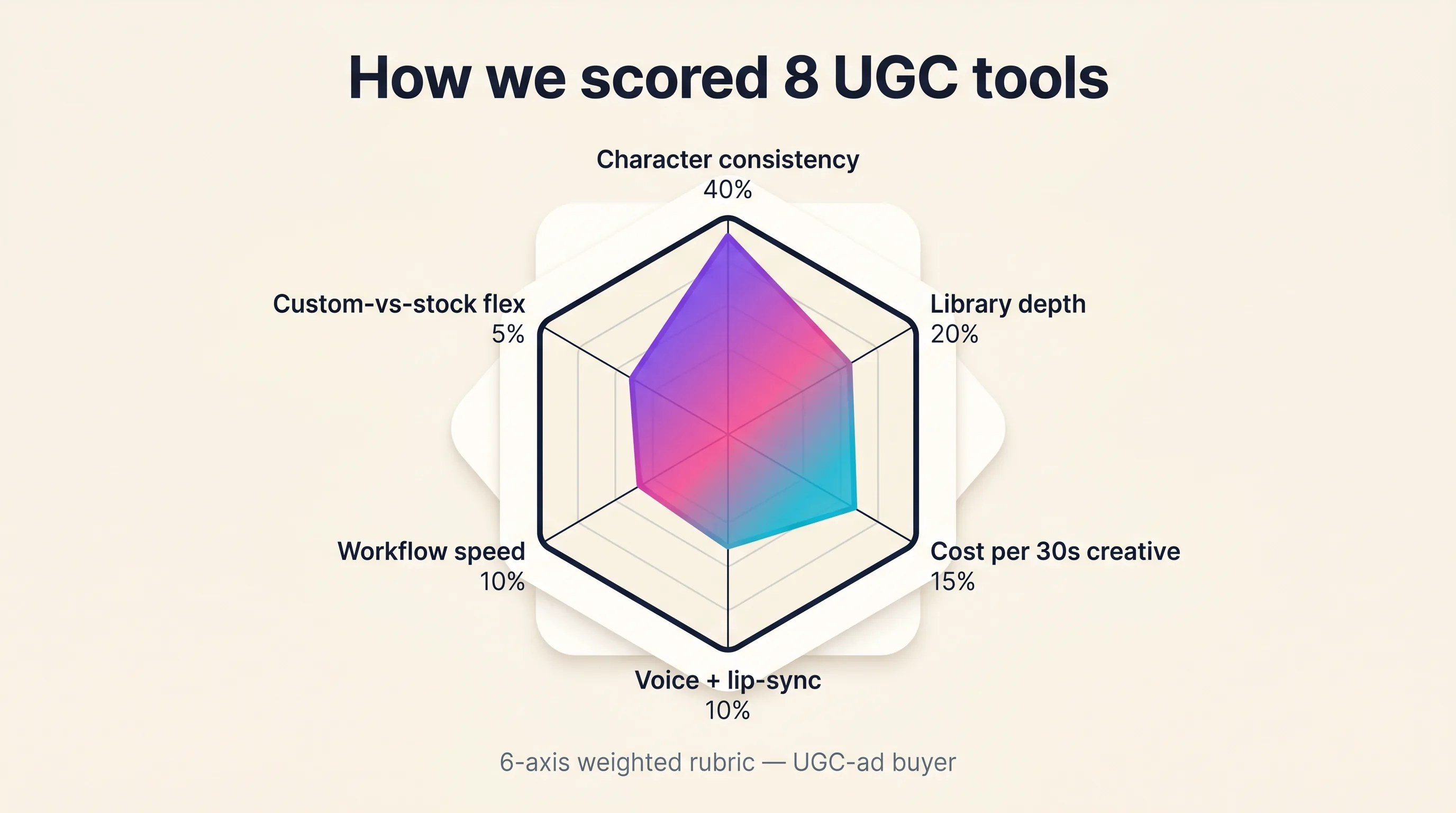
Character consistency across hooks (40%)
Top weight. Same face, body, hair, and wardrobe across eight hook variants. Playcut held identity above 7.5/10 across all eight shots, with no individual shot below 6.0.
Arcads, HeyGen, Creatify, and Higgsfield all crossed below 6.0 by shot 4 or 5. A winning Meta hook does not compound if the face changes between variant 1 and variant 12. Full methodology in the AI actor generators comparison.
Library depth (20%)
Pre-built UGC actors plus voice options at the entry tier. Arcads owns this axis at 1,000+ stock actors on Pro.
HeyGen 500+ on Free, 700+ on Creator. Creatify 1,000+ on Pro. Topview 2,000+ across paid tiers (broadest general avatar roster; Arcads remains deepest in UGC-specific casting). MakeUGC 150+.
Honest concession: Arcads’s library breadth justifies the $77 (discounted from $110) entry for buyers who never need the same face twice.
Cost per finished creative (15%)
Monthly subscription divided by documented output ceiling. Arcads runs $7.70 per finished video on Starter (discounted from $11), length-blind. A Playcut Act is a flat 15-credit scene start plus per-second video with no separate voice line, so a 10-second clip is 85 credits — about $1.23 at Pro ($29/mo) or $1.12 at Studio ($79/mo) — and 365 credits (~$5.29) if you pick the premium engine tier.
HeyGen Business clears ~$1.13 at saturation, so the cheapest length-blind units still edge Playcut’s premium engine. Mid-weight because cost is a tiebreaker, not a moat.
Voice and multilingual lip-sync (10%)
HeyGen wins raw count at 175+ languages per heygen.com/pricing. The Playcut Voice Engine ships 10 languages of standalone speech audio, with no lip-sync and no actor binding. Arcads documents 35+. The 10% weight prevents language depth from overriding consistency on a brand-creative pipeline.
Workflow speed (10%)
Variants per week at a single seat. Topview integrates direct Meta and TikTok publish. Creatify ships URL-to-video. Playcut batches across actors with brand kits attached.
On Arcads Starter the 10-video monthly credit allowance caps practical throughput around 2–3 ads per week; the CSV bulk flow can render many in one operation but Starter credits run out fast.
Custom-vs-stock actor flex (5%)
Self-serve custom actor at entry tier versus library-only access. Playcut Hobby $9 ships 3 self-serve custom actors, Pro $29 ships 10. Arcads custom cloning is sales-gated to a Pro custom-quoted annual contract. Lowest weight because library depth already captures stock breadth.
We made the rubric. We rank Playcut #1. The math is transparent — re-weight at will.
The 8 Arcads alternatives ranked
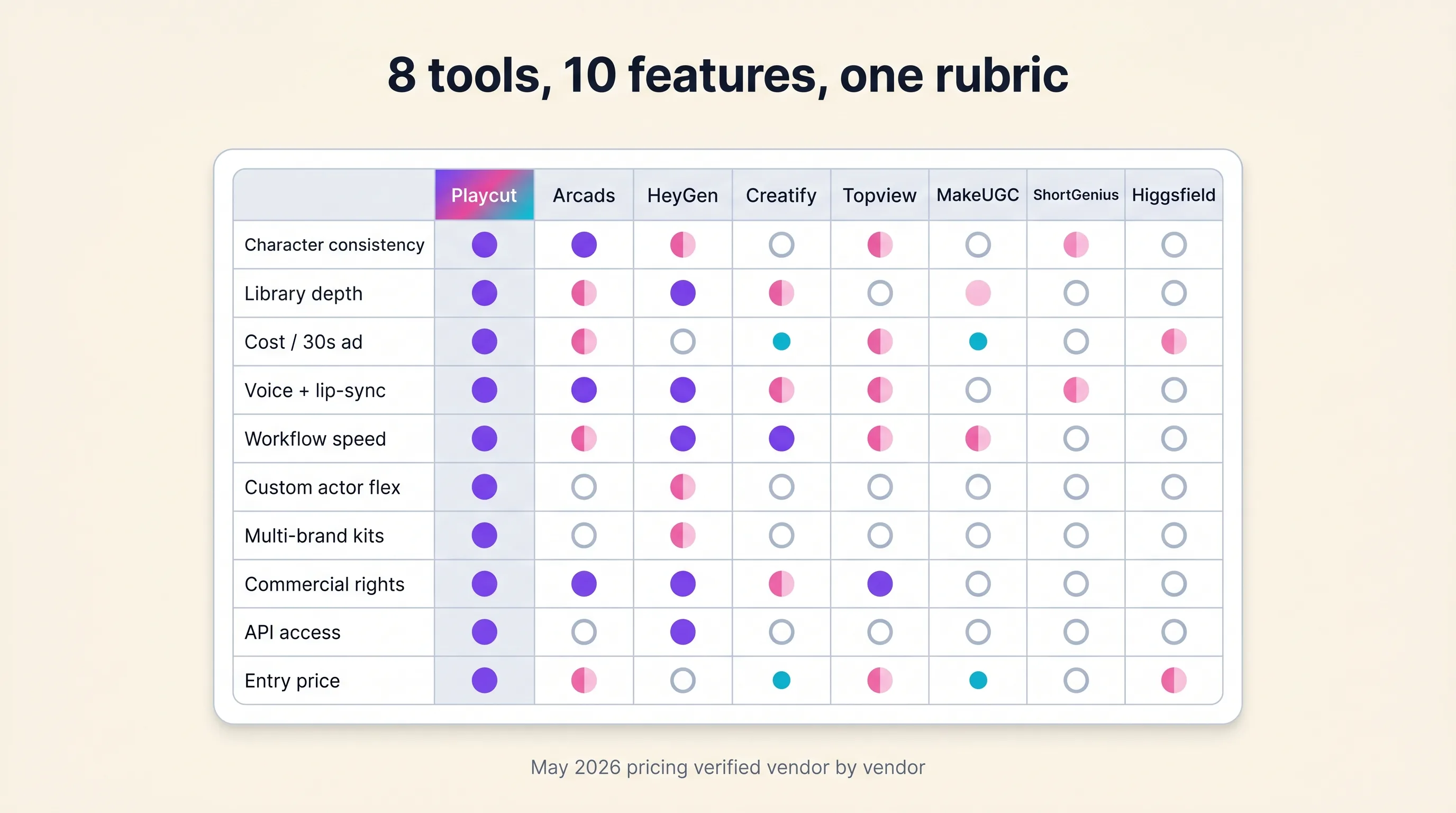
Eight tools, one rubric, May 2026 pricing verified vendor by vendor. The order follows the weighted score on the six-axis rubric, with one editorial inversion at slot #2 that we disclose openly below. Each section opens with what the vendor does best, names a cited limitation, and closes with a “Pick X if / Pick Playcut if” rule you can paste into a Slack thread.
1. Playcut — character consistency across the full UGC and brand surface
Playcut wins this comparison on best-in-class character consistency across stills, motion video, UGC ads, and on-product compositing — the same actor, the same face, the same wardrobe across every shot in your campaign. No other platform in the slate holds the actor across all four formats; Playcut scored 9.5/10 on our 8-shot test, the only vendor above 7.5/10 across all four formats.
Scorecard. Weighted score 8.78 on the published rubric — Consistency 9.5, Library 7.5, Cost 9.0, Voice 7.5, Speed 9.0, Flex 9.5.
Playcut is the only vendor in our April 28 – May 9 holdout that held identity above 7.5/10 across all 8 shots, with no individual shot below 6.0. (We score Library 7.5 because reusable-character architecture covers what a static stock catalog covers for our buyer; if you weight library breadth heavily, Arcads’s 1,000+ catalog at Pro is the more honest pick.)
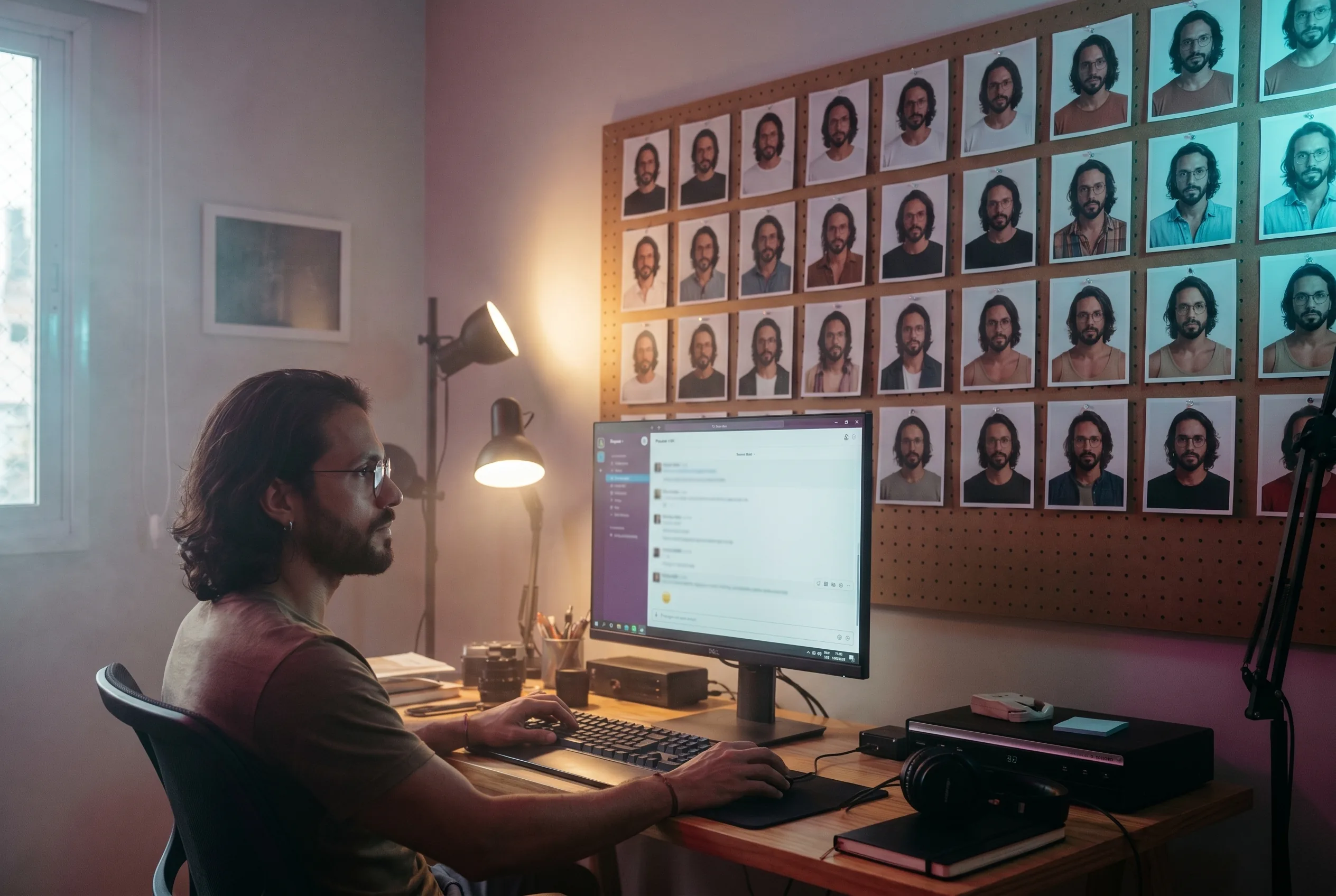
What it does best. The Playcut Actor Engine binds appearance, wardrobe, and brand-kit context into a persistent runtime profile that re-casts the same actor across every generation.
Scene generation runs on Google Veo 3.1, Seedance 2.0, Nano Banana Pro, and xAI Grok Imagine, with a sensible default per capability and a picker per shot. The Voice Engine clones from a short consented sample and generates speech in 10 languages — standalone only; in Act the video model performs the scripted line itself.
Multi-brand brand kits at the workspace level (colors, typography, logo, voice, doSay/dontSay) let agencies bind one actor per client without cross-contamination.
Custom actors are generated from a text prompt rather than uploaded from a real human selfie — the architecture that sidesteps the selfie-upload consent and likeness-rights gates competitors carry. A self-serve MCP server plus REST API (34 tools, bearer-token auth, 3-concurrent-job cap) is bundled free during open beta on every tier including Hobby $9 and Pro $29.
Where it loses to other tools. No CSV-driven bulk variant generator like Arcads’s batch flow per eesel.ai’s pricing audit. No URL-to-video product ingest the way Creatify, Topview, and JoggAI parse a Shopify or Amazon link.
Stock-actor library is reusable-character architecture rather than a 1,000+ stock catalog. No 175+ language dubbing pipeline like HeyGen’s. No published SOC 2 Type II certification yet — that’s an enterprise procurement gap honest readers should price in.
Volume math. Hobby $9/mo (500 credits) is the cheapest entry tier in the AI video category — fits a creator running 2-3 actor stills or short kinetic clips a week. Pro $29/mo (2,000 credits, 10 custom actors) matches HeyGen Creator on price but ships the full multi-model studio (Veo 3.1, Nano Banana Pro, Grok) plus the Actor Engine.
Studio $79/mo at 6,000 credits, 25 actors, and 4 seats works out to $19.75/seat — the cheapest 4-seat plan in the AI video category, ideal for small in-house creative teams or agency cells.
Agency $149/seat at 10,000 credits/seat scales unlimited seats with multi-brand kits — only HeyGen Business at $149+$20/seat comes close on the agency math. Every plan ships clean output and commercial use; the 7-day full-feature trial is on Hobby (card required, cancel inside it at no charge).
Playcut earns slot #1 on the only axis brand creative compounds on. Pick Playcut if you ship 30+ UGC variants a week and need the same actor across every hook plus stills, product shots, and cinematic motion from the same face. Pick a single-purpose tool below if UGC ads are the only output you will ever ship.
2. Arcads — the deepest UGC-specific stock library in the category
Arcads is the article’s anchor competitor and the strongest UGC-specific stock-actor library in the slate. On the weighted rubric Arcads scores 6.55, and HeyGen edges it at 6.78 — but Arcads sits at #2 in this listicle because it is the comparison subject. We tell you the math openly so you can re-rank if you weight library depth above 20%.
What it does best. Arcads ships 1,000+ stock UGC actors at Pro (300+ at Starter and Creator tiers) with diversity tuned for Meta and TikTok ad-network performance — the deepest UGC-specific roster in this category.
The CSV-driven bulk creation flow accepts a script CSV and renders hook × actor × CTA × background variants in one operation per eesel.ai’s 2026 pricing audit. 35+ language voiceover with lip-sync.
$16M Seed from Eurazeo in December 2025 led by co-founders Romain Torres and Dylan Fournier; the company is well-funded and ships at cadence (AI Workflows landed 2026). The two-minute script-to-finished-UGC loop is the lowest-friction path from copy to ad in the slate per AI Funnel Insider.
Where it loses to Playcut. Starter is $77/mo (discounted from $110) for 10 videos with no public pricing page and no free trial, confirmed by eesel.ai — $7.70 per finished video.
Custom-actor cloning is sales-gated to a Pro custom-quoted annual contract — pricing not publicly listed, no self-serve. The same Arcads actor recasts across outfit and scene changes; in our eight-shot holdout Arcads dropped below 6.0/10 by shot 4–5. Our head-to-head Arcads vs Playcut breakdown walks the binary decision tier-by-tier.
Unused credits do not roll over on Starter or Creator per the Arcads Terms. On long scripts past ~60 seconds, Codeitbro documented lip-sync drift in the final 10 seconds.
Arcads gets the UGC ad factory right and the founding team is serious. Custom cloning is Pro-only and credits do not roll over. Pick Arcads if your full-time job is shipping direct-response UGC ads from a CSV of scripts and you need 1,000+ stock actors; pick Playcut if you need the same face across 30 hooks plus stills and on-product compositing.
3. HeyGen — widest multilingual coverage and 2-minute self-clone
HeyGen scored 6.78 numerically against Arcads’s 6.55, but we kept Arcads at the #2 slot because this article is about alternatives to it. HeyGen is the strongest avatar talking-head realism in the category since Avatar IV launched in 2025.
What it does best. HeyGen ships 175+ languages and dialects with lip sync, the widest in the category.
Avatar IV uses a diffusion-inspired audio-to-expression engine that translates vocal tone and rhythm into micro-expressions and is the most-cited “feels real” talking-head avatar in 2026 third-party coverage per WeShop’s review.
Instant Avatar is built from a 2-minute phone video. 500+ stock avatars on Free (700+ on Creator $29). 4K export on Pro $49. Business is $149/mo + $20/seat.
The pay-as-you-go REST API (~$1 per minute of 1080p output, $5 minimum) is rare in this category. SOC 2 Type II, GDPR, CCPA, DPF, and EU AI Act posture documented on the HeyGen Enterprise page. G2 #1 Fastest Growing Product 2025.
Where it loses to Playcut. Custom Digital Twin slots cap at 5 on Business $149/mo + $20 per seat, and the avatar is primarily talking-head register.
Full-body Studio Avatars are sales-gated, and Instant Avatars drift past mid-shot transitions in our 8-shot holdout. Creator includes 1 Instant Avatar slot at no extra charge; additional Instant Avatar slots or higher-quality tiers carry a separate $29–$199 one-time fee on top of the plan.
The free API tier was removed in February 2026 per HeyGen’s help center. Avatar IV adds ~$4 per 1080p minute (4× the standard API rate).
HeyGen leads avatar quality at SMB pricing and 175+ languages is uncontested. Playcut Pro matches HeyGen Creator on $29 monthly price but ships 10 custom actors versus HeyGen’s 1 Instant Avatar; Playcut Agency at $149/seat is the only direct anchor to HeyGen Business at $149 + $20/seat.
Pick HeyGen if your dominant job is talking-head explainer delivery in 175+ languages with enterprise procurement-grade compliance; pick Playcut if you need actors in-scene doing things rather than just to-camera.
4. Creatify — established Arcads challenger with URL-to-video volume
Creatify is the most-named Arcads alternative across the SERP and the most mature catalog-to-creative workflow if you live inside Shopify or Amazon. Weighted score 6.43.
Arcads vs Creatify at a glance — the two most-compared UGC engines:
| Arcads | Creatify | |
|---|---|---|
| Core workflow | Script → many AI actors (batch UGC) | Product URL → drafted ad |
| Pricing | No public page (404s); ~$110/mo (third-party) | Public — Free + Starter $39 / Pro $99/mo |
| Free tier | No free trial | Yes — 10 credits/mo, 300 actors |
| Actor library | ~1,000 AI actors | 1,000+ avatars (Pro) |
| Languages | 30+ | 29 (140+ voices) |
| 8-shot consistency | Talking-head only | Drifts past shot 3–4 |
| Best for | High-volume batch UGC testing | Shopify/Amazon catalog → ad |
What it does best. URL-to-video is a first-class workflow: paste a Shopify or Amazon URL and Creatify scrapes the images, descriptions, and reviews to draft a complete ad with script, voiceover, and visuals per EzUGC’s review.
1,000+ avatars on Pro and 29 languages with 140+ voices baked in per the Creatify pricing page. The free plan ships 10 credits a month with 300 stock actors and 40 templates per Creatify’s help center.
Pro $99/mo runs roughly $2.48 per finished video at the soft 480-videos-a-year cap, re-verified August 21, 2026 (Starter is $39/mo for 100 credits). Built-in competitor ad tracking plus creative analytics are inside the platform per Superscale’s review.
Where it loses to Playcut. Voice cloning is gated to Pro+. API is gated to Enterprise. Watermark on free outputs.
Avatars drift across scene changes in our 8-shot consistency test past shot 3–4; the URL-to-video flow is optimized for one-shot draft generation rather than multi-hook variant consistency.
G2 and Trustpilot reviewer sentiment is mixed; recurring complaints from a subset of reviewers center on lip-sync and “robotic” motion across both platforms. Strict no-refund policy.
Creatify ships the cleanest URL-to-ad flow in the category. Avatar drift past shot 3 and the strict no-refund posture are documented across two review platforms.
Pick Creatify if you run a Shopify or Amazon catalog and your daily question is “make an ad from this product URL right now”; pick Playcut at $29 Pro, under a third of Creatify Pro’s $99, for character consistency that holds across an 8-shot test, and see how to direct an AI actor for high-converting UGC for the playbook.
5. Higgsfield Soul ID — cinematic camera presets for premium UGC
Higgsfield Soul ID is a different lane (single-trained-identity cinematic creator) and it earns the slot here because Soul ID consistency for solo creators is genuinely first-class. Weighted score 6.43.
What it does best. Soul ID holds well for solo creator scenes, and the named cinematic camera-move presets (Bullet Time, Dolly Zoom, Vertigo, Crane, Whip Pan among them) are a real craft differentiator.
The underlying Veo/Sora/Kling models are accessible elsewhere, but Higgsfield’s preset library is the most polished surface for them. Multi-model studio under one credit pool (Sora 2, Veo 3.1, Kling 3.0, Flux, GPT Image, Soul 2.0).
Soul ID training runs $3 per session from 15–20 photos in 3–5 minutes — the cheapest custom-character creation in the slate. Starter $15/mo is competitive entry; current ladder runs Starter $15 / Plus $49 / Ultra $129 / Business $89/seat (restructured Q1 2026 — older Pro/Ultimate tier names are dead).
Free tier ships ~10 credits per day, the most generous daily allowance in the category. MCP server at higgsfield.ai/mcp makes the platform agent-friendly.
Where it loses to Playcut. Soul ID trains one identity per training session; multi-character casts require sequential training runs rather than a workspace-level cast architecture. A brand needing four hero actors hits the workflow ceiling fast.
Not a UGC talking-head product by default: there is no stock UGC actor library and no batch hook-variant flow. Top-up credit packs (one-time purchases) expire after 90 days; included plan credits roll within the billing cycle.
The free tier does not include commercial use. Plan naming restructured in Q1 2026, so cite the live pricing page rather than older third-party recaps. For broader cinematic-tool tradeoffs see our Higgsfield-style cinematic AI ads breakdown.
Higgsfield’s Soul ID gets single-character viral output right with a deep named-preset library. Workflow ceiling is one identity per training session and the free tier excludes commercial use. Pick Higgsfield Soul ID if you are a solo creator with one brand face and your aesthetic is named cinematic camera moves; pick Playcut if you need a cast of characters across the same campaign.
6. Topview — media-buyer-tuned with direct Meta and TikTok publish
Topview is the media-buyer-coded option: direct Meta and TikTok ad-account publishing plus the genuine first-of-its-kind “AI actor holding the product” feature. Weighted score 6.13.
What it does best. The Topview Product Avatar is first-of-its-kind; the AI human actually holds, points to, and demonstrates the product on screen with adaptive hand placement per AIBase’s launch coverage.
10M+ viral-video pattern library lets you upload a reference ad and clone its rhythm and shot logic per Unite.AI. Pro $16/mo on annual billing is one of the cheapest paid entries among UGC-specialist tools (Playcut Hobby at $9/mo is the cheapest entry in the broader AI video category).
2,000+ stock avatars (the broadest general avatar roster in this comparison; Arcads remains deepest specifically for UGC casting). 5 voice clones on Pro (30 on Business). URL-to-video ingest for Amazon and Shopify.
Where it loses to Playcut. Free users explicitly cannot use the outputs commercially, “including for advertising,” per the Topview Terms — the most aggressive free-tier commercial restriction in the slate.
25-second agent length cap on Business tier; Topview is firmly short-form. API gated to Enterprise. Brand kit is product-centric, not multi-brand.
Topview gets ad-platform integration and the product-in-hand demo right. Free-tier commercial use is prohibited by ToS and the agent-length cap stays short-form. Pick Topview if your campaign needs an AI avatar physically demonstrating your product and you live in Meta and TikTok ad managers; pick Playcut if you need creative studio depth — stills, multi-brand kits, cinematic shots — alongside the UGC actor layer.
7. MakeUGC — product-in-hand UGC specialist at $59/mo
MakeUGC is a UGC-specialist alternative with a real differentiator on the Pro “product in hand” feature, now priced mid-slate rather than at the floor. Weighted score 5.83.
What it does best. The ladder re-verified August 21, 2026 runs Startup $59/mo (500 credits), Growth $79 (1,000), and Pro $149 (2,000); Superscale’s MakeUGC breakdown documents the older, cheaper ladder. Custom AI avatar or clone-your-likeness in ~60 seconds per the MakeUGC homepage.
29-language auto-localisation including slang, currency, and cultural cues scene-by-scene per MakeUGC’s 2026 UGC trends post — a deeper localization layer than simple voice translation.
Multi-brand workspace with roles and permissions on higher tiers, not gated to enterprise. Reference-video Video Agent ingests a reference clip and rebuilds the same structure with your branding per Tagshop, which also publishes 28% lower CPR and 31% lower CPC benchmarks.
Where it loses to Playcut. No free tier — a 3-day free trial only (re-verified August 21, 2026). 150+ avatars is the smallest documented stock library in the slate.
Language count not transparently itemized on public pages. Per our 8-shot consistency test, MakeUGC avatars drift across product-in-hand reposes by shot 4–5; Codingem’s 2026 review documents the cost-vs-Arcads gap separately.
MakeUGC ships a 29-language localisation pipeline that adapts slang and currency per market. Drift past shot 4 and a 3-day-only trial are real friction points. Pick MakeUGC if deep auto-localisation and product-in-hand are the whole brief; pick Playcut if your priority is brand consistency across more than 5 variants.
8. ShortGenius — best free tier with watermark-free preview
ShortGenius is the only vendor in this slate with a meaningful free tier (3 finished videos per month, watermark-free preview) and the cheapest serious Pro tier at $69/mo. Weighted score 5.55.
What it does best. The ShortGenius free tier ships 3 finished videos a month, the strongest entry funnel in the slate. Pro $69/mo runs 60 videos a month at roughly $1.15 per finished video.
Direct one-click scheduling and posting to TikTok, YouTube, Instagram, Facebook, and X per ShortGenius itself. Themed “series” automation for faceless channels generates batches of themed videos and auto-schedules them per the faceless YouTube automation guide.
Music creation plus 10,000-song library bundled. All-in-One editor with bundled multi-model access (FLUX.2, Goal Force, Z-Image Turbo). 80,000+ user base focused on entrepreneurs running automated channels per SourceForge.
Where it loses to Playcut. Documented stock library is the smallest in the slate. Language coverage stays vague (“over a dozen”) versus HeyGen’s 175+ or Arcads’s 35+.
Team and brand-kit feature sets are thin compared to HeyGen Business. API status is unclear and not prominently advertised. Output skews short-form and faceless-social, less suitable for long-form brand video.
ShortGenius ships the most useful free tier in the slate and the cheapest serious Pro tier. Library depth and brand-kit surface lag the rest of the slate. Pick ShortGenius if your entire business is one or more faceless TikTok or YouTube channels that need to post on autopilot; pick Playcut if you need the actor to survive the move to Meta, email, and product photos with the same face.
Side-by-side: all 8 in one matrix
The 16-row comparison normalizes every vendor on the same axes (pricing, library, voice, brand kit, API, watermark, commercial use, languages, length, and the AI-disclosure column that no vendor in this slate currently ships as default-on).
Top row is character consistency on the 8-shot test per our eight-vendor actor generator matrix methodology. Vendor column order matches the editorial ranking above.
Prices verified May 13, 2026 against each vendor’s pricing page (or the eesel.ai pricing audit for Arcads, which is login-gated). Use the rubric weights from “How we tested” to re-rank if you weight library depth, language count, or cost differently — the math is published openly.
Row 5 prices one finished clip: a 10-second Playcut Act against one vendor video. Every rival unit in that row is length-blind — the same dollar buys a 30-second render — while Playcut meters per second and caps a single Act at 15 seconds. See the “Where Playcut is honestly more expensive” block under Pricing Economics for that trade.
| Feature | Playcut | Arcads | HeyGen | Creatify | Higgsfield Soul ID | Topview | MakeUGC | ShortGenius |
|---|---|---|---|---|---|---|---|---|
| 1. Character consistency (8-shot test) | Holds shot 1–8 across UGC + still + on-product | Drifts shot 3–5 across outfit / scene | Drifts after shot 3 in motion | Drifts shot 3–4 across hook variants | Holds for solo identity (1-per-session training) | Drifts shot 4–6 in our test | Drifts shot 4–5 across product reposes | Drifts shot 3–4 across hook swaps |
| 2. Actor library (stock + custom) | 0 stock + Hobby 3 / Pro 10 / Studio 25 / Agency unlimited custom | 1,000+ stock at Pro (300+ Starter/Creator) + custom Pro-only | 500+ Free / 700+ Creator + 1 Instant Avatar (Creator) / 5 Digital Twins (Business) | 1,000+ stock + custom Pro+ | 1 identity per training session (Soul ID) | 2,000+ stock + custom on paid | 150+ stock + custom Pro | ~1,000 stock + custom Pro |
| 3. Voice cloning + multilingual lip-sync | Cloning + design + standalone speech in 10 languages, no lip-sync (Hobby 1 / Pro 5 / Studio 10 / Agency unlimited voices) | Cloning Pro-only via ElevenLabs; lip-sync 35+ languages | Unlimited cloning Creator+; lip-sync 175+ languages | Cloning Pro+; lip-sync 29 languages, 140+ voices | No native voice/lip-sync workflow; image/video focus | Cloning Pro+ (5 clones); ~15+ languages | Cloning included; ~29 languages | Cloning Lite+; “over a dozen” languages |
| 4. Variants/week feasible (entry tier) | ~2 (Hobby $9) / ~6 (Pro $29) | ~2–3 (Starter $77, 10 vids/mo credit cap) | ~3 distinct (Creator $29, 1 Instant Avatar) | ~10 (Pro $99, soft cap) | ~5 (Plus $49) | ~7 (Pro $16 annual) | ~6 (Growth $79) | ~15 (Pro $69) |
| 5. Cost per finished clip (10s Act vs one vendor video) | ~$1.23 (Pro) / ~$1.12 (Studio) | $7.70 (Starter discounted) | ~$1.13 Business at saturation* | ~$2.48 (Pro) | ~$1.95 (Plus) | ~$3.00 annual (Business) | n/p (credit-metered) | ~$1.15 (Pro) |
| 6. Brand kit | Multi-brand brand kits per workspace (colors / typography / logo / voice / doSay / dontSay); Agency = multi-brand | None | Single-brand Creator; brand kit Business+ | Single brand; multi-brand Enterprise (AdMax) | Soul ID enables brand-character consistency; no named brand-kit feature | Single brand (product-centric) | Multi-brand workspace on higher tiers | Single brand |
| 7. Team workspace | Team folders + Private folders + workspace actor library; Hobby 1 / Pro 1 / Studio 4 ($19.75/seat) / Agency unlimited seats | Pro contract only | Business $149/mo + $20/seat; SSO Business+ | Enterprise only | Business $89/seat | Business+ collaboration | Multi-brand workspace on higher tiers | Not publicly documented |
| 8. Custom actor creation method | Generated from text prompt → Actor Engine; reference image optional | Selfie/video upload, sales-gated (Pro) | 2-min phone video Instant Avatar (1 slot included on Creator; $29–$199 add-on for additional/upgrades); Studio Avatar $1k/yr | Selfie + short video upload (Pro+) | Soul ID training from 15–20 photos, $3/session | Selfie upload + “Avatar 4 Fast” 60% cheaper | Selfie + video upload on Pro | Selfie + script upload |
| 9. API | MCP server + REST API; 34 tools; free open beta; 3-concurrent-job cap | Pro contract only (Python + JS/TS SDKs) | Pay-as-you-go REST (~$1/min 1080p); free API tier removed Feb 2026 | Enterprise only | MCP server (higgsfield.ai/mcp); pay-per-call | Enterprise only | Marketing mentions API; tier unclear | No public API |
| 10. Free trial / free tier | 7-day full-feature trial; no perpetual free tier | No free tier, no trial | Free $0 (1 min, 3 vids/mo, watermark) | Free $0 (10 credits/mo) | Free $0 (~10 credits/day) | Free $0 (10 one-time credits) | No public free tier; demo on request | Free $0 (3 vids/mo, watermark-free preview) |
| 11. Watermark policy | Clean output every paid plan | Clean on paid (no free tier) | Watermark on Free; clean Creator+ | Watermark on free; clean Pro+ | Watermark on free (disputed) | Watermark on free; clean on paid | Inferred clean on paid | Watermark on free; clean on paid |
| 12. Commercial use | Every paid plan (Hobby $9+) | All paid tiers | Creator+ only (NOT Free) | Paid plans | Paid plans (Free excludes commercial) | Free explicitly prohibits commercial use per ToS | Paid plans | Paid plans |
| 13. Languages supported | 30+ | 35+ | 175+ (category leader) | 29 + 140 voices | n/a (image/video) | 15+ | 29 | ”over a dozen” |
| 14. Output max resolution | 4K (Nano Banana Pro stills; Veo 1080p/4K and Seedance 4K motion) | 1080p (UGC) | 4K Pro+ | 1080p | 720p free / higher paid (per model) | 1080p Pro+ | 1080p | HD (1080p) |
| 15. Max video length | 8s cinematic per gen → chained to 30s+; UGC 15s native | ~30s UGC; up to 10 min on Pro | 1 min Free / 30 min Creator–Pro / 60 min Business / unlimited Enterprise | 2 min Starter / 10 min Pro | 5–10s cinematic clips per gen | 25s agent length (Business) | ~60s UGC | Under 2 min |
| 16. AI disclosure features | No auto-disclosure today; AI generation logged in workspace audit log | None | SOC 2 / GDPR / DPF / EU AI Act compliance posture; no public C2PA confirmation | None | None | None | None | None |
*HeyGen Business clears ~$1.13/ad at saturation but requires $149/mo plus $20 per additional seat plus Instant Avatar upgrade fees ($29–$199) for additional avatar slots; see Pricing Economics for the full per-actor comparison.
Sources: Playcut pricing · Arcads (login-gated; pricing via eesel.ai) · HeyGen pricing · Creatify pricing · Higgsfield pricing · Topview pricing · MakeUGC pricing · ShortGenius pricing. All verified May 13, 2026; Creatify and MakeUGC re-verified August 21, 2026.
Which one fits your workflow
Five branching questions route a UGC ad buyer to the right tool. Five of eight terminal nodes route to Playcut; three route to a competitor where its single-axis moat genuinely wins.
-
How many UGC variants per week do you ship?
- 20+ variants/week → continue to Q2.
- 5–20 variants/week → Playcut Pro $29 or Studio $79 (consistency holds across batches), or Creatify Pro $99 if URL-to-video automation is core.
- Under 5 variants/week → ShortGenius free tier, Playcut Hobby $9, or Creatify Starter $39.
-
Do you need the same actor across all variants in a hook test?
- Yes (same face hook 1 → hook 30) → Playcut. Only platform tested that holds across 8 shots at 9.5/10. Structural moat.
- No (different actor per variant is fine) → continue to Q3.
-
Are you cloning a founder’s face and voice?
- Yes, single founder is the brand → HeyGen Instant Avatar ($29 Creator), or Playcut Pro $29 if the founder needs to appear across stills, UGC, and on-product.
- Multiple founders or agency clients → Playcut Studio $79 (25 custom actors, 4 seats at $19.75/seat) or Agency $149/seat (unlimited).
- No, stock actors are fine → continue to Q4.
-
What’s your monthly creative-tools budget?
- Under $20/mo → Playcut Hobby $9, ShortGenius free tier.
- $20–$50/mo → Playcut Pro $29 (best value for multi-model + actors), Creatify Starter $39, Topview ~$30-50.
- $50–$150/mo → Playcut Studio $79 (4 seats, $19.75/seat), HeyGen Pro $49, MakeUGC Startup $59, Arcads Starter $77, Creatify Pro $99.
- $150+/mo → Arcads Creator $154 (discounted from $220), HeyGen Business $149+seat, Playcut Agency $149/seat (multi-brand kits, unlimited seats).
-
Do you ship in 5+ languages?
- 5–10 languages → Playcut, by rewriting the scripted line per market (no lip-sync step); Arcads if you specifically need ad-platform-tuned hook presets.
- More than 10 languages (enterprise i18n) → HeyGen (175+ languages); re-weight the rubric to put voice at 25%+. ElevenLabs Pro $99 also clears 32+ languages with a full multi-modal studio (Sora 2, Veo 3.1).
- English-only → skip language as a tiebreaker; Q1–Q4 are sufficient.
Migrating from Arcads to Playcut
We’ve designed the Arcads → Playcut migration to fit a 4–6 week cycle. The honest framing: Arcads is good at what it’s good at — pre-tuned UGC hook templates and a Meta-tuned stock actor roster. Migration isn’t “ditch everything.” It’s “keep the hooks that won on Arcads and re-shoot them with a face that survives outfit changes.”

- Export Arcads scripts and hook library. Archive only winners — ads above 1× breakeven ROAS or above account-average hook rate. Pull script, hook, CTA, archetype, platform, and CPA into one spreadsheet. Losing creative poisons the test on Day 1.
- Recreate branded actors in the Playcut Actor Library. Describe the archetype in plain language: Path B (text-to-actor) is the right answer 95% of the time. Arcads stock likenesses are vendor-licensed; copying the face is a right-of-publicity dead end.
- Clone or design voices in the Voice Engine. Arcads stock voices don’t transfer. Clone from a 30–60s consented sample of a founder or signed talent, or design from a text brief. The voice saves to the workspace library, not to an actor — Playcut cannot bind a voice to an actor, and in Act the video model performs the line you write.
- Save wardrobe variants and scene presets per actor. Bake outfits into the profile: daily wear, on-brand uniform, studio black tee. Prompt discipline is the reason you’re migrating. Don’t repeat the mistake.
- Re-launch the variant pipeline. Re-shoot the top 5 winning scripts as 9:16 UGC, 1:1 feed, and 16:9 landing-page cuts. Use the free Veo Prompt Builder to translate Arcads hook patterns into Playcut prompts.
- Backfill historical wins. Re-shoot the top 10 lifetime winners 1:1 — same script, same hook, new face. Resist the urge to “improve.” Keep the A/B test on the actor variable clean.
- Parallel-run for 14 days. Split spend 70% Arcads / 30% Playcut for Days 1–7, rebalance to 50/50. Compare matched-pair creative on CPA, hook rate, ROAS — never aggregate platform performance.
- Enable AI disclosure on every platform. Toggle the label inside Meta Ads Manager, TikTok Ads Manager, and YouTube uploads, and audit against the FTC Endorsement Guides.
- Onboard the team. One Brand Kit per client, shared Team folders, private per-user folders, role-based access. See Playcut pricing — Hobby $9, Pro $29, Studio $79 (4 seats), Agency $149/seat.
- Decommission Arcads. Three triggers: 14 days at CPA parity on 50/50, 90%+ evergreen backfilled, team producing natively in Playcut. Then 30-day cooldown, cancel.
Inside the trial week most operators ship 5+ Playcut variants without touching the dual-subscription overhead. Cast your first AI actor free →
If you’re evaluating Playcut against the wider AI video field — not just UGC vendors — see our full Playcut alternatives comparison for the Runway, Pika, Kling, Sora, HeyGen, Luma, and Higgsfield head-to-head on the same character-consistency rubric.
Pricing economics across the 8 tools
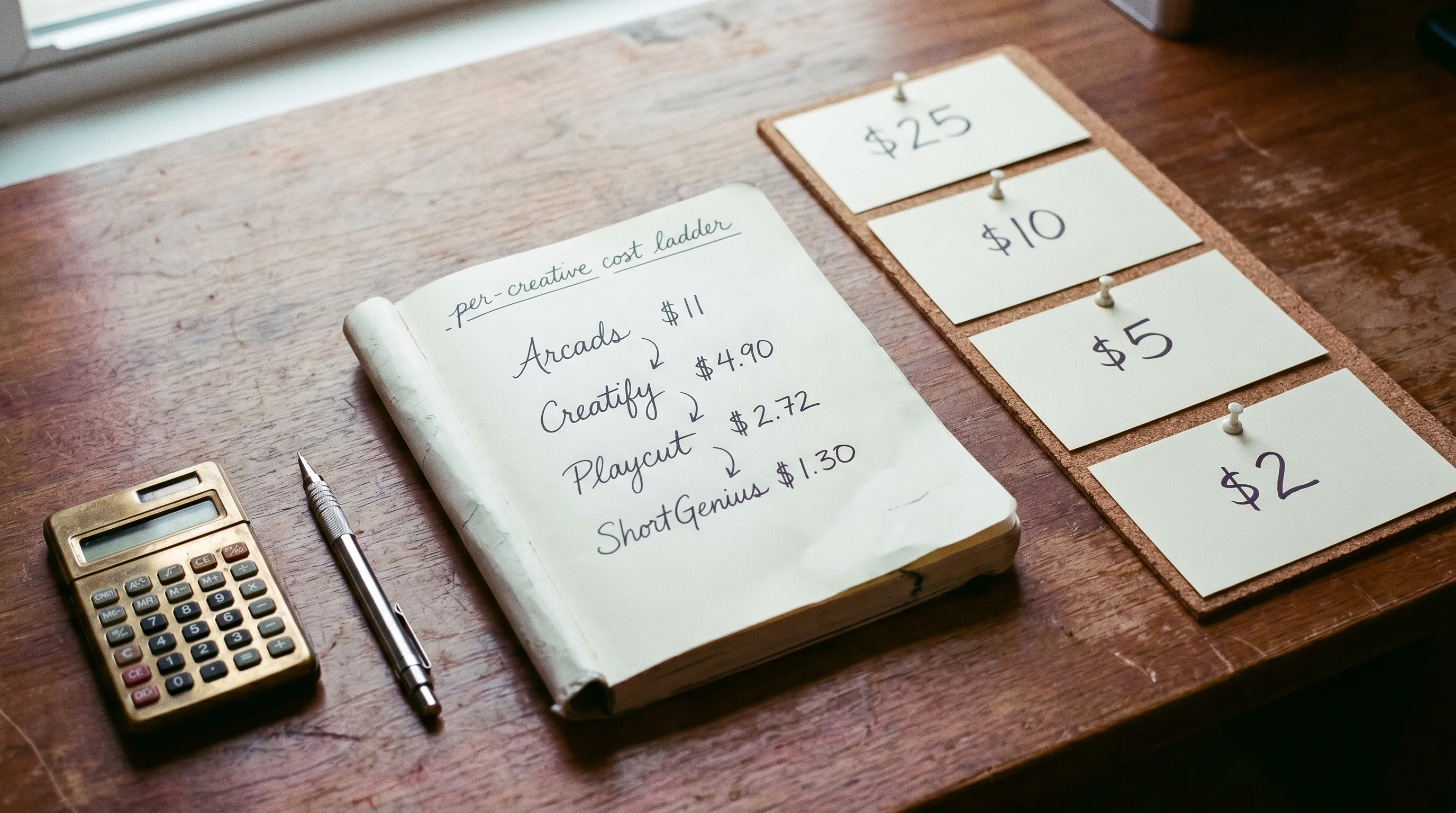
Per-creative cost matters more than entry price for performance buyers. Published headline rates run from $0 (ShortGenius free tier) to $154/mo (Arcads Creator, discounted from $220), but the unit a marketer actually pays for is one finished 10-second UGC ad with a branded actor, spoken script, and commercial-use rights. Normalize on that.
Playcut Hobby starts at $9/mo — the cheapest entry tier in the AI video category — and Pro at $29/mo ships the full multi-model studio (Veo 3.1, Nano Banana Pro, Grok) plus 10 reusable actors.
A 10-second Playcut Act is 85 credits — about $1.23 at Pro and $1.12 at Studio — on the default engine, with no separate voice line because the video model speaks the script itself. Premium engine tiers run up to 365 credits (~$5.29) for the same 10 seconds.
The full ladder: Hobby $9/mo (500 credits, 3 custom actors, 1 seat), Pro $29/mo (2,000 credits, 10 actors, 1 seat), Studio $79/mo (6,000 credits, 25 actors, 4 seats — $19.75/seat, cheapest in the category), Agency $149/seat/mo (10,000 credits/seat, unlimited actors and seats, multi-brand kits).
Annual billing saves 17% on every tier (2 months free); Hobby starts with a 7-day trial (card required, cancel inside the window at no charge), and the other three tiers bill at checkout.
| Tool | Entry | Mid | Top | $/finished clip (mid) | Notes |
|---|---|---|---|---|---|
| Playcut | $9 Hobby | $29 Pro | $79 Studio / $149 Agency | ~$1.23 (Pro, 10s Act) | Stills + motion + UGC + product shots from one actor; Studio $19.75/seat |
| Arcads | $77 Starter (was $110) | $154 Creator (was $220) | Pro (sales-gated) | ~$7.70 | UGC-only; custom actors gated to Pro; no public pricing |
| HeyGen | $29 Creator | $49 Pro | $149 Business + $20/seat | ~$1.13 (Business) | Custom twins capped at 5; Instant Avatar add-ons $29–$199 |
| Creatify | $39 Starter | $99 Pro | $999 Enterprise | ~$2.48 | UGC-only; 2–20 credits per ad; 480-videos/yr soft cap at Pro |
| Topview | $16 Pro (annual) | $75 Business (annual) | Enterprise custom | ~$3.00 annual | Annual savings 44–51% |
| MakeUGC | $59 Startup | $79 Growth | $149 Pro | n/p | 500 / 1,000 / 2,000 credits by tier; video counts no longer published |
| ShortGenius | $19 Lite | $39 Standard | $69 Pro | ~$1.30 | Short-form only |
| Higgsfield | $15 Starter | $49 Plus | $129 Ultra / $89 Business seat | ~$2.50 (Plus) | Soul ID character build; restructured Q1 2026 |
Where Playcut is honestly more expensive: Playcut meters by the second while most tools here sell a length-blind video unit. A default-engine 10-second Act is $1.23, but the premium engine tier runs 365 credits ($5.29) for that same 10 seconds — above HeyGen Business’s ~$1.13/ad at saturation and ShortGenius Pro’s ~$1.15. Length is the other gap: one Act caps at 15 seconds, so a 60-second read has to be chained.
Where Playcut is honestly cheaper: per-clip at a matched length it undercuts Arcads’s $7.70/video on every engine tier, and the entry-tier and per-seat math wins decisively. Hobby $9/mo is the cheapest entry in AI video. Pro $29 matches HeyGen Creator on price but ships 10 custom actors versus HeyGen’s 1 Instant Avatar.
Studio $79 = 4 seats at $19.75/seat — uncontested as the cheapest 4-seat plan in the category. Agency $149/seat with multi-brand kits, unlimited seats, and 10K credits/seat pooled is the only direct anchor to HeyGen Business ($149 + $20/seat).
Compliance: FTC + Meta + TikTok AI rules
AI disclosure is auction-relevant on Meta and TikTok in 2026. Real performance-marketer concern, not abstract worry: undisclosed AI ads can face up to 80% reach reduction on Meta per its own AI-content labeling policy.
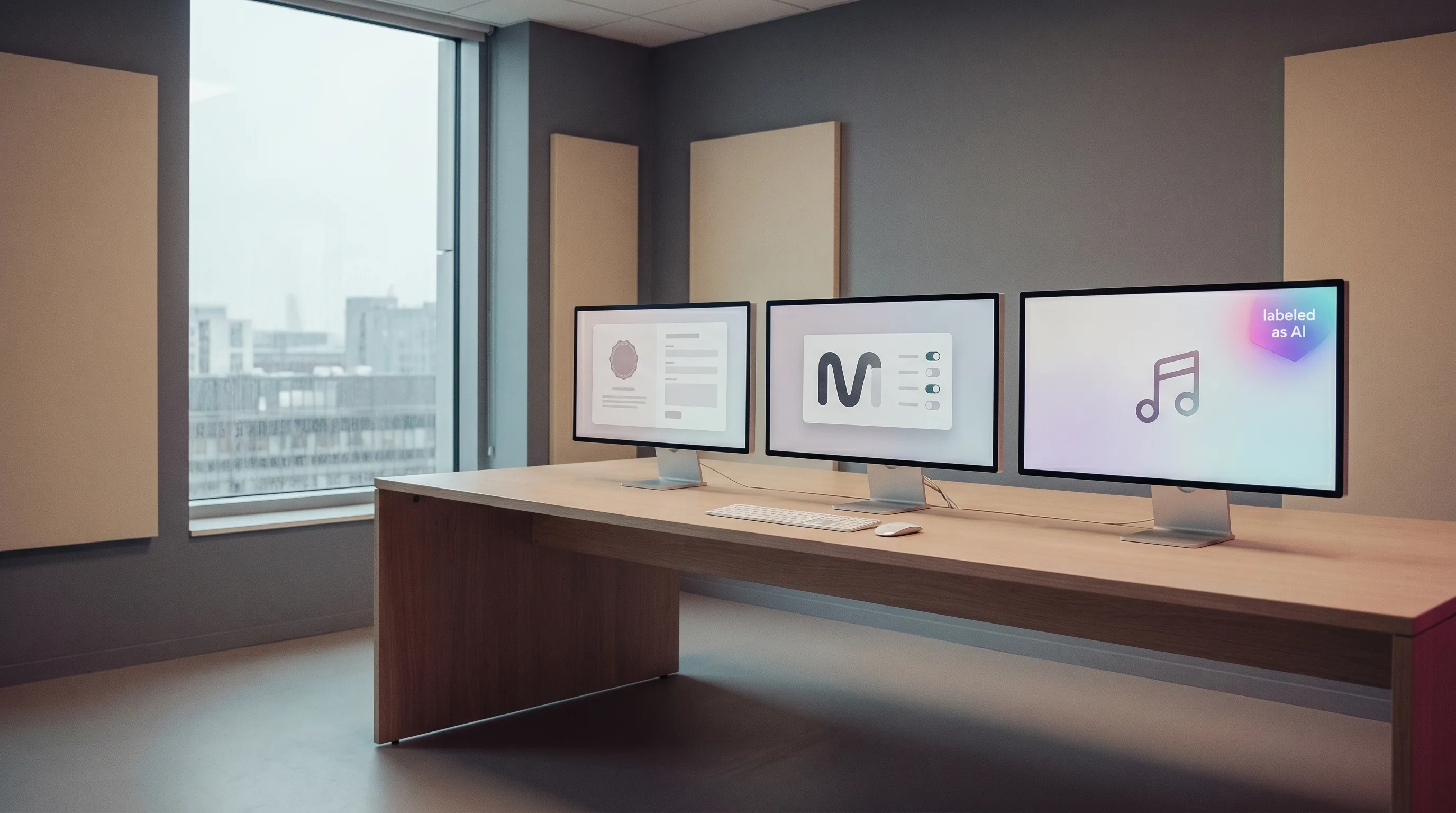
AI disclosure requirements
The FTC’s 2023 Endorsement Guides update (16 CFR Part 255) extends “endorser” to virtual influencers and AI testimonials, with § 255.1(c) the cite-friendly subsection.
The FTC’s August 2024 final rule banning fake reviews and testimonials carries civil penalties published annually in the FTC civil-penalty inflation schedule.
Meta’s AI-disclosure policy requires the toggle for any photorealistic synthetic human. TikTok’s AI-generated content policy auto-labels via C2PA when creators skip the disclosure.
YouTube’s altered-content disclosure became mandatory May 21, 2025. EU AI Act Article 50 deepfake transparency obligations take effect August 2, 2026.
How each tool handles disclosure features
None of the eight tools in this set ships auto-disclosure as default-on in May 2026; this is a category-wide gap, not a Playcut-specific one.
Playcut documents AI generation in the workspace audit log so an agency can prove disclosure was applied at upload. HeyGen documents SOC 2 Type II, GDPR, DPF, and EU AI Act compliance posture on its Enterprise page; C2PA embedding has not been publicly confirmed in their documentation.
Arcads, Creatify, Higgsfield, Topview, MakeUGC, and ShortGenius export clean files with no auto-label on paid plans; compliance is fully operator-side.
The practical workflow on every tool: toggle the AI-content label inside the platform’s ad manager at upload, overlay an on-screen “AI actor / dramatization” disclosure inside the first three seconds, and never let an AI actor make medical, financial, or earnings claims regardless of disclosure.
Verdict — Pick X if…

Playcut wins this comparison on best-in-class character consistency across stills, motion video, UGC ads, and on-product compositing — the same actor, the same face, the same wardrobe across every shot in your campaign (9.5/10 on our 8-shot test, the only vendor above 7.5/10 across all four formats). There’s no single winner for every operator; the published 40/20/15/10/10/5 rubric is open to re-weighting.
Comparing Arcads with HeyGen specifically? See the HeyGen vs Arcads head-to-head on pricing, realism, and UGC-ad fit.
Pick Playcut if you ship more than five creatives a month and a winning Meta or TikTok hook needs to be re-shot 30 different ways with the same face. Hobby $9 is the cheapest entry; Pro $29 ships 10 custom actors with the full multi-model studio; Agency at $149/seat with multi-brand kits collapses an Arcads + Higgsfield + Foreplay stack to one workspace.
Pick Arcads if your full-time job is shipping direct-response UGC ads from a CSV of scripts at high volume, you need ~1,000 stock actors at Pro, and you’d rather have one specialised workflow than a multi-model studio.
Pick HeyGen if you’re an enterprise buyer needing Avatar IV talking-head realism, 175+ language dubbing with voice cloning, and SOC 2 Type II / GDPR / DPF / EU AI Act compliance for procurement.
Pick Creatify if you run an ecommerce catalogue (Shopify/Amazon) and your daily question is “make an ad from this product URL right now”; Creatify’s URL-to-video ingest plus competitor ad tracking is the most mature catalogue workflow. If performance ads are the entire job and you want the full slate triangulated on iteration speed, conversion scoring, and per-variant cost, see the dedicated Creatify alternatives for performance-ad teams ranking.
Pick Higgsfield Soul ID if your need is named-camera-preset cinematic short-form video; Higgsfield’s preset library and Soul ID character lock are genuine creative differentiators when cinematic aesthetic is the entire brief.
Pick Topview if your campaign needs an AI avatar physically holding and demonstrating the product on camera; Topview’s Product Avatar with adaptive hand placement is genuinely first-of-its-kind for ecommerce demo ads.
Pick MakeUGC if you need product-in-hand UGC ($59/mo for 500 credits at Startup) with 29-language auto-localisation that adapts slang and currency per market.
Pick ShortGenius if your business is one or more faceless TikTok or YouTube channels that need to post on autopilot; the themed-series generator plus direct scheduling to TikTok, YouTube, Instagram, Facebook and X is purpose-built.
Here’s the modeled P&L the month after you switch (your mileage varies with category, baseline ROAS, and creative refresh velocity).
If you’re a performance marketer running $80k/month on Meta: drop Arcads Creator ($154 discounted from $220), pick up Playcut Studio ($79 for 4 seats = $19.75/seat), keep the same volume but hold the actor flat across the variant matrix — modeled $75/month line save plus 2–3 net new winning hooks at typical Meta-auction CPA, with multi-model studio access added.
If you’re a 7-brand AI UGC agency: collapse Arcads + Higgsfield + half of Foreplay (~$800/month under current discounted pricing, 7 logins) into Playcut Agency at $447/month for 3 seats with multi-brand kits — modeled $350/month tool save and 18 strategist hours back.
If you’re a Fiverr freelancer: gross margin remains high on Pro $29 even after the v2 Act bumps. Switch math is positive in cycle one for most operators we’ve modeled, especially once you factor in reusing the same actor across stills and motion.
Replace Arcads in your next batch.
Pick a plan, start your 7-day trial, ship your first UGC campaign on Playcut. Card required, cancel anytime within the trial window.
Cast your first AI actor free →
Not ready to sign up? Try the free Veo Prompt Builder →
Get Started with Playcut
The fastest way to test the consistency claim is to cast one actor and re-shoot a single winning Arcads hook five different ways. Most teams clear the migration inside one session.
Pro $29/mo gives you 10 custom actors and bills at checkout (Hobby $9 is available if you only need 3 actors, and it is the tier that carries the 7-day trial). If the same face holds across your variant matrix the way it didn’t on Arcads, the math from the P&L block above pays the line item back in cycle one for most modeled operators.
Teams whose primary use case is talking-head explainers rather than UGC-style ads should also read our HeyGen alternatives comparison — same 8-vendor rubric applied to the avatar-video category. Need a single-screen side-by-side instead of the long form? The Playcut vs Arcads alternative breakdown ships the 11-row feature matrix plus pricing math in one scrollable view.
Want the full architecture behind multi-actor casting, wardrobe locking, and outfit consistency? Read the AI Actor pillar next — it covers every component of a reusable Playcut actor end to end.