
Best AI Ad Makers 2026: 8 Tools That Ship a Finished Ad
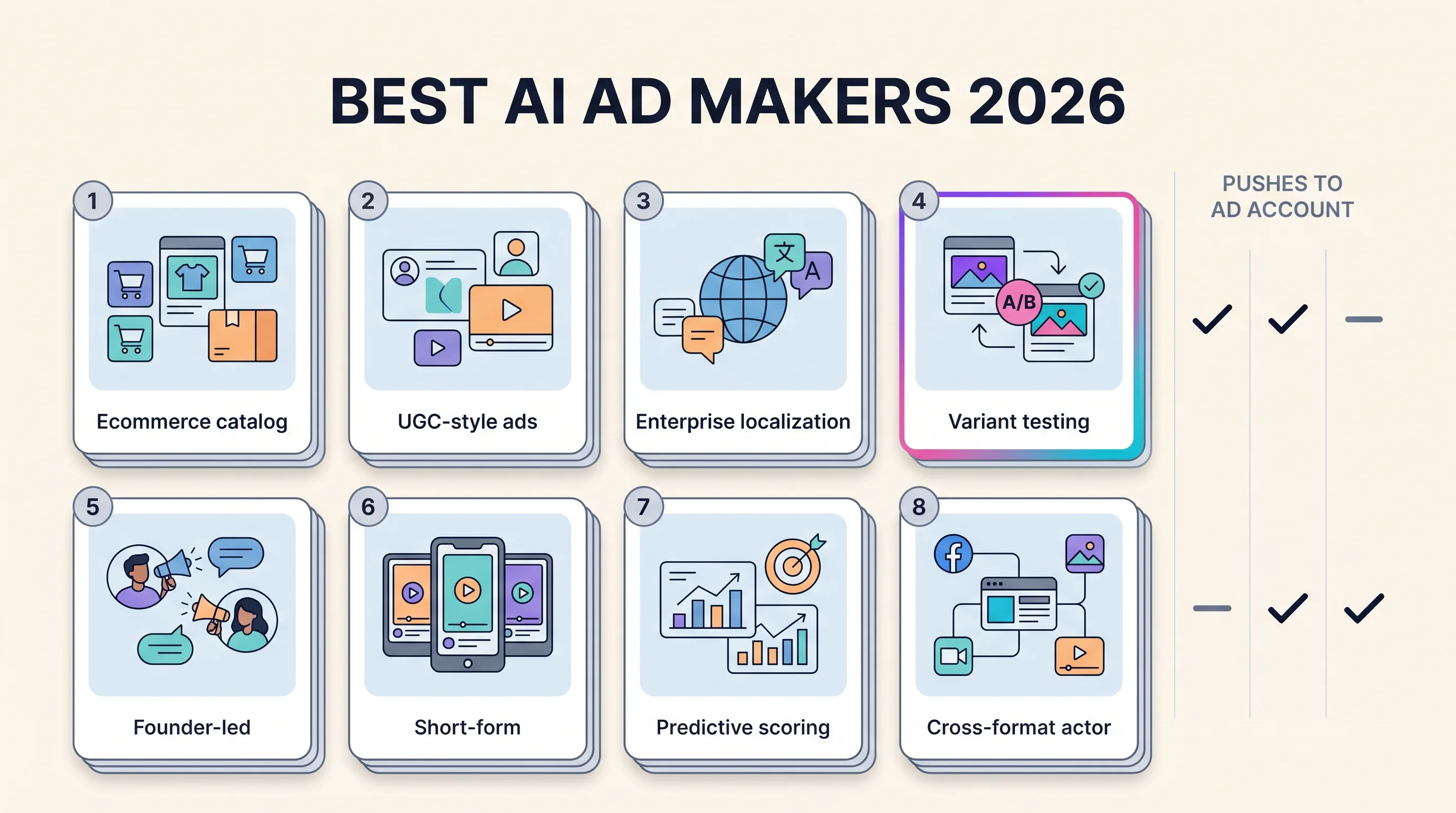
The best AI ad maker is the one that hands back a finished, platform-ready ad — script, footage, voiceover, captions and the right aspect ratio — not a clip you still have to assemble. Eight tools are scored below on six published criteria. HeyGen finishes first overall, Creatify is the highest-scoring tool here with a published push into a connected ad account, and Playcut, which publishes this page, finishes third.
Playcut publishes this ranking and Playcut is one of the tools in it. This is not an independent review. The rubric below was fixed and published before any tool was scored, and Playcut was scored on it like everything else.
It ranks first on one criterion out of six — reusing one actor identity across a whole variant set — and it loses the criterion a media buyer cares most about, delivery straight into the ad account. The tool that wins that one is named in its own card, with the reason.
Table of contents
- What an AI ad maker is, and what it is not
- The method: six criteria, fixed weights, published before scoring
- At a glance: what each tool ships, and when we checked
- AI ad makers ranked by the ad they hand back
- Static or video? The fork most buyers get wrong
- The free option that lives inside the ad account
- Which tool wins which ad job
- Re-weight it yourself
- Named but not ranked, and why
- Where Playcut loses, and to whom
- Frequently asked questions
- How to pick the best AI ad maker
What an AI ad maker is, and what it is not
An AI ad maker turns a brief or a product page into a finished ad: script, footage or layout, voiceover, captions and a platform-ready export. An AI video generator stops earlier, at a clip you still have to edit, caption and resize.
That one distinction changes the shortlist. A tool that renders beautiful footage and hands you a 16:9 file has left the ad-assembly work with you: the hook rewrite, the caption burn, the 9:16 crop, the upload.
So the engines are out of scope here. Runway, Pika, Kling and Sora are graded on a different axis and sit on our separate slate, ranked by motion and cinematic fidelity. For the layer underneath all of it — what AI video ads are, the seven formats, and how they get made — start at the pillar and come back.
The method: six criteria, fixed weights, published before scoring
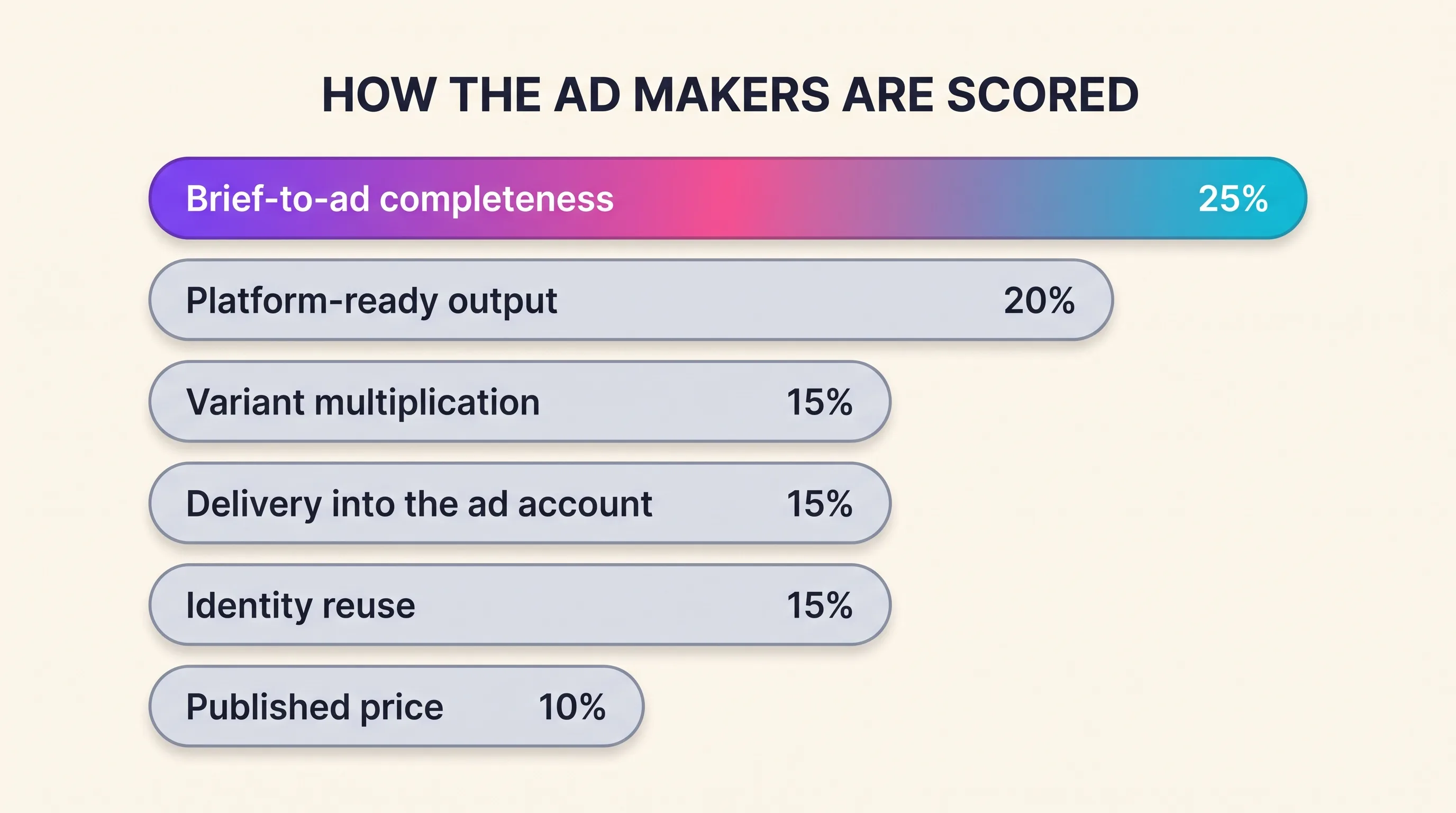
Six criteria, weighted, published before we scored anything. Every level comes from a document you can open — a vendor feature page, a pricing URL with its status code, or a column in our own verified benchmark — and nothing here is a quality judgement. Assigning the level is our editorial audit of that document.
The six criteria
Each tool scores 0 to 4 on each criterion, integers only, no decimals. The weights below were fixed before the first tool was scored and were not touched afterwards.
| # | Criterion | What a level 4 requires | Weight |
|---|---|---|---|
| A1 | Brief-to-ad completeness | Script, footage or layout, voice, captions and export all documented as in-product stages | 25% |
| A2 | Platform-ready output | Published aspect-ratio list, caption system, safe-zone or spec documentation, watermark policy | 20% |
| A3 | Variant multiplication | A documented way to turn one concept into many ads without re-briefing | 15% |
| A4 | Delivery into the ad account | A connector that creates or launches the ad inside Meta, TikTok, Google or an equivalent | 15% |
| A5 | Identity reuse across a variant set | One saved person or brand identity that holds across every asset in the set | 15% |
| A6 | A price published at a stable URL | A reachable pricing page serving a full ladder to a plain HTTP client | 10% |
The formula is score = Σ ( weight × level ÷ 4 ) × 100. Ties break on axis 4 first, then axis 6, then alphabetically. Where no artifact exists the cell renders — and the tool leaves the weighted table entirely; it is never scored 0 by default.
The weights, and where they come from
Weight tracks the cost of the failure: how much of the ad pipeline you must rebuild outside the tool when the criterion fails. A1 leads at 25% because it is the only unrecoverable one — if a tool cannot get from brief to assembled ad, nothing downstream saves you.
A2 outranks A4 because caption and crop failure is per-variant while upload friction is per-ad. Delivery into the ad account is this page’s own novel axis, and it sits mid-table on purpose: raising it moves the winner further from Playcut, not closer.
Conflict of interest, stated plainly: we make one of these tools. The rubric and its weights are published above the slate so you can re-weight them and get a different winner. Where Playcut loses a criterion, its card says which competitor wins it and why.
What this ranking does not measure
This page measures no output quality at all. There is no realism ranking, no identity-consistency number, no lip-sync score, no artifact rate, no cost-per-usable-video and no generation latency anywhere in it.
The capability columns come from the Playcut AI Actor Benchmark v0.9, where every figure was live-checked against the vendor’s own page, across twelve platforms. v0.9 carries verified capability, pricing and policy facts only.
Those missing figures are instrument metrics, and they publish in a later release under the same protocol for every platform, including ours. Nothing here claims one tool produces better-looking ads than another, because that has not been measured. The protocol, including what PAB v0.9 measures and what it deliberately does not, is published separately.
At a glance: what each tool ships, and when we checked
Eight tools, six criteria, one score each, every price checked against the vendor’s own page on the date shown. Two of these columns appear on no other page ranking this category: whether the tool delivers into the ad account, and when we last looked.
| Tool | Best for (ad job) | Entry price | Delivery into the ad account | Limitations | Verified on |
|---|---|---|---|---|---|
| HeyGen — 81.2 | One script, every market | Free tier; Creator $29/mo | Export, then manual upload | No 4:5 preset; US-only data residency; avatar count published three ways | Aug 21, 2026 |
| Creatify — 76.2 | Creative that reaches the ad account | Starter $39/mo | Meta, TikTok, AppLovin — Pro $99 only | No 4:5 in its API enums; annual discount claimed with no dollar figure | Aug 21, 2026 |
| Playcut — 70.0 | One person carrying a whole ad set | Hobby $9/mo | Export only | No ad-account path; no captioning feature; video renders 16:9 and 9:16 only | Aug 21, 2026 |
| Topview — 63.8 | Many models behind one brief | Pro $29/mo list, $16/mo annual | Export only | No free plan published; 960 credits released for the whole year | Aug 21, 2026 |
| Pencil — 57.5 | Launch and track from the entry tier | Core $14/mo | Seven named platforms, launch and track | A generation is a model call, not an ad; hard-capped below Pro | Aug 21, 2026 |
| AdCreative.ai — 56.2 | Static and display at volume | Starter $39/mo | Meta, Google, LinkedIn — one-click push | No pricing URL; no aspect-ratio list, resolution or per-video credit cost published | Aug 21, 2026 |
| Predis.ai — 46.2 | Every placement sized from one brief | Core $19/mo | None — organic scheduling only | 4:5 not stated; integrations page returned 403 to our checks | Aug 21, 2026 |
| Arcads — 36.2 | A talking-actor roster | Not published | None published | Pricing page 404s; no A/B framework; no reporting; no 4:5 | Aug 21, 2026 |
Scores are arithmetic over levels we assign by auditing each vendor’s published documentation, not a measurement of output quality. Entry price is the lowest-priced paid rung that removes the watermark where one exists. For the maintained cross-vendor version of that column — normalised entry prices, metering models and free-tier terms across twelve platforms — use the pricing index.
AI ad makers ranked by the ad they hand back
Every card below names at least one thing that tool does better than Playcut. If a card could not produce one, the tool would not be in the ranked slate. Playcut publishes this ranking, and its own card is written to the same template as the other seven.
1. HeyGen — one script, the same ad in every market
Score 81.2. HeyGen scores highest overall because it takes the top level on both of the two heaviest criteria, brief-to-ad completeness and platform-ready output, and is the only tool here that separately names and prices a lip-synced translation against an unsynced dub.
What it costs. Free at $0 for three watermarked videos a month; Creator $29/mo for 600 credits; Pro from $49/mo on a slider; Business $149/mo plus $20 a seat. Avatar IV and V meter at 20 credits a minute, so Creator’s 600 credits buy 60 thirty-second ads at about $0.48 each. Checked on HeyGen’s pricing page, August 21, 2026.
Where it loses. Delivery is export-only. HeyGen’s own wording is upload directly to Meta Ads Manager, TikTok Ads Manager, or download — a file upload, not an ad-account connection. There is no 4:5 preset either; that ratio is reachable only through custom dimensions.
HeyGen’s security page states that all HeyGen customer data is stored in the United States on AWS infrastructure, and it publishes no deletion timeframe. The avatar library is reported three ways across HeyGen’s own surfaces — 500+, 700+ and 1,100+ — so no unqualified count appears here, and the 175-language figure is a vendor claim.
Handoff. HeyGen also sits on our UGC slate, ranked by the creator-style clip they produce rather than by the finished ad.
2. Creatify — the highest-scoring tool here that pushes creative into the ad account
Score 76.2. Creatify is the highest-scoring tool in the ranking whose output stops being a file and starts being a live ad: Ad Launcher pushes creative into Meta, TikTok and AppLovin ad accounts without leaving the tool. AdCreative.ai and Pencil publish an ad-account path too, and Creatify is the only one of the three that reaches AppLovin.
What it costs. Starter is $39/mo for 100 credits; Pro is $99/mo for 300, with a slider to 5,000; the free plan is a recurring 10 credits a month, watermarked. Captions ship as 39 burned styles across 10 font families. Checked on Creatify’s pricing page and its billing documentation, August 21, 2026.
Where it loses. There is no 4:5. The ratio appears zero times across Creatify’s own link_to_videos and lipsyncs endpoint enums, so a Creatify ad in Meta Feed is letterboxed from 1:1 or cropped from 9:16. Ad Launcher is also paywalled at the $99 Pro tier.
What the page does not answer. An annual banner claims up to 50% off with no dollar figure in the served HTML, 13 of the 14 pricing-page FAQ answers do not render without JavaScript, and Pro seats are published as both “up to 5 seats (1 included)” and “Seats: 1” on the same page. Our Creatify alternatives breakdown covers that field.
3. Playcut — one brief, a complete ad set, one actor holding across every placement
Score 70.0. Playcut is the pick when the same person has to carry an entire ad set at a cadence you can sustain: an actor built from your own casting brief and reference photos, saved once and reused across stills, motion, UGC and on-product shots, from $9 a month.
What it costs. Hobby $9/mo for 500 credits and 3 custom actors; Pro $29/mo for 2,000 credits and 10 actors; Studio $79/mo for 6,000 credits across 4 seats, or $19.75 a seat; Agency $149 per seat. Annual billing takes 17% off. A voiced 10-second actor clip on the default fastest tier costs 85 credits, about $1.23 on Pro, before any re-rolls.
The one criterion it wins. Of the twelve platforms live-checked in the Playcut AI Actor Benchmark, Playcut is the only one whose saved actor object we verified as reusable across stills, motion, UGC and on-product generation. HeyGen publishes a competing cross-scene claim, which we record as a vendor claim rather than a verified one, and score at 3 instead of 4.
See the verified-capability table for all twelve platforms and how the field compares on holding one actor identity. It is a verified capability, not a quality score.
Where it loses. There is no ad-account delivery path — Playcut exports and you upload, and that is the criterion Creatify, AdCreative.ai and Pencil all clear while Playcut does not. There is no captioning feature at all. The Veo 3.1 video path renders 16:9 and 9:16 only, so 4:5 is reachable on stills but not on video.
There is no free tier either: the trial is 7 days on Hobby, card required, one per user ever. The UGC-specific workflow sits on Playcut’s AI UGC ad generator page.
Cast one actor, then run a whole ad set through them — from $9 a month.
Start 7-day trial →
4. Topview — many generation models behind one ad brief
Score 63.8. Topview accepts a product URL, a product image or a campaign brief and returns 15-, 30- or 60-second vertical creative with captions, voiceover and hook variations — check the credit math before you buy the sticker price.
What it costs. Pro lists at $29/mo and bills at $16/mo annually: $192 a year for 960 credits, released once for the whole year. Business is $44/mo annually; Ultra is $50/mo annually and meters 500 credits a month that expire monthly. Checked on Topview’s pricing page, August 21, 2026.
The credit math worth doing first. On Topview’s own published Seedance 2.0 720p rate of 4 credits per 4 seconds, a 30-second ad costs 30 credits. Pro’s 960 credits are therefore 32 thirty-second ads for the year, about $6.00 each, before any re-rolls.
Where it loses. Topview publishes no free plan; the ladder starts at Pro. There is no ad-account connector anywhere on the site, so every export is a manual upload, and no catalog, Shopify or Amazon import is named on any surface we checked.
5. Pencil — launches and tracks in seven ad platforms from the entry tier
Score 57.5. Pencil gets a generated ad into a connected ad account at the lowest entry price in this ranking: Facebook, Instagram, TikTok, YouTube, Google Display, DV360 and LinkedIn, launched and tracked, from the $14 Core tier.
What it costs. Core is $14/mo ($11 annual) for 50 generations and one workspace; Growth is $55/mo ($44 annual) for 250 generations and unlimited workspaces; Pro is custom-quoted. Predictive scoring begins on Core once ad accounts are connected. Checked on Pencil’s pricing page, August 21, 2026.
Where it loses. A generation is a model call, not an ad. Pencil’s own definition is that a generation is every time a customer interacts with an AI model to generate something, so each re-roll, resize and copy variation burns one of the fifty. Core and Growth are hard-capped, with overage only on Pro.
Not published. Seat counts per tier and free-trial length are absent from the pricing page, so neither appears above. Pencil has been owned by The Brandtech Group since June 2023.
6. AdCreative.ai — static and display creative at volume
Score 56.2. AdCreative.ai is the static-and-display half of this category: a brief becomes ad creative, product photoshoots and ad copy, pushed to Meta, LinkedIn and Google, with generation uncapped and the meter on download.
What it costs. Starter is $39/mo for 10 credits, one brand and one seat; Professional is $249/mo for 50 credits and 10 brands. In its own words, a credit is used when you download a generated ad creative, and generation itself is unlimited. The 7-day trial carries 10 credits and requires a card.
Where it loses. There is no pricing URL. Its /pricing, /plans and /pricing-b paths all returned 404 on August 21, 2026, and prices render only on the homepage. No aspect-ratio list, no maximum resolution and no per-video credit cost appears across its 174 sitemap URLs, so cost-per-video is not computable from published information.
Read its own docs first. Of the three UGC formats its product page markets, its Academy documentation says talking head is available now, with show-and-tell and fashion styles coming soon. Its published integration list is Meta, Google, LinkedIn, Pinterest and Microsoft Ads; TikTok is not on it.
7. Predis.ai — one brief, sized for every placement
Score 46.2. Predis.ai is the only tool in the ranking that publishes a throughput ladder — price, credits, and the vendor’s own conversion into images and videos — so a month of variant testing is calculable before you pay.
What it costs. Core is $19/mo ($230 a year) for 1,300 credits, which Predis.ai converts to roughly 86 images or 9 videos. Rise is $40/mo ($474 a year) for 3,200 credits, or 213 images or 22 videos, and Enterprise+ is $212/mo for 10,000 credits. Checked on Predis.ai’s pricing page, August 21, 2026.
Where it loses. Its own instruction to buyers is: just download, upload, and launch. The “publish to 10, 20 or 60 channels” line describes organic social scheduling, not ad-account delivery — the served homepage contains zero occurrences of “Ads Manager” and zero of “ad account”. A 4:5 preset is not stated; its published specs name only 1440×1440 and 1440×2560.
One check we could not complete. The Predis.ai integrations page returned 403 to our requests, so its connector list could not be enumerated. That is a gap in our verification, reported rather than filled from a third-party list.
8. Arcads — the talking-actor roster with no published price
Score 36.2. Arcads publishes no price. Its pricing page returns a 404 on both hosts, the URL appears in none of its 280 sitemap entries, and the Internet Archive has never captured it once.
What it does publish instead. Its help centre lists Starter at 8,000 credits a month and Creator at 16,000, with Pro, Scale and Business quoted by email. A Talking Actor costs 800 credits per minute, per actor, rounded up, so a 30-second ad and a 60-second ad cost the same.
What that works out to. Dividing Arcads’ own published credit allowances by its own published rate gives 10 videos a month on Starter and 20 on Creator. Its documented flagship workflow — 20 eight-second clips, 10 actors, English and Spanish — comes to 16,000 credits, an entire Creator month in one run.
What Playcut has no answer to. That flagship run is a batch primitive: one script fans out to ten actors and two languages in a single documented workflow. Playcut publishes no equivalent batch step, and it meters each generation separately.
Where it loses. Across 280 URLs, 39 help articles and its Terms there is no A/B framework, no performance reporting, and no ad-account connector of any kind. There is no free tier, no free trial, no published maximum resolution and no 4:5.
One correction worth carrying. The widely repeated claim that Arcads credits never roll over is half right. Starter and Creator reset, and the account is temporarily blocked at the limit; Pro, Scale and Business roll over and bill overage per credit.
Static or video? The fork most buyers get wrong
Some ad makers output video, some output image and display creative, and a few meter both. Match the tool to the placement you are buying, not to the demo you watched. Static and display is where AdCreative.ai and Pencil concentrate; video-first is where HeyGen, Creatify, Topview and Playcut sit. Predis.ai is the only tool here that publishes a credit conversion for both.
This is a buying question, not a performance debate. Nothing on this page claims a static ad converts better than a video ad, or the reverse, because that depends on the placement, the offer and the account. What the tool decides is which placements you can fill at all this month.
The static half. AdCreative.ai’s named outputs are ad creatives, product photoshoots and ad copy, pushed to Meta, Google and LinkedIn, with the meter on download rather than on generation. Its published integration list adds Pinterest and Microsoft Ads, and does not include TikTok. If your placements are display, search and feed images, that is the half of the category you are shopping in.
The video half, and the ratio to check first. That ratio is 4:5, the Meta Feed placement. Creatify’s API enums do not contain it, HeyGen reaches it only through custom dimensions, Arcads never names it, and Predis.ai’s published specs stop at 1440×1440 and 1440×2560. Playcut is in the same position on video: stills reach 4:5, the Veo 3.1 path renders 16:9 and 9:16 only.
Both halves get graded against the same published specs. TikTok documents its in-feed video ad specifications, and Google publishes image and video asset requirements for Google Ads. Check the ratio list a tool publishes against the placement you are actually buying.
If the ad is a product rather than a person, start with the product-photo-to-ad workflow and the four product-ad formats, then pick the tool that fills those placements.
The free option that lives inside the ad account
Meta and Google both generate ad creative inside the buying surface with no separate subscription, which makes them the free baseline every paid tool has to beat. Neither publishes a standalone price. Access is not universal, and Google’s own documentation says its generative tools are designed to limit the creation of faces.
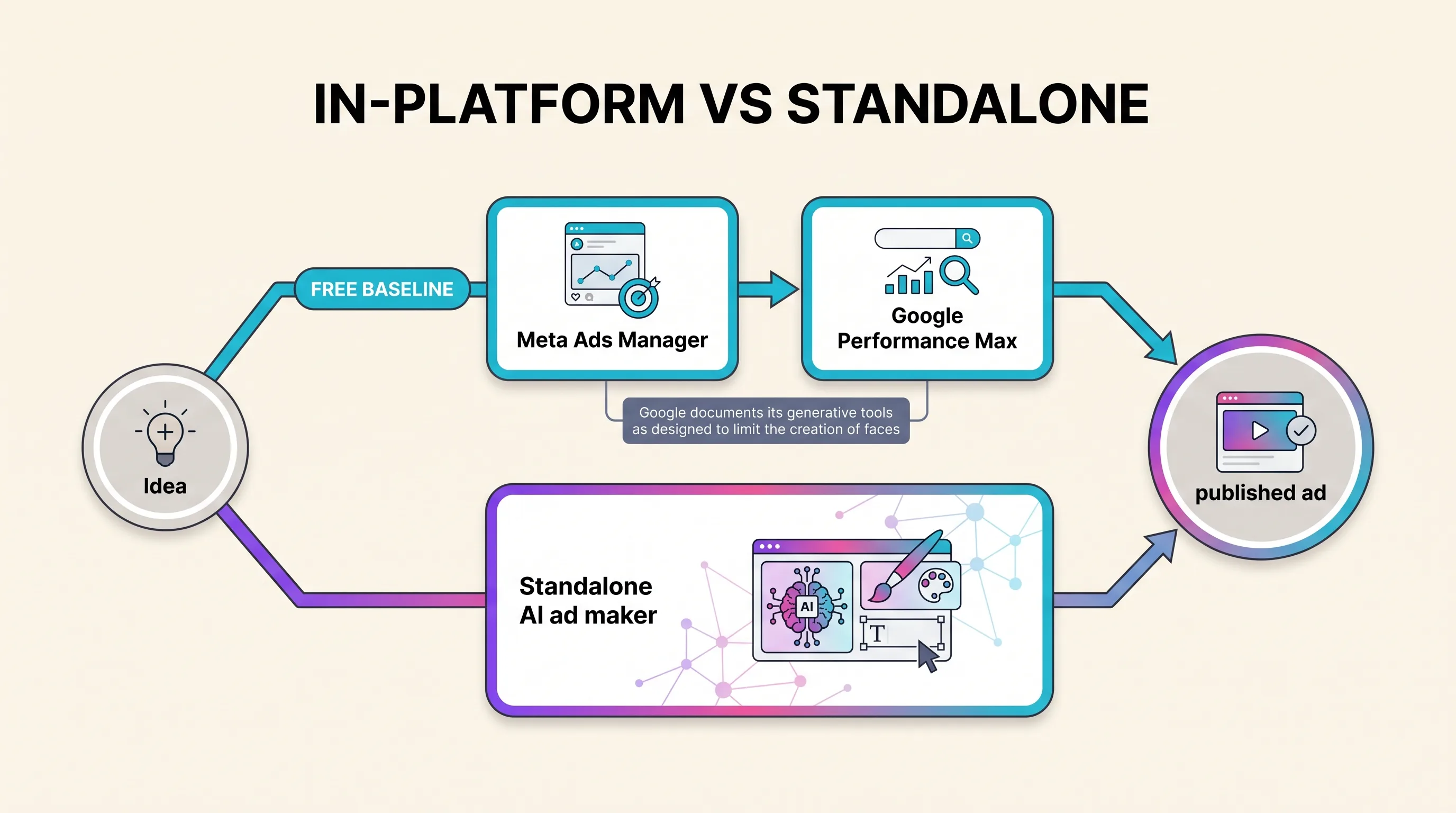
Meta Advantage+ creative
Advantage+ creative generates and enhances ad variations inside Ads Manager, not in a separate app. Meta’s own feature page names background generation, video expansion, related media, image animation, image expansion, text generation, image generation and image touch up. Background generation is scoped to catalog ads by name, some enhancements are on by default, and Meta states its previews are not an exhaustive list.
That feature page is deliberately not linked here. It returns a 400 to an ordinary browser request, and a source a reader cannot open is not a citation.
Google Performance Max asset generation
Performance Max generates four asset categories inside the campaign: text assets, image assets, logos and business name assets, and video assets. Google’s help page for generative asset creation publishes no fee, states the feature is rolling out gradually to customers that meet certain criteria, and lists the Performance Max asset group using generative AI as US only. Assets it creates are not guaranteed to be approved by Ads Policy.
One thing that doc does not describe is generating assets from a Merchant Center product feed. Performance Max consumes a feed for targeting; its generative layer edits a product or service summary you write yourself.
Why the free option still leaves a gap
The gap is a person. Google’s wording is worth quoting rather than paraphrasing: generative AI tools in Google Ads are “designed to limit the creation of certain content, including faces, children, branded items, responses to matters of opinion or advice, and images that may violate Ads Policy or the Generative AI use policy.” Designed to limit is not the same as cannot, and it is Google’s sentence, not ours.
Meta’s position is to label the case rather than limit it. Its transparency post on generative AI in Meta’s ads products describes an AI label appearing next to the Sponsored label when its generative features produce a photorealistic human, and says Meta will begin automatically detecting ads created or edited with third-party AI tools and apply an “AI info” label.
That auto-detection applies to output from any tool on this page, which makes labelling a workflow question rather than a tool question. AI ad disclosure, the FTC rules, and what the platforms auto-label covers it in full.
Two Playcut pages carry the placement detail underneath both platforms: Meta’s placement specs and how Advantage+ compares to a dedicated tool, and TikTok’s 9:16 specs and the AIGC label.
Need a person to carry the ad? Google documents its own generative tools as designed to limit the creation of faces.
Start 7-day trial →
Which tool wins which ad job
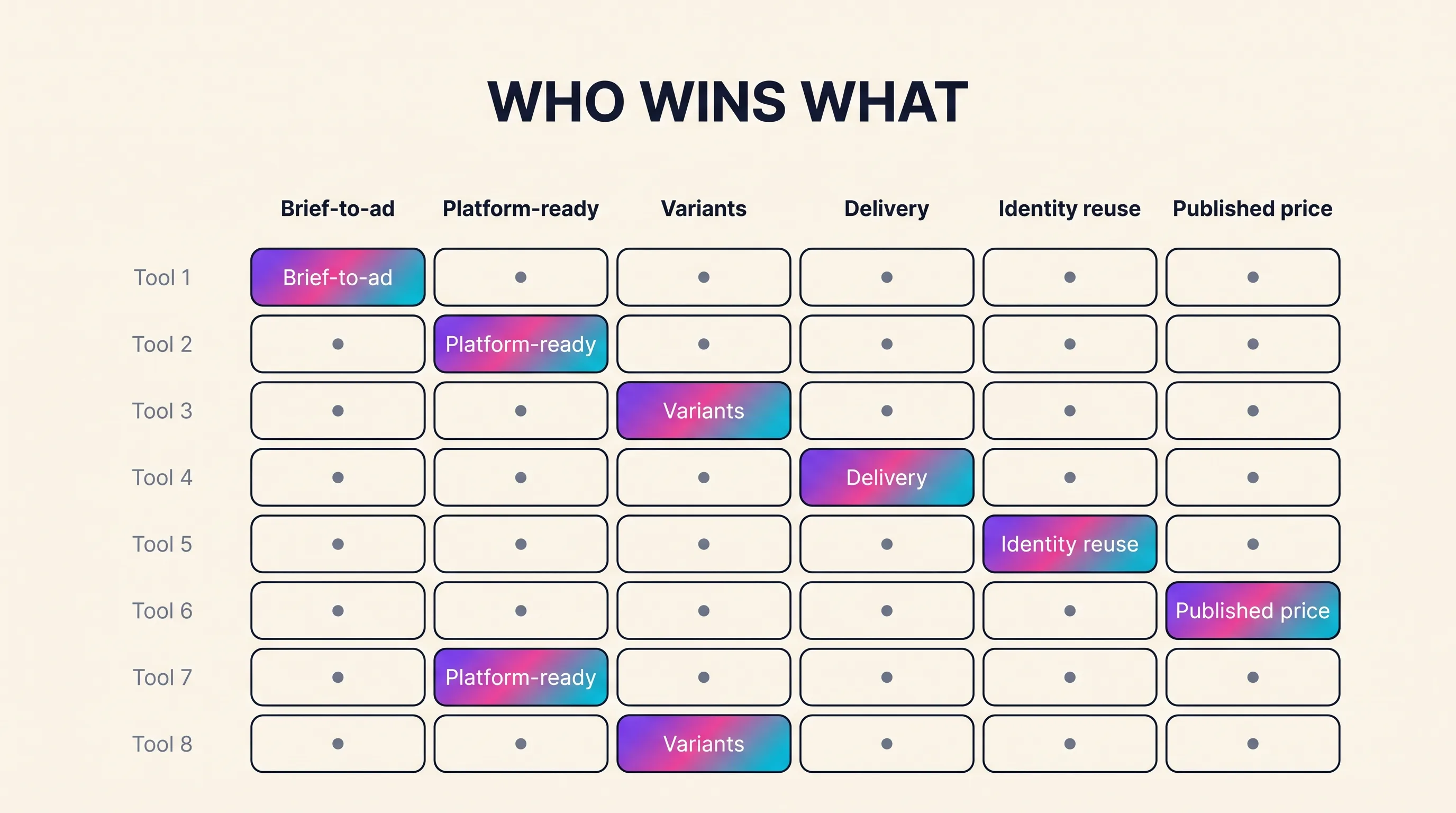
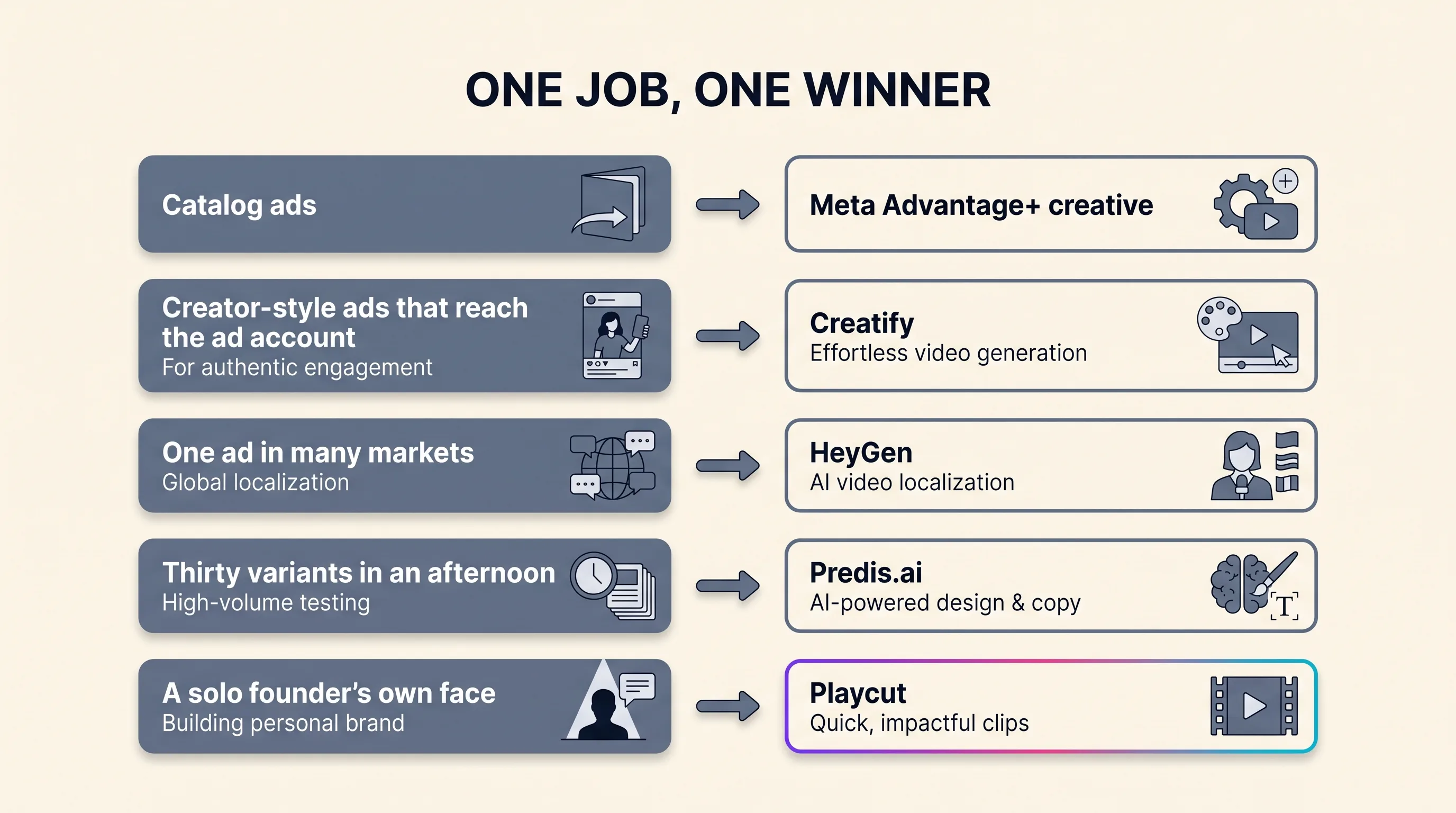
Five ad jobs, five different winners, and no tool wins twice.
| Ad job | Winner | Why it wins that job |
|---|---|---|
| Ads for a whole catalog, not one product | Meta Advantage+ creative | Background generation is scoped to catalog ads by name and runs inside Ads Manager, with no separate subscription |
| Creator-style ads that reach the ad account | Creatify | Ad Launcher pushes finished creative into Meta, TikTok and AppLovin ad accounts from the $99 Pro tier |
| One ad, many markets | HeyGen | Lip-synced translation is metered separately from an unsynced dub, so the translated cut is a line item you can budget |
| Thirty variants by this afternoon | Predis.ai | The only vendor here that converts each plan’s credits into a finished image and video count, so the variant count is calculable before you pay |
| It’s just you and a Stripe account | Playcut | An actor cast from your own reference photos or a written brief, plus a voice clone from an audio sample, from $9 a month |
Two of the five winners sit outside the top three of the weighted table, and one of them is not in the ranking at all. That is what scoring six criteria buys you over picking a favourite: the tool with the highest total is not automatically the right tool for the ad in front of you.
The last row is the one to read sceptically, because we publish this page. Playcut wins it on one constraint, the lowest paid entry price that includes custom actors and voice cloning, and it still finishes third behind HeyGen and Creatify in the solo-founder weighting below.
Route by who is buying, not by the leaderboard. A DTC brand shipping product creative should start at the Playcut product ad generator. An agency running ten client accounts wants how agencies run ad creative across ten client accounts before it picks a seat model.
An in-house brand team building a spot rather than a feed ad is on a different job again, and the AI commercial generator workflow covers that one. A solo founder is the only buyer here for whom the entry price and the actor question are the same question.
A brand whose strongest asset is a shelf of real five-star reviews is on a fourth job again. The AI testimonial video maker comparison scores that one on whether the tool lets you stay inside the FTC endorsement rules.
Re-weight it yourself
Change the weights and the winner changes. Five buyer weightings are precomputed below on the same six criteria and the same published levels, and Playcut finishes first in none of them.
| Weighting | A1 | A2 | A3 | A4 | A5 | A6 | Top four |
|---|---|---|---|---|---|---|---|
| House default | 25 | 20 | 15 | 15 | 15 | 10 | HeyGen 81.2 · Creatify 76.2 · Playcut 70.0 · Topview 63.8 |
| Performance media buyer | 20 | 20 | 20 | 25 | 5 | 10 | Creatify 76.2 · HeyGen 75.0 · AdCreative.ai 63.8 · Pencil 63.8 |
| Brand / agency | 30 | 20 | 10 | 5 | 15 | 20 | HeyGen 90.0 · Creatify 81.2 · Playcut 78.8 · Topview 73.8 |
| Solo founder, first ad | 35 | 25 | 10 | 5 | 5 | 20 | HeyGen 92.5 · Creatify 85.0 · Playcut 76.2 · Topview 76.2 |
| One face across everything | 25 | 15 | 5 | 5 | 40 | 10 | HeyGen 85.0 · Playcut 83.8 · Creatify 72.5 · Topview 66.2 |
In the solo-founder row Playcut and Topview tie at 76.2; the published tiebreak is criterion A4, then A6, then alphabetical, which lists Playcut first. In the performance-media-buyer row AdCreative.ai and Pencil tie at 63.8 and break the same way.
Playcut does not finish first under any of these five weightings. Our actor comparison weights identity consistency at 40% and Playcut wins it there. Here the same capability is capped at 15%, because on an ad-maker page identity is one input among six. Even in the weighting that pushes identity to 40%, HeyGen’s published cross-scene claim edges us, and we score a vendor claim at level 3 rather than zero because we have not verified it ourselves.
The page’s own novel criterion cuts against us, which is the cleanest available test of whether the weights were set to flatter the publisher. At 0% weight on delivery into the ad account Playcut scores 77.5; at the published 15% it scores 70.0; at 30% it scores 62.5 and Creatify takes first outright.
Named but not ranked, and why
Six tools that belong in this conversation are not in the ranking, and each is out for a stated structural reason rather than a demotion.
- Synthesia. Its own Acceptable Use Policy, page-stamped February 23 2024, prohibits “incorporating a Stock Avatar in content for ‘promoted’, ‘boosted’, or ‘paid’ advertising on any social media platform or similar media, absent written express consent from Synthesia.” That is a licence fact about the ad job, not a judgement about the product. The compliant route is a Personal avatar: 3 on Starter, 5 on Creator.
- MakeUGC. A clip tool rather than an ad maker, and already ranked on our UGC generator slate. Its ladder is $59, $79 and $149 with a 3-day free trial, verified at two check dates. Its “30% off Special 24h offer” sat above a countdown reading 24 days on the date we checked, which is a fact about the banner and not about the product.
- Canva Magic Studio. canva.com returned 403 to every user agent we tried, including a real browser, so no price and no feature list could be verified. Nothing about Canva is scored here. That is our verification failure, not a finding about Canva.
- Creatopy, now trading as The Brief. Display and banner resize at scale, and a fixture of competing roundups. No first-party verification was run for this page, so it carries no price and no score. Naming both names correctly matters, because several published slates still use them interchangeably.
- Revid AI. Its own structured data classifies it as a video editor for short-form social video, and the loop it is built for is organic growth rather than paid delivery. There is no ad-account path, so it sits outside the criterion this page treats as the category’s dividing line.
- Icon. Raised more than $30M, bought icon.com for $12M and launched as “The AI Admaker”, then rebranded to “The Human Admaker” with “no AI / 100% real” on every surface — which is what takes it out of an AI slate. It sells six human-filmed UGC ads for $1,000, billed at $0 today and $1,000 a month after three days. That is $166.67 per finished human ad, the honest price anchor for the non-AI alternative.
Presenter and avatar products are graded on a different axis and sit on their own page: avatar-first tools ranked separately. An avatar is one stage of an ad, not the ad.
Where Playcut loses, and to whom
Playcut loses the criterion a media buyer cares most about. It has no Ad Launcher equivalent, no campaign launch and no media-buyer agent; Creatify has all three, and on delivery into the ad account Creatify beats us outright.
- No ad-account delivery. Playcut exports a file and you upload it. Creatify, AdCreative.ai and Pencil all publish one, and Pencil launches and tracks in seven named ad platforms from its $14 Core tier.
- No captioning feature. Burned captions are a finishing stage Playcut does not ship at all. Creatify publishes 39 caption styles across 10 font families.
- No 4:5 on the video path. Stills reach 4:5; the Veo 3.1 video path renders 16:9 and 9:16 only. Synthesia is the only vendor we checked that ships a native 4:5 preset, and its own licence bars its stock avatars from the paid placements that ratio serves.
- No batch variant primitive. Generations are metered one at a time, with no documented fan-out step. Arcads publishes a single run that turns one script into ten actors in two languages.
- No free tier. The offer is a 7-day Hobby trial, card required, one per user ever. That is a deliberate anti-abuse decision, and it is still a thinner on-ramp than Creatify’s recurring 10 monthly credits or HeyGen’s three free videos a month.
- Ten verified languages. HeyGen claims 175 languages and dialects, and Synthesia claims 160-plus voice languages. Both are vendor claims, and both are larger than the number we can verify.
- No static or display ad system, and no published stock-actor library count. Playcut also appears on none of the eleven competing slates in this SERP. We are the newcomer in this category.
Playcut is placed where the published rubric puts it, not where we would like it. It wins one criterion, one actor identity holding across a whole variant set, and that criterion carries 15% of the score. For everything else on this page, the tool named in that row wins.
Playcut’s four-tier pricing is the only place the full ladder is stated, and the per-clip credit math on Playcut shows what a voiced actor clip costs before you commit to a month.
Frequently asked questions
What is an AI ad maker?
An AI ad maker turns a brief or a product page into a finished ad: script, footage or layout, voiceover, captions and a platform-ready export. An AI video generator stops earlier, at a clip you still have to edit, caption and resize. The split matters at purchase, because a tool that only renders footage leaves the ad-assembly work with you. For the layer underneath both, start at the AI video ads pillar.
What is the best AI ad maker in 2026?
It depends on the ad you need to ship. On our six published criteria HeyGen scores highest overall, Creatify is the highest-scoring tool in the ranking with a published push into a connected ad account, and Pencil launches and tracks in seven ad platforms from its entry tier. Playcut publishes this ranking and finishes third on it.
Can an AI ad maker launch ads straight into Meta or Google Ads?
Some can, and the two platforms are not equivalent. Meta ships an official ads MCP server that lets a connected agent create, edit and delete campaigns, ad sets and ads. Google documents its Ads MCP server as strictly read-only: it cannot modify bids, pause campaigns, or create new assets. Among the tools here, Creatify, Pencil and AdCreative.ai connect to ad accounts; the rest export a file you upload.
Do I still need an AI ad maker if Meta and Google generate ads for free?
Often yes. Neither Meta nor Google publishes a standalone subscription price for in-platform generation, so those tools are bundled into ad spend, but access is not universal. Google’s help page says generative AI in Performance Max is rolling out gradually to customers that meet certain criteria, and lists the Performance Max asset group using generative AI as US only. Assets it creates are not guaranteed to be approved by Ads Policy.
Will Meta’s or Google’s built-in AI generate a person for my ad?
Google says its tools are limited here; Meta says it labels the case. Google’s help page says its generative AI tools are designed to limit the creation of certain content, including faces, children and branded items. Meta’s transparency post describes a label next to the Sponsored label when its generative features produce an AI-generated photorealistic human. If a person has to carry the ad, that is what an actor-based ad maker is for.
Do I need a static ad maker or a video ad maker?
Match the tool to the placement you are buying. Static and display creative is where AdCreative.ai concentrates, with named outputs including ad creatives, product photoshoots and ad copy generation. Video-first ad makers are the pick for Reels, TikTok and in-feed video, where the ad has to hold a face and a voice. Several tools claim both, so check which one their pricing tiers actually meter.
Which AI ad makers publish a price you can actually check?
Creatify, HeyGen, Topview, Pencil, Predis.ai and Playcut all serve a live pricing page. Four platforms in the Playcut AI Actor Benchmark do not: the Arcads pricing page returns a 404, Akool renders every paid tier as $0 per seat per month, Argil renders a permanent loading state, and Higgsfield’s page will not render for a crawler. AdCreative.ai publishes prices on its homepage but has no pricing URL, and Canva blocks our checks.
Playcut published this ranking, so why should I trust it?
You should not trust it on our say-so. We publish the six criteria and their weights before the slate so you can re-score it yourself, we name the tool that wins each criterion Playcut loses, and every price is checked against the vendor’s own page on a stated date or left blank. Playcut is not first on this page, and the one criterion it wins is a verified capability, not a quality score.
How to pick the best AI ad maker
Buy for the ad you are actually shipping this month: HeyGen if one script has to become the same ad in every market, Creatify if the creative has to land in a connected ad account, Playcut if the same person has to carry an entire ad set at a cadence you can sustain.
If the placement is display or a product still, AdCreative.ai is the specialist, and Predis.ai is the one tool here publishing an image-per-credit conversion you can budget against.
If budget is the binding constraint, Pencil’s $14 entry tier is the lowest-priced route to an ad that launches inside a connected account. And if nothing in the ad has to carry a face, Meta and Google will generate it inside the buying surface for no extra fee.
Playcut is $9 a month on Hobby and $29 on Pro, and the thing it is built for is one cast actor carrying every placement in a set. It finishes third on its own page, and the two tools above it are named at the top with the reasons.
Cast one actor, then run the whole ad set through them. Hobby $9/mo, Pro $29/mo, annual billing 17% off.
Start 7-day trial →