
AI Testimonial Video Makers Compared 2026

An AI testimonial video is a customer testimonial performed by a generative AI actor or avatar instead of filmed. The FTC’s 16 CFR Part 465, effective October 21, 2024, makes inventing the endorser unlawful. The endorsement guides at 16 CFR § 255.2 separately require an ad that appears to show actual consumers to disclose when it does not. A lawful AI testimonial is therefore a real customer’s real experience, disclosed.
That distinction is a buying criterion, and nobody in this category scores it. So we checked ten testimonial video tools against six things a product can actually ship — consent capture, an on-clip disclosure preset, export provenance, a platform AI-label handoff, a field binding the script to the source review, and a published policy on fabricated endorsements. Two of those six columns produced no Yes from any tool we checked.
Playcut publishes this page and Playcut is one of the ten. It ships none of the six, so it finishes last on this page’s ordering, and its card says so in the first line. Every card names one thing that tool does better than we do.
The statutes themselves, penalty by penalty, live in the full 2026 AI UGC compliance map, and where testimonial sits among the seven AI video ad formats is covered in the AI video ads pillar. This page is only about which vendor lets you obey the rules inside the product.
Table of contents
- The line that decides which tool you need
- Two families of tool, and most lists only cover one
- How we compared them: six affordances, checked in the product
- The compliance matrix: what each AI testimonial video tool actually ships
- The ten tools, compared
- What to demand from a testimonial vendor before you buy
- The five records that make an AI testimonial defensible
- Which tool for which testimonial job
- Frequently asked questions
- Picking a tool when the testimonial has to be true
The line that decides which tool you need
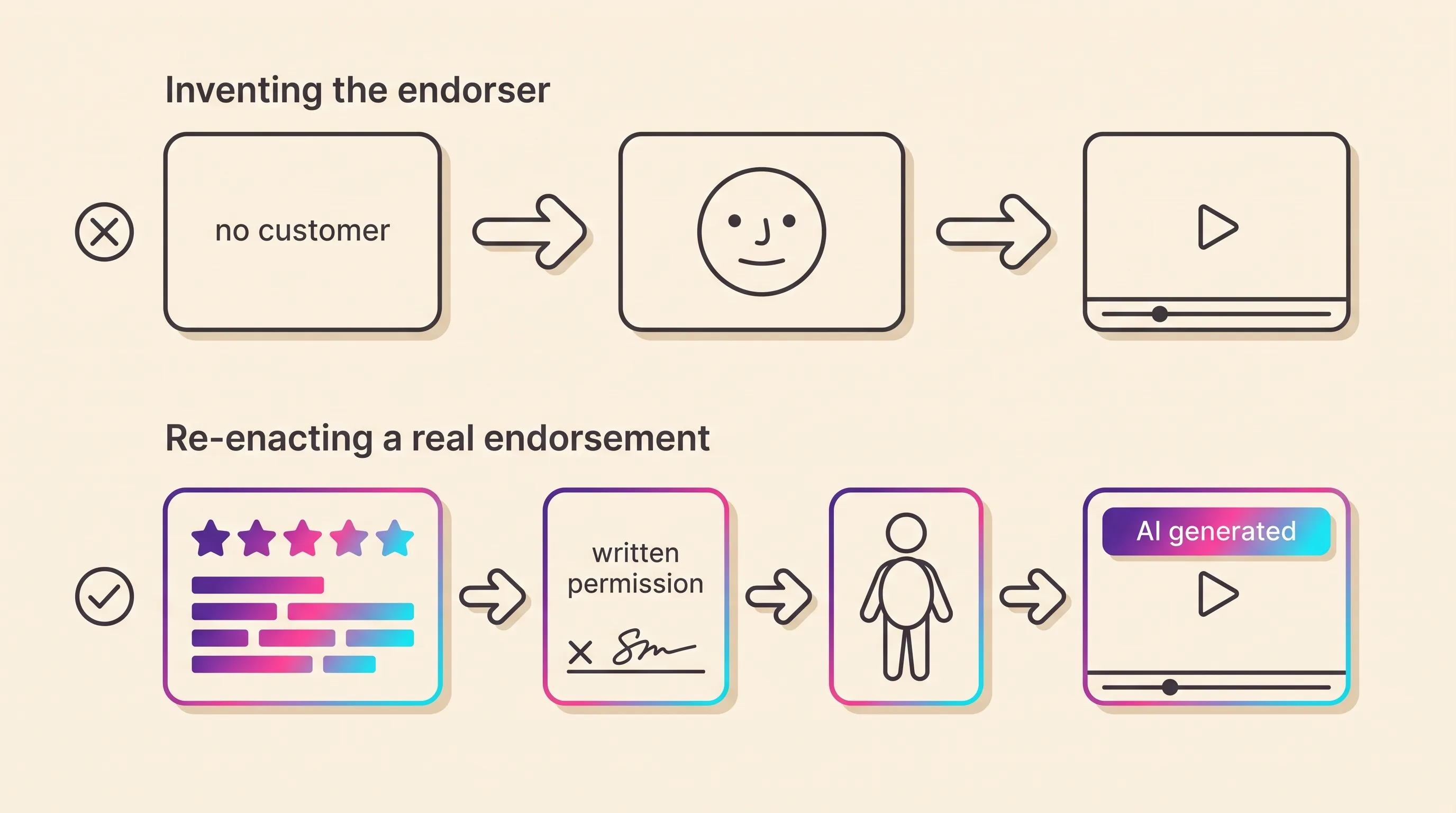
One line separates a lawful AI testimonial from an unlawful one: whether the endorsement already exists. The FTC’s own staff answers on AI avatars and the rule put that same test in the regulator’s words, with the caveat staff attach — the guidance is not definitive and offers no safe harbor.
Inventing the endorser
A testimonial from a person who does not exist, or a real person’s experience they never had, is unlawful in the US however it was produced. That is 16 CFR § 465.2, which reaches a testimonialist who does not exist, and it covers writing, creating and selling alike. The fake testimonial AI question turns on existence and experience, not on render quality.
Re-enacting a real endorsement
An actor delivering a real customer’s substantiated words has always been ordinary advertising when the portrayal is disclosed. The FTC’s long-standing actor-portrayal disclosure rule says an ad presenting what are represented to be actual consumers should use actual consumers, or clearly and conspicuously disclose that they are not. An AI customer testimonial made this way applies a production method to an endorsement that already exists.
Elsewhere on this site, AI UGC for testimonials gets a flat no. That no governs inventing the endorser. This yes governs re-enacting a substantiated one: a real customer, their real words, documented permission, plus the actor portrayal and the AI disclosed on the clip. When a real customer on camera still beats any synthetic stand-in is a separate question.
Two families of tool, and most lists only cover one
Testimonial tools split into two families that solve different problems, and most roundups only cover one. Capture platforms collect a real customer on camera; synthetic performer tools turn a script into a person delivering it. Which family a tool belongs to decides which affordances even apply.
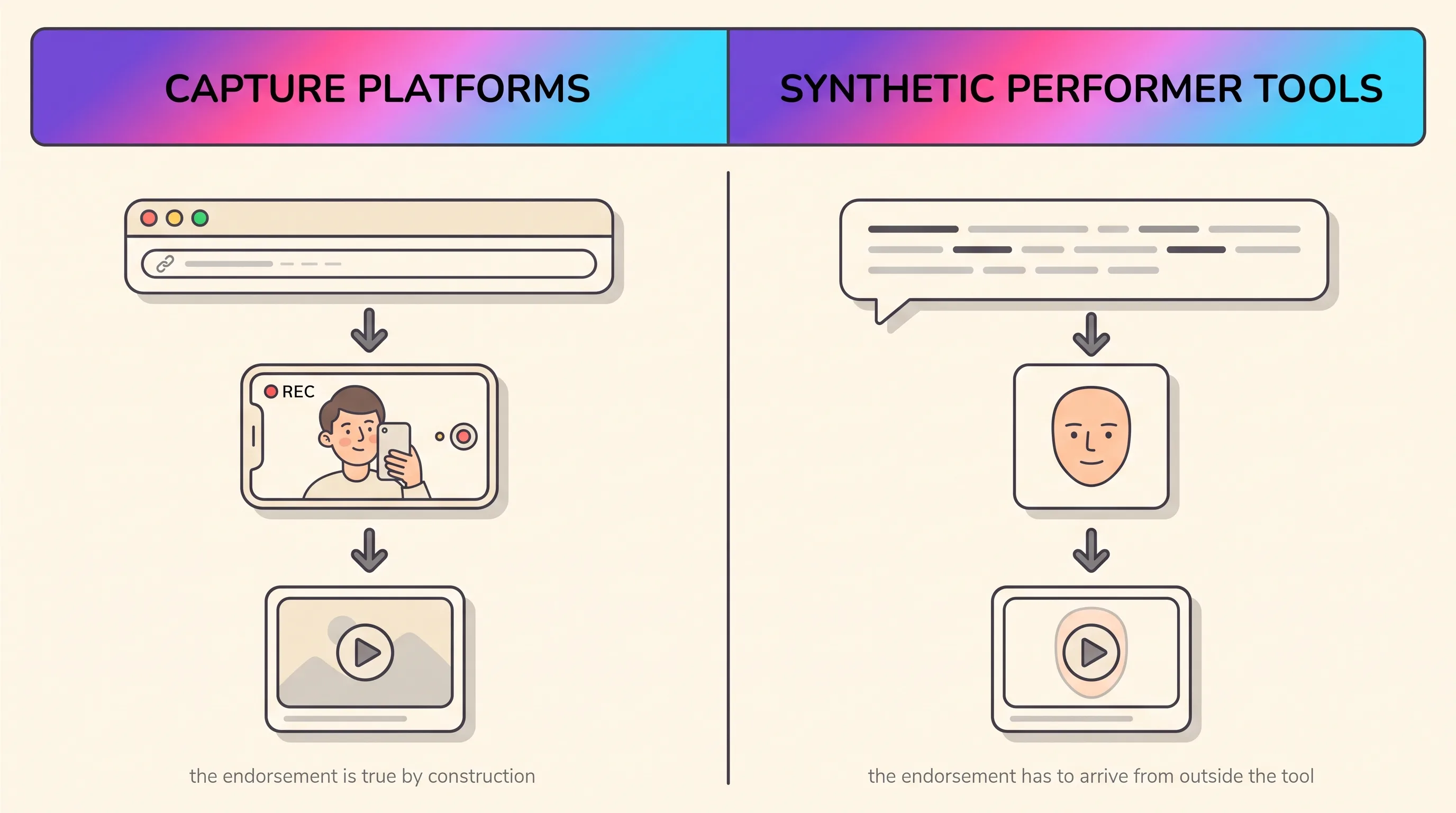
Capture platforms: a real customer, on camera
Capture platforms send your customer a request link, the customer records themself, and you review and publish the result. The testimonial is true by construction — the person exists, the experience is theirs, and no AI label is owed because nobody was synthesised. What they cannot do is produce a video from a written review, or from a customer who will not go on camera.
Synthetic performer tools: a script, read by a generated face
Synthetic performer tools take any script and return a person delivering it, in any language, at volume. This is what the category calls itself — an AI testimonial generator, testimonial video AI, a testimonial video maker — and the naming hides the problem. What they cannot do is make the endorsement true. That has to arrive from outside the tool, and none of the ten has a slot to put it in.
How we compared them: six affordances, checked in the product
We checked ten tools against six things a product can actually ship, each one an artifact on the vendor’s own published surface on August 21, 2026. Nothing is scored from a claim we could not open and read. Output quality and delivery into the ad account belong to our general AI ad maker ranking, on a different instrument.
The published ordering rule: capture platforms first, then synthetic performer tools. Inside each family, most verified Yes cells first, then most partials, then whether a full price ladder renders to a plain HTTP client, then alphabetically. We publish no composite score, so you count the cells yourself.
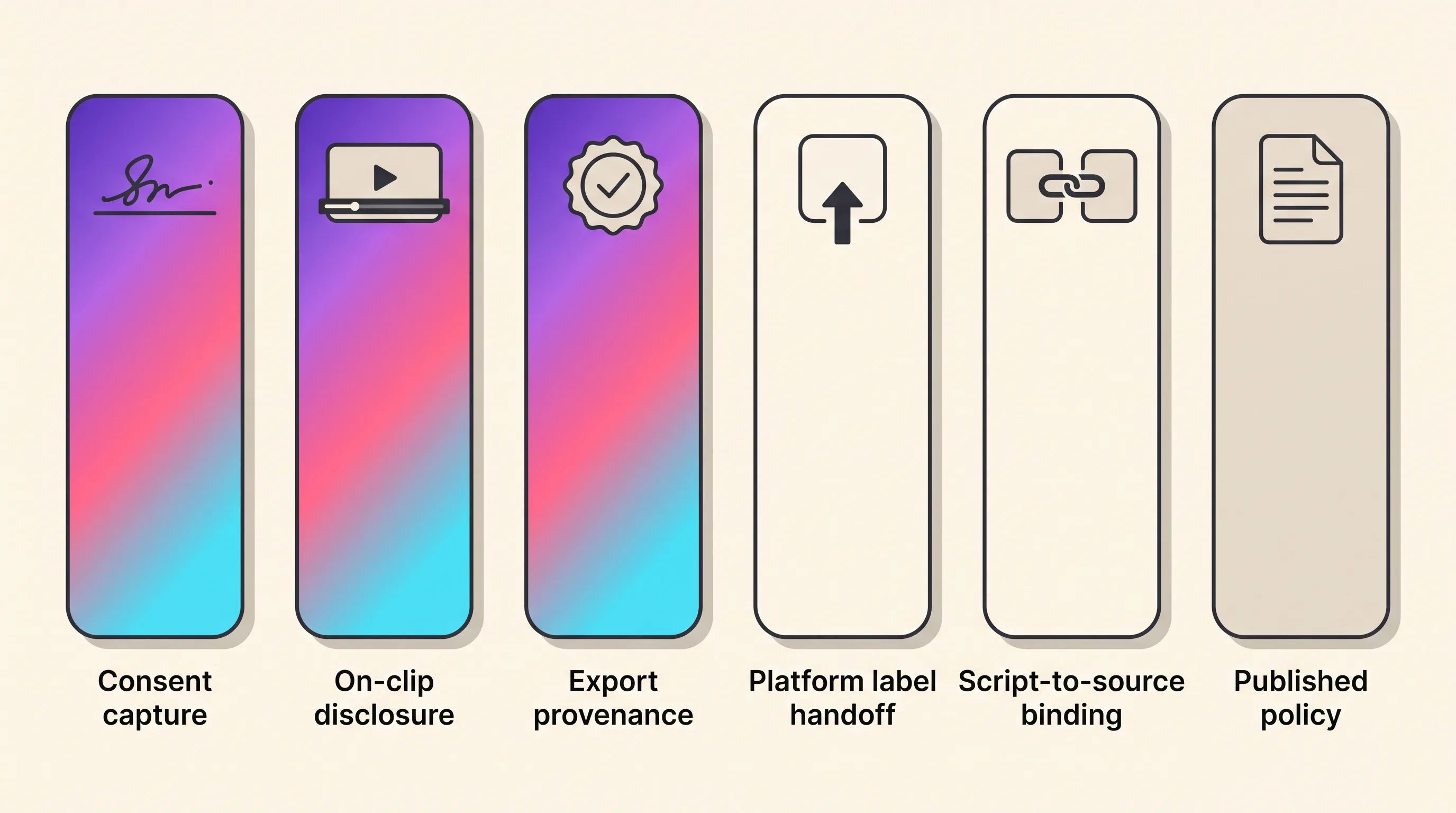
The six affordances
Each affordance is something a product either ships or does not.
| # | Affordance | What a Yes requires |
|---|---|---|
| C1 | Consent / release capture | An in-product flow that records the customer’s authorisation and stores it against the clip |
| C2 | On-clip disclosure | A caption, overlay or template preset that renders an AI-generated notice onto the export |
| C3 | Export provenance | C2PA Content Credentials, SynthID or signed metadata that survives the download |
| C4 | Platform AI-label handoff | Sets the TikTok AI-content toggle or the Meta AI-disclosure flag on push, not export-only |
| C5 | Script-to-source binding | A field tying the script to the review it came from — a URL, an order ID or a permission record |
| C6 | Published policy on fabricated endorsements | Terms or acceptable-use text that addresses inventing an endorsement, quotable and linkable |
Five values appear in the cells, and they are not interchangeable. Each is an audit of a document you can open — a feature page, a policy URL, a docs page:
- Yes — verified on the vendor’s own published surface on August 21, 2026.
- Partial — the affordance exists but is incomplete; the card says how.
- No — the surface where the affordance would live is documented and it is not there, or we know first-hand, as with Playcut.
- Not published — no artifact found on the surfaces we read on August 21, 2026. That is not the same as “the vendor does not have it.”
- n/a — structurally inapplicable: a capture platform does not synthesise a person, so no AI disclosure arises and there is no script to bind.
C3 and C4 are on the list because platforms act on them. YouTube’s synthetic-content disclosure policy requires disclosure when AI makes a real person appear to say something they did not, and it locks the label on content carrying C2PA metadata. That cuts both ways: signing takes the decision out of your hands, and C2PA’s own FAQ notes manifests can be separated from the asset.
What this page does not measure
This page does not measure output. There is no realism ranking, no lip-sync score, no identity-consistency number and no cost-per-usable-video — those sit on a separate instrument, and what our AI actor benchmark does and does not measure carries no compliance column either.
The compliance matrix: what each AI testimonial video tool actually ships
No tool in this comparison ships all six affordances. Ten tools, six columns, every cell checked against a document you can open on August 21, 2026. Bold marks a verified Yes; everything else is an absence, a partial, or a column that does not apply to that family.
| Tool | Family | C1 consent | C2 disclosure | C3 provenance | C4 label handoff | C5 script binding | C6 policy | Entry price | Verified |
|---|---|---|---|---|---|---|---|---|---|
| Vocal Video | Capture | Yes | n/a | n/a | n/a | n/a | Not published | Free $0; Essential $99/mo billed yearly | Aug 21, 2026 |
| Senja | Capture | Not published | n/a | n/a | n/a | n/a | Not published | Free $0; Starter $29/mo | Aug 21, 2026 |
| Testimonial.to | Capture | Not published | n/a | n/a | n/a | n/a | Not published | Free $0; Starter $25/mo | Aug 21, 2026 |
| VideoAsk | Capture | Not published | n/a | n/a | n/a | n/a | Not published | Not published | Aug 21, 2026 |
| Synthesia | Synthetic | Yes | Yes | Yes | Not published | No | Partial | Free $0; Starter $29/mo | Aug 21, 2026 |
| HeyGen | Synthetic | Yes | Not published | Not published | Not published | No | No | Free $0; Creator $29/mo | Aug 21, 2026 |
| Creatify | Synthetic | Partial | Not published | Not published | Not published | No | No | Free tier; Starter $39/mo | Aug 21, 2026 |
| Arcads | Synthetic | No | Not published | Not published | Not published | No | Partial | Not published | Aug 21, 2026 |
| Jogg.ai | Synthetic | Not published | Not published | Not published | Not published | No | Not published | Free $0; Starter $29/mo | Aug 21, 2026 |
| Playcut | Synthetic | No | No | No | No | No | No | Hobby $9/mo | Aug 21, 2026 |
Entry price is the lowest paid rung the vendor prints, and a ladder that will not render to a plain HTTP client is a finding, not a gap. Full ladders and the quotes behind each cell sit in the cards below.
For the maintained cross-vendor version of that price column, use our tracked pricing index across twelve AI UGC platforms. For what a finished testimonial ad costs to produce, see the full AI video ad cost stack, from cost per clip to cost per finished ad.
What the matrix shows
Two of the six columns produced no Yes from any vendor: the platform AI-label handoff and the script-to-source binding. The closest anything comes is Synthesia writing C2PA credentials that TikTok and YouTube then read and label on their own side. The second absence matters more — a field tying the script to the review it came from is the single artifact that would make a re-enactment provable, and no product here publishes one.
The capture family is not scored on the synthetic-disclosure columns, because its output is a real person and no AI label is owed. Those cells read n/a, not No, and reading them as a loss inverts the finding. Its real advantage is not a column at all: the endorsement is true by construction.
So the honest reading is that no tool here makes you compliant. They differ only in how much of the work they leave with you.
The ten tools, compared
Cards run in matrix order. Every card names one thing that tool does better than Playcut; a tool that could not produce one would not be here. Output quality is a separate instrument — see how these same vendors score on holding one identity across shots.
Vocal Video — the only published customer-release capture
The job it does. Capture platform: a request link, a real customer, their own camera.
Compliance affordances. The only customer-release capture verified in this audit — the consent flows at Synthesia and HeyGen authorise cloning a face, which is a different artifact. From Pro upward its pricing page offers “Custom releases & waivers: Upload custom video release language and require click-through consent”, checked August 21, 2026. Nothing is synthesised here, so the disclosure columns do not apply.
What it does better than anything else here. It puts the release inside the collection flow — the customer clicks through your release language before recording — instead of leaving permission in somebody’s inbox.
Where it leaves you exposed. Its AI is production-side only — blur, transcripts, subtitles, hooks — so it cannot build a video from a written review. And release capture is a Pro-tier feature at $149/month, a rung above the $99 Essential price the matrix quotes.
Price. Free $0 forever; Essential $99/month, Pro $149/month and Scale $249/month, each billed yearly ($1,188, $1,788 and $2,988 a year); Enterprise from $1,250/month (Vocal Video pricing, checked August 21, 2026). No month-to-month figure rendered.
Senja — real footage, edited rather than synthesised
The job it does. Capture platform: it collects real customer video, then cuts what they recorded into a captioned reel.
Compliance affordances. None published on the surfaces we read as of August 21, 2026 — no consent, permission or release language on its pricing page. Senja ships no AI avatar and no AI video generation, so no synthetic speaker exists to label.
What it does better than anything else here. Its AI works only on footage that already exists — it cuts sound-bites out of what the customer actually recorded rather than synthesising a speaker to say it.
Where it leaves you exposed. Collecting a video is not capturing a release. Permission to run that face in a paid ad is still obtained and stored outside the product.
Price. Free $0; Starter $29/mo; Pro $59/mo (Senja pricing, checked August 21, 2026). No annual figure rendered.
Testimonial.to — the cheapest full published ladder in the capture family
The job it does. Capture platform: a branded request page collects video and text, and the Ultimate + rung adds what it calls an AI testimonial video editor.
Compliance affordances. None published on the surfaces we read as of August 21, 2026 — no consent, permission, release-form or rights-to-use language on the pricing page. The disclosure columns do not apply.
What it does better than anything else here. It publishes the cheapest complete ladder in the capture family, and the table renders without JavaScript — more than VideoAsk or Arcads manage.
Where it leaves you exposed. Same gap as Senja, plus a hard cap: Free and Starter allow 2 video testimonials in total, and unlimited video begins at Ultimate, priced per space.
Price. Free $0; Starter $25/mo ($300/yr); Ultimate $50/mo per space; Ultimate + $95/mo per space; Enterprise custom (Testimonial.to pricing, checked August 21, 2026).
VideoAsk — the conversational request link, with no published price
The job it does. Capture platform: a conversational link walks the customer through recording answers on their own camera, one question at a time.
Compliance affordances. None published on the surfaces we read as of August 21, 2026 — no consent, GDPR or release language rendered. A consent step is widely reported second-hand, but we could not verify it against VideoAsk’s own documentation, so the cell reads “not published” rather than “no”.
What it does better than anything else here. Typeform owns it, and it is named in all four “best testimonial software” roundups we scraped — the category’s default answer for getting a camera in front of a customer.
Where it leaves you exposed. With no rendered price, it cannot be cost-compared against anything here without a sales conversation.
Price. No published price as of August 21, 2026. The plan table does not render on VideoAsk’s pricing page, and no tier names, prices or allocations appear.
Synthesia — consent gate, AI label and file provenance
The job it does. Synthetic performer: a typed script delivered by a stock avatar, or by an avatar of a real person who recorded consent first.
Compliance affordances. The only tool here shipping consent capture, an on-clip disclosure control and export provenance together. Its docs state “Consent videos must be recorded live and cannot be uploaded”, with an on-screen passcode and possible manual review (Synthesia’s personal avatar docs, checked August 21, 2026).
An AI Labels control renders a label in the top right corner, and generated videos “carry C2PA-based provenance signals embedded in the file” automatically (Synthesia’s own account of its AI label control and file provenance). It connects to no ad account and sets no platform flag, so C4 reads not published: TikTok and YouTube label the file only because they read those credentials themselves.
What it does better than anything else here. It wins this instrument outright and it is not close. Its stock avatars are also “built from footage of real actors who give their explicit consent and are paid each time their avatar is used” (Synthesia avatars) — the only per-use payment claim in the set.
Where it leaves you exposed. The consent covers the avatar’s likeness, not the endorsement, and a consented avatar reading an invented testimonial is still an invented testimonial. Synthesia’s own wording on the label is that “the choice to use it stays with you”, and no field ties a script to the review it came from.
Its acceptable-use policy is the only one here naming the endorsement mechanism, banning use meant to make viewers think a stock actor “personally holds, endorses” your stated opinions, on non-enterprise plans (Synthesia acceptable use policy). It protects the actor, not the customer you are re-enacting, and is dated February 23, 2024 — eight months before Part 465. Hence C6 Partial.
Price. Free $0; Starter $29/mo, or $18/mo billed yearly; Creator $89/mo, or $64/mo billed yearly; Enterprise custom (Synthesia pricing, checked August 21, 2026).
HeyGen — consent as queryable state
The job it does. Synthetic performer: a script becomes an avatar clip, from HeyGen’s stock roster or from a digital twin of a real person.
Compliance affordances. Consent is modelled state, not a checkbox. Third parties record theirs from a QR code; the webcam flow makes the subject read a four-letter code aloud; the statement is “validated semantically, so minor wording differences are fine, and the statement can be in any language”; a consent_status field gates generation (HeyGen’s avatar consent API, checked August 21, 2026).
What it does better than anything else here. Its consent flow is the only one in this comparison documented as queryable state over an API, with a hosted link that expires after 24 hours. One approved script also becomes the same clip market by market.
Where it leaves you exposed. The consent object records permission to clone a likeness, not that the person bought the product or said those words. On provenance HeyGen publishes only that “We are a member of the Content Authenticity Initiative” (HeyGen ethics, dated November 13, 2023) — membership is not an implementation.
Price. Free $0; Creator $29/mo; Pro $49/mo; Business $149/mo plus $20/seat/mo; Enterprise custom (HeyGen pricing, checked August 21, 2026). No annual figure is displayed, and the watermark that comes off from Creator upward is a brand mark, not an AI disclosure.
Creatify — a consented stock roster, straight into the ad account
The job it does. Synthetic performer built for paid social: a product URL or a script becomes an actor-led ad that need not stop at a download.
Compliance affordances. Partial consent, nothing else published. Its stock avatars are “based on real human actors who have provided their explicit written consent for the use of their images and voice”, who are “fairly compensated” (Creatify AI ethics, checked August 21, 2026). Bring-your-own-avatar takes an uploaded consent video, human-reviewed and “typically ready for use within 1 - 2 business day” (Creatify BYOA docs).
What it does better than anything else here. It pushes finished creative into connected Meta, TikTok and AppLovin ad accounts — exactly where a platform AI-label handoff would have to live.
Where it leaves you exposed. It publishes no such handoff, so the AI-content toggle on each platform is still yours to set. An uploaded consent video — with no passcode or liveness requirement published on that page — is also a thinner record than a live one.
Price. Free tier, 10 watermarked credits; Starter $39/mo; Pro $99/mo; Enterprise “Let’s talk!” (Creatify pricing, checked August 21, 2026). A banner promises up to 50% off annual, but no annual dollar figure renders.
Arcads — the largest published roster, with consent assigned to you
The job it does. Synthetic performer: a script delivered by one of a large stock roster of AI actors, aimed at short paid-social ads.
Compliance affordances. Consent is assigned to you, not captured. Terms section 13.4 reads: “The Client is solely responsible for obtaining the authorizations of the personality rights of the persons appearing in the Client Video” (Arcads terms, checked August 21, 2026). Section 13.3.1 restricts “misleading or deceptive advertising”, but no testimonial, endorsement or AI-disclosure clause exists in the terms.
What it does better than anything else here. It publishes the largest stock roster in this comparison: its homepage advertises “1,000+ Captivating AI Actors”, built for exactly this ad shape.
Where it leaves you exposed. Arcads publishes nothing about where those likenesses come from, so no Arcads actor can be called a consenting performer on Arcads’ own evidence. With section 13.4, every likeness question lands on the buyer.
Price. No published price as of August 21, 2026. The /pricing path returns HTTP 404, and the Arcads homepage prints no dollar figure and links to no pricing page.
Jogg.ai — reviews into avatars, at batch scale
The job it does. Synthetic performer aimed at this page’s hardest case: its testimonial video maker page markets turning written customer reviews into avatar-delivered testimonial videos.
Compliance affordances. None published. There is zero consent, disclosure, labelling or FTC language anywhere on that tool page as of August 21, 2026, and no path to upload a real customer’s own footage.
What it does better than anything else here. It is the only vendor here that quantifies throughput — its batch mode “allows you to generate 10 videos at once” — and it prints a full price ladder inline.
Where it leaves you exposed. Review-to-avatar is legitimate when you hold the permission and disclose the re-enactment. At batch scale with no consent field and no disclosure control, it is also the shortest path to an AI review video whose endorsement you cannot substantiate.
Price. Free $0; Starter $29/mo; Creator $69/mo; Team $89/seat/mo; Enterprise custom (Jogg.ai’s testimonial video maker page, checked August 21, 2026). Each paid tier also shows a lower promotional figure; the list price is quoted here.
Playcut — one reusable actor, and none of the compliance tooling
Compliance affordances. None. Playcut ships no consent capture, no disclosure overlay and no content-credential signing as of August 21, 2026, and on this instrument that is last place. The tooling does not exist; nothing is withheld behind a tier.
The job it does. Synthetic performer. It can build one reusable AI actor that holds the same face across every cut, so a testimonial series looks like one person rather than ten strangers.
What it does better than anything else here. Two things, both narrow. Every paid plan from $9 Hobby upward leaves no watermark and carries a full commercial licence, so a disclosure is a mark you choose to add rather than one you pay to remove. And the free UGC ad script generator shapes a review you already hold into a short read.
Where it leaves you exposed. Maximum clip length is 15 seconds, so a testimonial here is a hook, not a monologue. Custom actors cap at 3, 10, 25 and unlimited, and the template roster’s provenance is undisclosed rather than documented.
Price. Hobby $9/mo with 500 credits; Pro $29/mo with 2,000; Studio $79/mo with 6,000 across 4 seats; Agency $149/seat/mo with 10,000 per seat; annual takes 17% off (Playcut pricing, checked August 21, 2026). A 10-second actor clip costs 85 credits, about $1.23 on Pro. There is no perpetual free tier — the trial is 7 days, Hobby only, card required.
Named, not carded
Fliki is the only vendor on either SERP publishing a disclosure claim of its own: its FAQ says it “adds disclosure overlays automatically when AI narration is used”, and its page is the only one on either SERP naming the FTC endorsement guides. That claim sits only in the FAQ, on no feature or documentation surface we could reach on August 21, 2026 (Fliki testimonial video maker), so it is credited here and scored nowhere.
MakeUGC publishes the sharpest sentence in the category — “Misuse of AI outputs to impersonate real people, fabricate testimonials, or make deceptive claims is strictly forbidden” (MakeUGC fair use policy) — while shipping no consent capture and no disclosure control. Captions, now branded Mirage, bans “deceptive comments or reviews” and input that does not reflect “your honest views” (Mirage acceptable use policy), which tracks the endorsement framing closely, and also ships no disclosure control.
Speechify, Steve.ai, VideoGen, FlexClip, Vidnoz and Topview rank on this term or sell into it, and publish no compliance artifact to audit on the surfaces we read on August 21, 2026.
What to demand from a testimonial vendor before you buy
Ask these six questions before you sign. The answers tell you which parts of a compliant testimonial the product carries and which land on you — none of them is about output quality.
- Where does the release live, and can I export it attached to the clip? Attached, or it is not evidence.
- Can the export carry an on-screen AI notice without me opening an editor? One vendor here ships that control.
- Does the file leave with content credentials, and do they survive a re-encode? C2PA’s own FAQ says manifests can be separated.
- When you push to TikTok or Meta, do you set the AI-content flag or do I? No vendor here publishes an answer.
- Can I record which review this script came from, inside the product? No product here ships the field.
- What does your terms of service say about a testimonial from a customer who does not exist? Read the clause, not the pitch.
A vendor that cannot answer six of six is not disqualified — it has told you where the work lands. If this testimonial is one asset in a wider store campaign, see how testimonial ads slot into an ecommerce funnel.
The five records that make an AI testimonial defensible
Five artifacts, retained by you, are what make an AI testimonial defensible after the fact. They are records, not steps. Keep them in one folder per clip, dated.
- The source review, captured with its date, its channel and its author. A dated screenshot of the original beats a copy-paste.
- A written permission that names AI re-enactment specifically, not a generic marketing release. The customer should know a synthetic face will read their words.
- The script, diffed against the source review so the words are traceably the customer’s. No tool here stores that link for you.
- The delivered file with its on-screen disclosure baked in, not added at upload time. A caption you can delete is a caption you might.
- The platform-side label state at the moment of publication, screenshotted. Toggles change; your screenshot is the only record of what shipped.
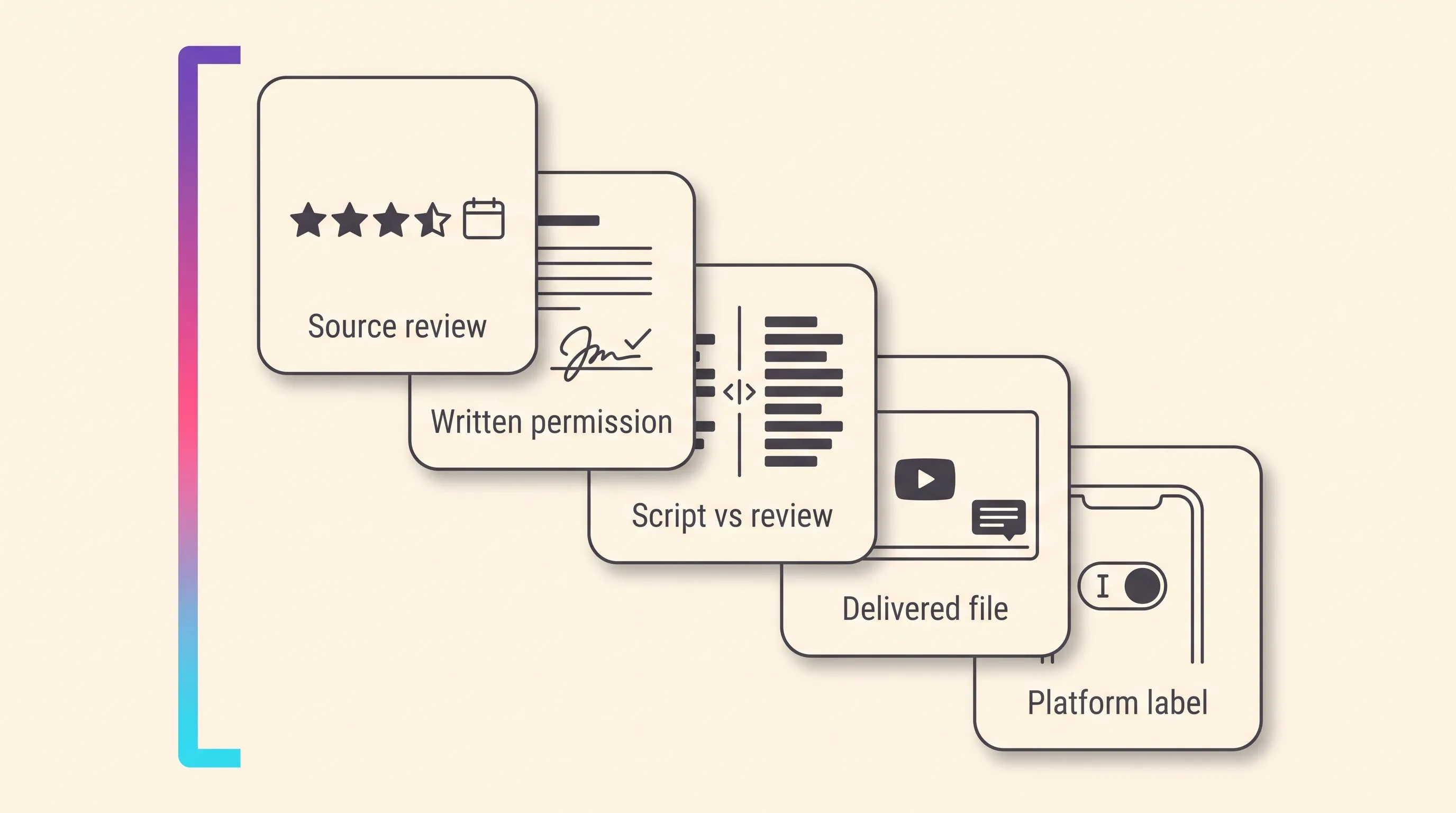
None of the ten tools produces all five. How many each produces at all is the only thing this page’s matrix measures.
Which tool for which testimonial job
The job decides the family, and the family narrows the shortlist to one or two names. Read it from the left column — what you actually have to work with — rather than from the tool you already like.
| The job | Family | Where to look | Why |
|---|---|---|---|
| A case-study video from a named, quotable customer | Capture | Vocal Video, Testimonial.to | The customer is willing and identifiable, so the endorsement is true by construction and no AI label is owed |
| A written five-star review you have permission to re-enact | Synthetic | Synthesia | The only tool here that ships both a consent gate and an on-clip AI label control |
| One true testimonial rolled out across many languages | Synthetic | HeyGen | Turns one script into the same clip market by market; the release and the per-language disclosure are still yours |
| High-volume review-to-video where the endorsement cannot be verified | — | None of them | This is the job 16 CFR Part 465 does not let you do, and no product solves it |
| A regulated category where the record matters more than the render | Capture | Vocal Video | The only tool here that publishes a release-capture feature |
The fourth row is the one worth sitting with. High-volume review-to-video where the endorsement cannot be verified is not an underserved market; it is the thing 16 CFR Part 465 prohibits, and no product solves it because no product can. Note also that the table never picks on render quality, because this instrument does not measure it. Once the family is settled, the step-by-step AI video ad build covers what comes after vendor choice.
Frequently asked questions
What is an AI testimonial video?
An AI testimonial video is a customer testimonial performed by a generative AI actor or avatar instead of filmed. The FTC’s 16 CFR Part 465, effective October 21, 2024, makes inventing the endorser unlawful, and the endorsement guides at 16 CFR § 255.2 require an ad that appears to show actual consumers to disclose when it does not. Every tool on this page can produce either kind, and this comparison scores which ones help you produce the lawful one.
Are AI-generated testimonials legal?
Not automatically, and not automatically illegal either. FTC staff have written that the consumer reviews rule has no blanket prohibition on the use of AI-generated avatars in marketing, and that such use is prohibited only if the underlying testimonials were fake or false. So the test is the endorsement, not the technology: a real customer’s documented experience, disclosed, is ordinary advertising, while an invented endorser is not. Our full statute breakdown lives in the AI UGC legal guide.
Can I turn a written customer review into a testimonial video?
Yes, if the review is genuine, you hold the customer’s permission for that use, and the clip discloses that the speaker is not the actual customer. That is a re-enactment, and it is the path this category rarely explains. What is not permitted is producing the same clip from a review you cannot substantiate, or from a person who does not exist. No tool here has a field for the source review, so that record is yours.
Do I have to disclose that the person in the video is an AI actor?
Two disclosures apply and they are different. The FTC endorsement guides say an ad presenting what appear to be actual consumers should either use actual consumers or clearly and conspicuously disclose that the people shown are not actual consumers. On top of that, TikTok, Meta and YouTube each require an AI-content label for a realistic synthetic person. Of the ten tools compared here, only Synthesia ships a control that renders an AI label onto the export.
Which AI testimonial video tools capture customer consent?
Consent capture splits along family lines. Vocal Video is the only capture platform here that publishes a release feature, letting you upload custom video release language and require click-through consent. Among the synthetic tools Synthesia is strictest: a live-recorded consent video is required before an avatar of a real person exists, and consent videos cannot be uploaded. HeyGen requires one too, but that consent covers the avatar’s likeness, not the endorsement it delivers.
How long should a testimonial video be?
Under a minute, and for an AI-produced clip usually far shorter. Wistia’s 2026 State of Video, drawn from more than 13 million videos, reports a 46 percent engagement rate for customer testimonial videos under a minute against a 52 percent all-format average. Generator limits bite before attention does: a Playcut actor clip runs 4 to 15 seconds, so an AI testimonial is a hook rather than a monologue.
Playcut published this comparison, so why should I trust it?
Because the instrument runs against us and the result is published. Playcut ships no consent capture, no disclosure overlay and no content-credential signing, which places it last in this page’s ordering. The six affordances are defined above the matrix so you can re-check any cell yourself. Every price is either linked to the vendor’s own page with the date we checked it, or recorded as not published.
Picking a tool when the testimonial has to be true
Start from whether the endorsement already exists. If it does, you are choosing between capture and re-enactment, and the table above settles it in a line. If it does not, no tool on this page can help you, and that is a legal fact rather than a product gap.
The five records travel with you regardless of vendor, which is the whole money argument for this category: you already own the endorsement, so what you are buying is production, not proof. Getting that wrong is expensive — a five-figure civil penalty per violation is the exposure, and no subscription tier covers it.
If you hold a real review and want the clip, Playcut’s free tool will script the re-enactment from a review you already hold using its built-in testimonial structure — no signup, and it runs in the browser. From there, Playcut’s AI UGC ad generator turns that script into a clip. The disclosure is still yours to write.