
AI Video Ads Cost: 2026 Pricing Guide
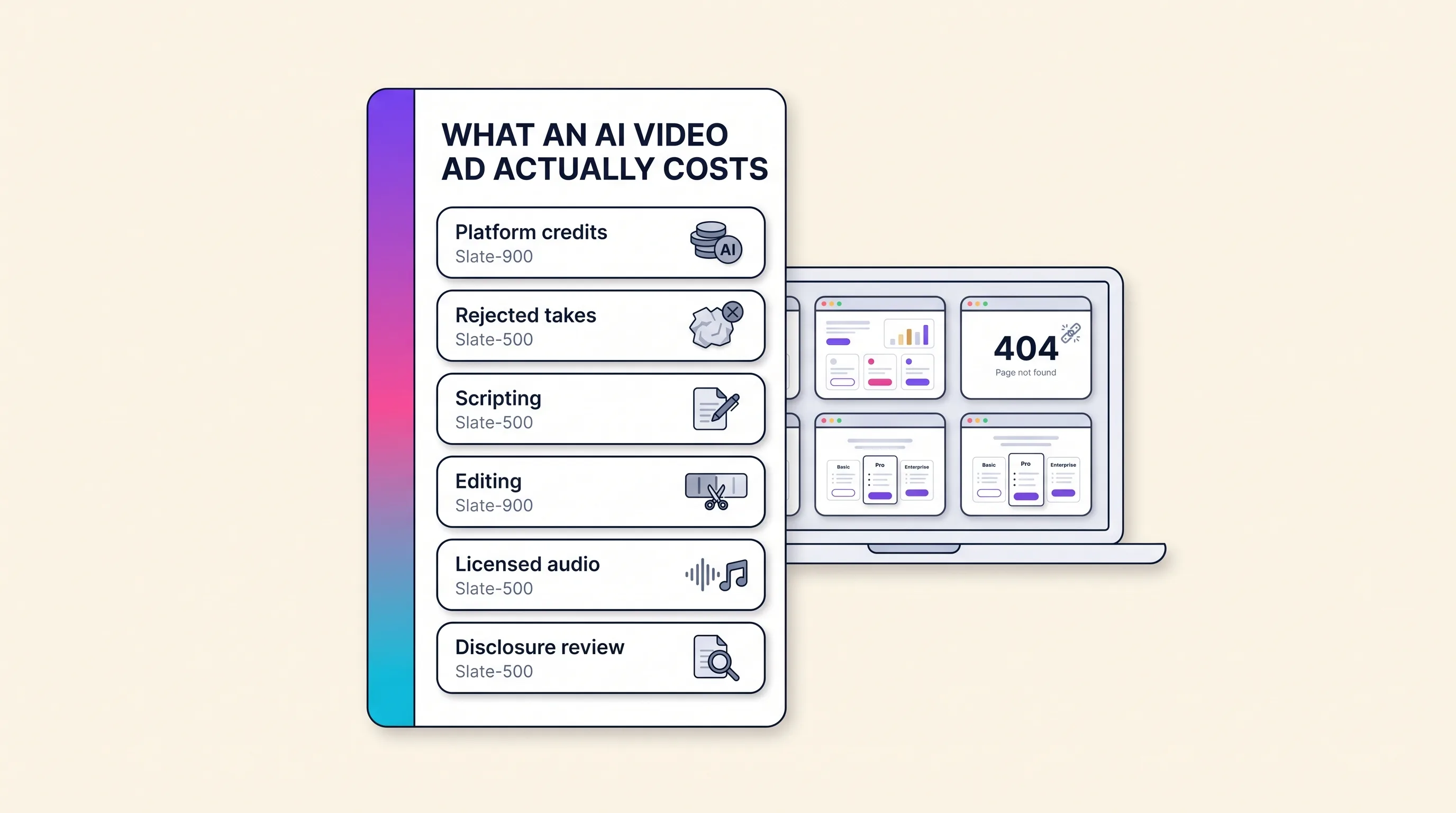
Across the AI ad platforms that publish enough for a buyer to compute it, 30 seconds of generated ad video costs roughly $0.07 to $6.00. Every figure in that band comes from an entry plan under $40 a month. The generation line is one of six in a real ad budget, and it is the only line any vendor prints on a pricing page.
This page is buyer-side. It answers what ai video ads cost to make and to run, not what to quote a client, which what to charge clients for AI video covers instead. It is the cost spoke of the full AI video ads guide, and one disclosure applies throughout: we build Playcut, one of the twelve platforms in the dataset cited here, and its row carries a vendor label.
The short version
Computable cost for 30 seconds of generated ad video: about $0.07 to $6.00, from the four entry plans under $40 a month that publish enough to compute it. Four of twelve platforms publish no verifiable price at all, and several that publish one never publish the credits-per-video ratio you would need to convert it.
Generation is line one of six. The other five are rejected takes, scripting, assembly and versioning, licensed music and voice, and disclosure review. Jump to what a month actually buys, the vendors with no published price, or the six-line cost stack.
Table of contents
- What AI video ads cost in 2026
- Why the monthly sticker is not your ad budget
- What an entry-tier month actually buys
- When a vendor publishes no price
- From cost per clip to cost per finished ad
- The AI video ad cost stack: six lines, one of them published
- What one tested concept costs
- What the same ad costs through an agency, a freelancer or a creator
- Production cost versus media spend
- Budget templates by advertiser size
- Frequently asked questions
- Sources and how we checked them
What AI video ads cost in 2026
There is no single price, because a finished ad is not one clip and no two platforms sell the same unit. Four of the twelve platforms in Playcut’s AI UGC Pricing Index publish no verifiable price at all, and several that do publish a price never publish the credits-per-video ratio you would need to turn it into a cost per ad.
The index was compiled 2026-07-17, with six vendors re-checked 2026-08-21. Against the platforms that publish enough arithmetic to follow, the computable band for 30 seconds of generated ad video runs from about $0.07 to $6.00. Read that band carefully. The cheap end is a talking-head avatar reading a script, not a UGC-native ad shot to look like a phone camera.
Verifiable entry prices run from $9 to $59 a month. One platform is widely reported higher, but it has no live pricing page to confirm that, so the figure stays out of this article. Every price below states its billing period, because a monthly sticker and an annual-prepay rate are two different numbers for the same plan.
That band covers generation only. It excludes media, which is the larger number for almost every advertiser, and it excludes the five unpublished production lines this article itemises further down.
This page prices an ad campaign, not a clip. Per-clip dollar math for a single AI UGC video, including the credit formula underneath it, lives on our per-clip page and is not restated here. The pillar guide carries a three-row directional band for readers who want the one-line answer, and the pillar’s cost summary is deliberately a summary. This article is the itemisation underneath it.
Why the monthly sticker is not your ad budget
A sticker price is a rate, not a cost. AI ad platforms bill on five different meters, three of which cannot be converted into a cost per finished ad without a number the vendor does not publish, so two plans at the same monthly price can differ by more than an order of magnitude in what they actually produce.
The five meters
- Per finished video. The only meter that maps directly onto an ad. Almost nobody uses it.
- Per video minute. Convertible, once you know whether the minutes are a monthly or an annual allowance.
- Per credit at a published per-minute rate. Convertible. HeyGen publishes 3 credits a minute on its Avatar III engine and 20 on Avatar IV and V.
- Per credit at a published per-second rate. Convertible. Topview publishes Seedance 2.0 at 720p as 4 credits per 4 seconds.
- Per credit at an undisclosed ratio. Not convertible. Captions and MakeUGC both sell credits without publishing how many a finished video consumes.
A sixth pattern sits outside the credit model entirely. Akool meters per seat and per feature, with no credit allowance published for any tier, so neither axis can be priced from its own page.
A credit is not a currency
Credits are vendor scrip, not a unit of account. Across the platforms that publish both a sticker and a credit count, the same nominal credit ranges from $0.005208 on Hedra Professional to $0.390000 on Creatify Starter. Both figures are the monthly sticker divided by that plan’s published monthly credit count, and the spread between them is 74.9 times.
The inputs are on each vendor’s own page: Hedra Professional is $75 a month for 14,400 credits, though Hedra’s plan prices render only after JavaScript runs, and Creatify Starter is $39 a month for 100 credits. Neither number is wrong. They simply are not the same unit, and no page anywhere converts between them.
The blunt rule that follows: never compare credit counts across vendors. A larger credit allowance is evidence of nothing until you know what one credit buys.
The one line the index will let you quote
The pricing index states the problem in a sentence:
A $29 plan giving 600 credits and a $29 plan giving 10 minutes are not the same deal.
Here is the sharper version, and it is the part almost no cost article says out loud. For several vendors the dollars-per-credit figure is exactly derivable while the dollars-per-video figure is not, because credits-per-video is the half they withhold.
Captions is the clean case. Its Max plan is $24.99 a month for 500 credits, so a Captions credit costs $0.04998, and Scale 4x at $279.99 for 5,600 credits works out at $0.05000. Captions does not publish how many credits a finished video consumes. Cost per ad is therefore not computable from its own page at any tier.
That asymmetry is the whole problem with sticker shopping. The number vendors publish is the one you cannot budget against, and the number you need is the one they leave out.
What an entry-tier month actually buys
On the platforms that publish enough to compute it, a month of entry-tier subscription buys anywhere from 2.7 to 400 finished 30-second clips, from the four computable stickers below, none of them above $39 a month. The spread is a unit spread, not a quality spread, and the cheapest sticker in the set is not the cheapest output.
| Vendor and tier | Sticker | Meter | 30s clips per month | $ per 30s |
|---|---|---|---|---|
| HeyGen Creator, Avatar III | $29/mo | 3 cr/min | 400 | $0.07 |
| HeyGen Creator, Avatar IV/V | $29/mo | 20 cr/min | 60 | $0.48 |
| Synthesia Starter, billed monthly | $29/mo | minutes, annual bucket | 20 | $1.45 |
| Creatify Starter | $39/mo | credits, ratio published only for the free tier | 20 (derived) | $1.95 (derived) |
| Topview Pro, billed annually | $16/mo | 1 cr/sec, annual bucket | 2.7 (32/yr) | $6.00 |
| Captions Max | $24.99/mo | credits, ratio not published | not computable | not computable |
| MakeUGC Start up | $59/mo | credits, ratio not published | not computable | not computable |
| Arcads, Argil, Akool, Higgsfield | no published price | — | not computable | not computable |
Every figure is the vendor’s own live page on 2026-08-21, or arithmetic on two of that vendor’s published numbers with the inputs named. Every price states its billing period. “Not computable” means the vendor does not publish the conversion, and never that the number is high.
The arithmetic is reproducible from each pricing page. HeyGen Creator is $29 a month for 600 credits, against published engine rates of 3 and 20 credits a minute. Synthesia Starter is $29 billed monthly for 120 minutes a year. Creatify Starter is $39 for 100 credits, and Creatify’s free tier discloses 10 credits as two video ads, which implies about five credits an ad.
Topview is the row that most often gets misread. Pro is $16 a month billed annually, $192 for the year, and the allowance is 960 credits per year rather than per month. At the published rate of one credit a second, that is 32 finished 30-second clips in twelve months.
The model picker is a 6.7 times price lever inside one sticker. Same $29, same 600 HeyGen credits: the Avatar III engine bills 3 credits a minute and yields 200 minutes, while Avatar IV and V bill 20 and yield 30. Nothing about the plan changed. A dropdown did.
Two rows meter annually while billing monthly. Synthesia Starter’s 120 minutes is a per-year allowance, and Topview Pro’s 960 credits is a per-year allowance. Read either as a monthly number and you overstate your capacity by twelve times.
Upgrading is not a volume discount. Captions charges $0.04998 a credit on Max at $24.99 and $0.05000 on Scale 4x at $279.99, so eleven times the spend buys no unit improvement at all. Four seats on HeyGen Business is $149 plus three seats at $20, or $209 a month for 1,500 credits, against $116 for four Creator seats and 2,400 credits.
Per credit that works out 2.88 times dearer for less capacity. The same test applies to us, and we fail a version of it: Playcut Agency at $149 a seat for 10,000 credits is 1.13 times dearer per credit than Studio at $79 for 6,000. Agency buys seats, actors and brand kits, not cheaper output.
For the full twelve-platform dataset behind these rows, including metering model, free-tier and watermark columns, see the AI UGC Pricing Index table.
When a vendor publishes no price
Four of the twelve platforms in the index make their list price unverifiable from their own page, and all four were still that way on 2026-08-21. Arcads’ pricing page returns a 404, Akool’s renders every paid tier as $0 a seat, Argil’s never gets past a loading placeholder, and Higgsfield’s serves no dollar figure.
An unverifiable price is not a high price. It is a price you cannot put in a budget, approve in a forecast, or compare against anything.
The four, and what each one does
Arcads. Its /pricing path returns HTTP 404 on every variant tested, with and without www, with and without a trailing slash, plus /plans. The root domain returns 200, so the site is up. Its sitemap spans seven locales and contains no pricing, plans, cost or billing URL in any of them.
Akool. Every paid tier renders “$0/seat/mo” on both the monthly and the yearly toggle, and that state has persisted across three independent checks. The page’s only paid dollar figure is an illustration inside a seat-billing FAQ, and it does not reconcile with the figure recoverable from Akool’s own in-app data. Two numbers, one vendor, and we publish neither as the price.
Argil. The page returns HTTP 200 and roughly 51KB of HTML containing the literal string “Loading plans…” and zero plan prices. Its yearly toggle is labelled “2 months free”, so the discount structure is published while the thing being discounted is not. Unchanged across three checks spanning 71 days.
Higgsfield. The pricing page returns 200 with roughly 80KB of HTML and no dollar figure anywhere in it, and the team-plan page behaves the same way. The dollar amounts on the homepage are AI-generation prompt examples and a film-festival prize, not prices.
Opacity compounds
Akool is the case where two forms of opacity stack. It meters per seat and per feature at once, so a buyer cannot compute either axis, and it publishes no credit allowance for any tier to anchor the second one.
Its licence row makes that worse for an advertiser specifically. Three of its five tiers carry a Personal licence, and the first business-licensed tier’s price is unpublished. An advertiser cannot buy commercial rights from Akool at a knowable price.
What fills the vacuum
Absence does not stay empty. A single monthly figure for Arcads, sourced from a post-signup screen rather than a public page, is now repeated by nine sites that all sell a competing product. The most-cited of them says on the record that its numbers come from reviewers who went through that onboarding, not from a public page.
The pattern repeats for Higgsfield, where one of the pages ranking for its price is written by a direct competitor. Treat any competitor-hosted price for an opaque vendor as marketing collateral, not as a citation. If you need the number, ask the vendor in writing.
It is not only the AI vendors
The opacity tax runs across the category, not just its AI end. Billo’s /pricing path 301-redirects to a login wall, so every per-video figure circulating for Billo is third-party. Artlist’s pricing page returns HTTP 403 to crawlers outright.
Epidemic Sound serves a 288KB pricing page whose only dollar figures are artist earnings, with no plan price in the HTML at all. What it will say without a number is that the model is “a flat subscription price for unlimited usage, and there’s no additional cost when you publish or monetize your content.”
The buyer’s rule
A vendor that will not publish a price has usually not published the rest of the contract either: credit expiry, add-seat rate, watermark tier, refund policy. Those are the terms that decide what a plan really costs you in month three.
So budget “request a demo” as a risk line, not as a zero. If two shortlisted tools are otherwise equal, the one whose price renders without JavaScript is the cheaper one to plan around. The four platforms in the index that publish no verifiable price are listed with their status in the transparency column of the pricing index.
From cost per clip to cost per finished ad
A shipped ad is not one clip. It is several shots, multiplied by however many takes you generate to get the ones you keep, plus a voiceover and an edit. Every vendor prices the generation attempt; none prices the usable output, so the real unit is the list rate divided by your own usable-take rate.
The arithmetic
The formula is one line:
Cost per usable second = list rate per generated second ÷ usable-take rate
Run it on a plan where every input is published. HeyGen Creator is $29 a month for 600 credits, and the Avatar IV and V engines bill 20 credits a minute, which is 1,800 generated seconds a month at $0.01611 a second.
| Takes per keeper | Cost per usable second | Cost per usable 30s | Usable 30s clips in the plan |
|---|---|---|---|
| ×1 | $0.0161 | $0.48 | 60 |
| ×2 | $0.0322 | $0.97 | 30 |
| ×3 | $0.0483 | $1.45 | 20 |
| ×6 | $0.0967 | $2.90 | 10 |
The left column is an illustration, not a measurement. Notice what moves: the per-second rate is fixed by the vendor, but the plan ceiling collapses in step with the reroll ratio, and the ceiling is usually what actually breaks a campaign schedule.
Nobody publishes a usable-take rate, including us
Our own benchmark methodology defines cost per usable video as dated list price divided by usable-take rate, and defines artifact rate against a fixed defect taxonomy. Defining an instrument is not the same as having run it.
So we say the unflattering half plainly. The AI Actor Benchmark is at v0.9, and artifact rate, usable-take rate, cost per usable video and latency all publish in a later instrument release. No instrument number appears on that page until the run is complete.
The only specific numbers published anywhere come from invideo’s own production write-ups: 164 generated clips for 41 used in a three-minute animated episode, and usable-take bands of 60–85% for social against 4–5% for broadcast. invideo publishes these as its own production data with no external study cited.
Treat the direction as the finding and the percentages as one vendor’s experience. The gap between a social bar and a broadcast bar is the real lesson: the same generator has wildly different economics depending on the quality bar you hold it to.
Measure your own over one week
Pick one brief. Count every generation you run and every clip that survives into a shipped ad, for seven days. Divide, and you have the only reroll ratio that belongs in your budget.
Then convert. Multiply your platform’s published per-second or per-credit rate by that ratio to get cost per usable second, and run your monthly volume through the AI video credit calculator to see where the plan ceiling lands. For per-clip figures on a single AI UGC video, see the per-clip AI UGC cost breakdown, which owns that math.
The AI video ad cost stack: six lines, one of them published
The subscription is line one of six. The other five are rejected takes you still pay for, scripting and concepting time, assembly and aspect-ratio versioning, licensed music and voice, and disclosure review. No AI ad platform we checked publishes any of lines two through six, and none of the cost articles we read on this query itemise them either.
| # | Line | Who publishes a price | What it scales with |
|---|---|---|---|
| 1 | Generation | The vendor | Per variant |
| 2 | Rejected takes | Nobody | Per variant |
| 3 | Scripting and concepting | Nobody | Per concept |
| 4 | Assembly, editing, versioning | Nobody | Per placement |
| 5 | Music, stock and voice licensing | Stock and voice suppliers, partly | Per concept, then per usage term |
| 6 | Disclosure and compliance review | Nobody | Per concept |
Where each line actually comes from
Line 2, rejected takes. A one-to-six-times multiplier sitting directly on top of line one. Its size is set by the brief and by how much drift your brand tolerates, never by the vendor, which is exactly why no pricing page can quote it.
Line 3, scripting and concepting. Priced per concept, not per variant. This is the line AI does not cheapen. The hook, the objection it answers and the offer are still written by a person, and generating forty variants of a weak concept costs forty times as much as generating one.
Line 4, assembly, editing and versioning. This one scales with placement count, a third axis most cost articles collapse into the word “editing.” One concept cut for feed, story, Reels and a 6-second bumper is four edit passes, not one. For the human-labour equivalent, Vidico prices each additional revision round at $500 to $2,000 (read 2026-08-21).
Line 5, music and stock. Storyblocks Individual and Small Business licences exclude broadcast and streaming use, and Small Business excludes agencies, production companies and broadcast companies outright. The cheap tier every roundup quotes is not licensed for the use an advertiser is actually buying.
Line 5, voice. Voiceover is priced by usage term, not by the recording. A three-month social and paid-placement term runs $400 to $500 local and $1,000 to $1,250 national, per Voice Crafters restating the GVAA guide, read 2026-08-21. Extend the term and the same read costs more, with nothing re-recorded.
Line 6, disclosure and compliance review. Priced per concept, and priced by nobody. None of the pages we read on this query budget for it. Budget review time per concept the way you budget legal sign-off on a claim, and take the disclosure rules themselves from the pillar guide rather than from a cost page.
Per variant, per concept, per placement
Lines 1 and 2 are per variant. Lines 3 and 6 are per concept. Line 4 is per placement. Those three scaling units are the reason AI moves the cost curve at all: variant count becomes nearly free, while concept count stays exactly as expensive as it always was.
Plan granularity is its own quiet cost line. You cannot buy a fractional plan, so a test that consumes 75% of a month’s allowance still bills the whole sticker, and a test that overruns it by one clip bills a top-up on top. Size the plan to the concept count you actually intend to test.
What one tested concept costs
Budget by concept, not by clip. A five-concept, three-variant test is fifteen finished 30-second ads. At an illustrative three-takes-per-keeper ratio that is 22.5 minutes of generated video, which fits inside one $29 month. You pay the $29 either way, because plans do not sell in fractions.
Run the same shape at four sizes against the one plan on this page whose per-minute rates are fully published. HeyGen Creator is $29 a month for 600 credits, billed monthly, at 3 credits a minute on Avatar III and 20 credits a minute on Avatar IV and V. That is 200 minutes or 30 minutes of generated video, decided by nothing but which engine you pick.
| Test shape | Finished 30s ads | Generated minutes at ×3 | Fits a $29 Creator month? |
|---|---|---|---|
| 3 concepts × 2 variants | 6 | 9.0 | Yes on either engine |
| 5 concepts × 3 variants | 15 | 22.5 | Yes, with 7.5 minutes spare on Avatar IV/V |
| 8 concepts × 4 variants | 32 | 48.0 | Avatar III only |
| 12 concepts × 5 variants | 60 | 90.0 | Avatar III only |
The ×3 column is an illustration, not a measurement. It is also the single input you should replace first, using your own week of counting from the section above.
The concept count is the expensive axis
Watch which number moves the human lines. Variants are cheap and getting cheaper, so the generation line barely notices the jump from six ads to sixty. Concepts are not cheap, because scripting and disclosure review are priced per concept. A twelve-concept test carries four times the human work of a three-concept test on an identical subscription.
That is the whole budget model. Set the concept count from what you actually need to learn, multiply out the variants your placements require, then check the total against the plan ceiling rather than against the sticker. The sticker tells you nothing about whether the test fits.
No platform we checked publishes a creative count
We could not find an ad platform that publishes a recommended number of creatives. Meta’s own creative-diversification post argues for assets that are truly different from one another and names no volume target anywhere in it. Until a platform publishes one, read any “you need 30 to 50 creatives a week” figure as an agency assertion rather than a platform requirement.
We publish no per-variation testing budget either, for the same reason. The $150-to-$250-per-creative numbers circulating on this query have no disclosed method behind them. What you can compute is the return threshold, and the breakeven ROAS a variant has to clear is arithmetic on your own margin.
UGC-style ads consume the most variants per concept, because hook, actor, framing and caption all get swapped independently against one script. The UGC ads format breakdown covers how that multiplication works before it reaches your credit balance.
What the same ad costs through an agency, a freelancer or a creator
The honest comparison is not AI against a shoot. It is what each supply route charges for a finished asset. Clutch’s review-based data puts the average video-production project at $42,280.92 and the average monthly engagement at $7,788.37, with hourly rates of $100 to $149 in the US, Canada and Australia. Human UGC sits far below that, at $198 per deliverable on average, per DesignRevision’s creator-pricing data.
Clutch states its own method: the figures are compiled from first-party reviews submitted by verified video-production clients. It discloses no review count and no agency count, and the identical $100-to-$149 hourly band appears against all nine service types on the page. Read the project average as a market signal, not as a quote anyone could be held to.
Freelance against agency, on one page and one basis
| Line | Freelancer | Agency |
|---|---|---|
| Day rate | $600–$1,200 | $2,500–$8,000 |
| Editing, hourly | $60–$150 | $100–$300 |
| Project minimum | $1,000–$3,000 | $5,000–$15,000 |
Both columns come from Vidico’s production-cost page, published 2026-04-11, so the comparison holds one publisher, one page and one basis. That is rarer than it sounds on this query, where the side-by-side tables we read blend sources without disclosing them.
One more line rides on top of the agency route. Vidico and Simulmedia independently publish the same campaign-management fee of 15 to 20% of media spend, charged on delivery rather than on production. Two publishers with the same number is two witnesses, not two studies.
The traditional side has a reroll ratio too
Traditional production publishes its own version of the multiplier, and it is worth printing next to ours. NeedaCrew, updated May 2026, advises setting crew budgets at 1.25 to 1.4 times quoted day rates, with kit fees adding 5 to 30% and overtime at 1.5 times from hour ten. A quoted day rate is no more a finished cost than a subscription sticker is a finished ad.
The steel-man, in the traditional side’s own words
A shoot day amortises across formats in a way a single generation does not. Vidico’s commercial-cost page puts it plainly: shooting multiple lengths and placements in one session means one production investment can yield 5 to 10 or more usable assets. That is the strongest argument for a shoot, and most AI cost articles decline to print it.
Human UGC and the meter AI does not have
Human UGC is the closest human comparison to an AI ad, and its price has fallen hard. DesignRevision, published 2026-02-20 and updated 2026-05-16, puts the market average at $198 per deliverable, a 44% decline from 2024. The same page puts marketplace commission at 20 to 30%.
The base rate is only half the human meter. The other half is usage rights, priced as a multiplier on that base.
| Usage-rights add-on | Uplift on the base rate |
|---|---|
| 6-month paid ad rights | +50–100% |
| 12-month exclusive | +75–150% |
| Perpetual | +100–150% |
| Whitelisting | +50–100% |
Those multipliers have no AI equivalent. A generated performer is not licensed by term, so extending a campaign from three months to twelve adds nothing to the generation line. The closest analogue on the AI side is binary rather than graduated: either the plan grants a commercial licence or it does not, which is exactly where several free tiers fail an advertiser.
Two neighbouring pages own the rest of this comparison. Broadcast and brand-film production cost, including the recycled survey figure this category keeps quoting, belongs to what a broadcast-grade AI commercial costs. Per-clip AI-versus-human math belongs to the AI-versus-human per-clip comparison.
Production cost versus media spend
AI changes what creative costs to produce and changes nothing about what platforms charge to deliver it. TikTok requires a campaign daily budget above $50 and an ad group daily budget above $20. Google Ads caps a campaign’s monthly charge at your average daily budget times 30.4. Against those floors a $29 generation plan is a rounding error.
TikTok publishes the arithmetic itself. A lifetime budget is the minimum daily budget multiplied by the number of days, and its own worked example for a 31-day campaign comes to $620.
| Minimum-viable test at TikTok’s $20 ad-group floor | Media, 7 days | Production | Production share |
|---|---|---|---|
| 5 ad groups | $700 | $29 | 4.0% |
| 15 ad groups | $2,100 | $29 | 1.4% |
Both rows carry the same $29 production line, and the share falls purely because media rises. That is the shape of the category: a small, near-fixed production number sitting underneath a variable one you do not set. TikTok is the worked example here because it publishes hard floors instead of guidance, and the creative side of that placement lives on building TikTok ads with a saved actor.
Creative quality still moves delivered cost
Cheap creative stops being cheap once it reaches the auction. Google states that ad price is auction-set and names six factors, one of which is the quality of your ads and landing page. A worse ad can cost more to deliver the same result. That is the mechanism behind most claims that better creative lowers acquisition cost.
Two heuristics, both attributed, neither a standard
Planning ratios exist, but they are opinions with names and dates on them. TrinityP3 puts production at 10 to 15% of media for service industries, 15 to 20% for FMCG and up to 30% for luxury, and flags anything above 35% as waste. That page was published 2013-05-24 and updated 2023-06-06, which is old enough to matter.
Admiral Media, published 2026-02-19, suggests roughly 10 to 20% of paid media for creative production. Use either as a sanity check on a number you derived from your own concept count. Neither is a benchmark, and neither knows your media floor.
Why there is no CPM table on this page
Every 2026 Meta and TikTok CPM figure we tried to source traced back to a vendor or agency blog with no disclosed methodology and no stated panel. We will not print one. The only CPM that belongs in your budget model is the one in your own ad account, and CPM and CPA math turns that number into comparable per-variant costs.
Budget templates by advertiser size
Size the production line against how many concepts you need to test, then check it against your media floor. Playcut’s plan ladder is Hobby $9, Pro $29, Studio $79 with four seats included, and Agency $149 per seat, all billed monthly, with annual billing at two months free. No tier gates a feature.
Solo founder or DTC operator
Start from concept count, not from the cheapest row. Hobby at $9 a month carries 500 credits and one seat; Pro at $29 carries 2,000 credits and one seat. For an outside reference point, Vidico’s small-business template puts a total campaign at $5,000 to $25,000, with $2,000 to $5,000 in production and $3,000 to $15,000 in media.
Read that template as a shape rather than as an amount. Its production share was set by human production costs, and shrinking that share is the entire point of this page.
In-house growth team
Studio is $79 a month with four seats included, which works out at $19.75 a seat. The per-credit comparison against HeyGen Business appears earlier and is not repeated. What belongs here is a warning about reading any four-seat number off a pricing page at all.
HeyGen’s pricing page states Business two incompatible ways on the same day. The plan card and the FAQ say $149 a month plus $20 per seat per month; the comparison table headings say $149 per seat per month. Four seats is either $209 or $596 depending on which half of the page you read. Ask in writing before you budget it.
Agency running multiple brands
Agency is $149 per seat per month, with unlimited seats, unlimited custom actors, multi-brand kits and 10,000 credits per seat. Here is the unflattering half. At $0.0149 a credit it is 1.13 times dearer than Studio’s $0.0132, so Agency buys seats, actors and brand kits rather than cheaper output.
The contrast worth knowing is Akool, which charges every invited admin or editor the full owner rate, with no team discount published and no tier price published either. Per-seat metering multiplies cost by headcount rather than by output, which is the wrong axis for an agency running many small brands.
What every Playcut tier includes
Every tier ships every model, 4K image output, no watermark, a full commercial licence and the 34-tool MCP server, Hobby included. Tiers differ only by credits, custom actors, voices, seats, storage, concurrency and queue priority. That is the entire list. Nothing is swapped behind your back, so a 20-credit model cannot quietly become a 160-credit one on the invoice.
Now the counterweight. There is no perpetual free tier in v2, and the on-ramp is a 7-day trial on Hobby only, card required. HeyGen, Synthesia, Creatify and Higgsfield all beat us on free entry. Their free output is watermarked, and HeyGen’s terms bar free-plan output from advertising outright.
One mechanic to settle before you commit: subscription credits reset monthly, including on annual billing, and only the one-time top-up packs never expire. Those packs are 600 credits for $9, 2,500 for $35 and 5,000 for $65. The rest of the mechanics sit in how Playcut credits and top-ups work.
Templates are a starting point, not an answer. Take your own concept count, your own variants per placement and your own reroll ratio, then run your own volume through the AI UGC cost calculator. If the plan you land on is decided by actor count rather than by credits, the AI actor library is the page that explains that axis.
Frequently asked questions
How much does one AI video ad cost to produce?
There is no single number, because a finished ad is not a single clip. On the platforms that publish enough arithmetic to follow, 30 seconds of generated video runs from about $0.07 to $6.00. The cheap end is a talking-head avatar reading a script, not a UGC-native ad.
Generation is one line of six. Rejected takes, scripting, assembly, licensed audio and disclosure review are the other five, and no vendor prints any of them on a pricing page.
Does using AI to make ads lower my ad spend?
No. AI moves production cost and leaves delivery cost where it was, because delivery is priced at auction. Google caps a campaign’s monthly charge at your average daily budget times 30.4, and TikTok will not run a campaign under $50 a day.
Creative quality does still move what delivery costs you, since ad quality is one of the six auction inputs Google names. That is an indirect lever on price, not a discount on it.
Why isn’t the cheapest AI ad plan the cheapest ad?
Because the meters use different units, and the ad is not the metered unit. Across the twelve platforms in the index some bill per finished video, some per credit, some per video minute, and one bills per seat and per feature at once.
Convert every shortlisted plan into cost per finished ad, using the clips, voiceovers and rerolls your format actually consumes. A sticker only tells you the monthly charge.
What should I budget for rejected takes?
Budget something, then replace the guess with a measurement inside a week. Every rejected generation still spends credits, so the unit that matters is cost per usable clip rather than cost per generation.
We do not publish a usable-take rate. Our AI Actor Benchmark is at v0.9 and publishes only live-verified capability, pricing and policy, with usable-take rate and cost per usable video due in a later instrument release. Treat any vendor quoting a reject rate without a published method as marketing.
What should I do when an AI ad tool publishes no price?
Price the absence as risk and carry on. Re-checked 2026-08-21, Arcads’ pricing page returns a 404, Akool renders every paid tier at $0 per seat, Argil serves a permanent loading placeholder, and Higgsfield’s page carries no dollar figure at all.
A price you cannot verify cannot be forecast, approved or compared. Ask for a written quote, or shortlist the vendor whose price renders without JavaScript. Absence is a finding about disclosure, never evidence that the price is high.
How much of my ad budget should go to creative production?
Set the production line against your own media floor rather than against an industry average. On Playcut that line is $9, $29, $79 for four seats, or $149 per seat, with annual billing at two months free.
TikTok alone requires more than $50 a day at campaign level, so a month of minimum delivery outweighs any of those plans. Size production by concept count first, then sanity-check it against what delivery will cost.
Can I run AI video ads on a free plan?
Rarely, and free is not the same as usable in a paid placement. Captions’ free tier carries no AI usage credits at all, so it edits without generating, and Arcads publishes no free tier.
Where a free tier does generate, the output is usually watermarked, and HeyGen’s terms bar free-plan output from advertising outright. Playcut’s on-ramp is a 7-day Hobby trial, and every paid tier ships watermark-free with a commercial licence.
What costs appear after the subscription line?
Watermarks come first. Free tiers at HeyGen, Synthesia, Creatify and Akool mark their output, and Synthesia’s help centre says removing its logo means re-generating the video.
Per-seat metering multiplies cost by headcount rather than by output. Advertised prices are often the annual-prepay rate: Topview’s $16 entry is the yearly figure, and month-to-month is $29 on its own page. Last, check whether unused credits expire before you can spend them.
Sources and how we checked them
Every price on this page was read off the vendor’s own live page on the date shown, or the page says the vendor publishes none. Nothing here is estimated, and nothing is inherited from a third-party roundup.
“Checked” means one of two things. A live figure was read directly from the named first-party URL on the stated date. A derived figure is arithmetic on two live figures from the same vendor, with both inputs named in the same sentence where the result appears.
A missing figure means the vendor publishes none, and it never means the figure is high. The underlying dataset is Playcut’s AI UGC Pricing Index, compiled 2026-07-17 with six vendors re-checked 2026-08-21. Where this page and the index differ in precision, the first-party page read on 2026-08-21 governs.
Three sources below are named but not linked, because none of them serves a clean response to every client. One is the 404 that is itself the citation, and the other two return an error to either a crawler or a browser. A dead link is worse than a citation you can search for.
Vendor pricing pages, read 2026-08-21
- HeyGen pricing — tier prices, the 3 and 20 credits-a-minute engine rates, the $20 seat add-on, the Business self-contradiction.
- Synthesia pricing — $29 Starter billed monthly, 120 minutes a year, a free tier with no MP4 download.
- Creatify pricing — $39 and $99, a free tier of 10 credits for two video ads, an annual percentage with no dollar figure.
- Captions pricing — $24.99 for 500 credits, and free-tier AI usage credits listed as none.
- MakeUGC pricing — the $59, $79 and $149 platform tiers, sold in credits with no published ratio.
- Topview pricing — $16 annual against $29 month-to-month, the per-year credit bucket, and Topview’s Team tier direct per-render price of $3.60 for 720p 30 seconds.
- Hedra pricing — $15, $30 and $75, with plan prices that exist only after JavaScript runs.
- Akool pricing — every paid tier at $0 per seat, the Personal licence rows, per-invite owner-rate billing.
- Argil pricing — a served page carrying a loading placeholder and no plan price.
- Higgsfield pricing — no dollar figure anywhere in the served HTML.
- Arcads pricing — HTTP 404 on every URL variant tested. Not linked, because the status code is the citation.
Policy and terms pages
- HeyGen’s terms of service — free-plan output barred from advertising and client work.
- Synthesia’s watermark help article — removal requires re-generating the video.
Media platforms
- TikTok’s budget documentation — the $50 campaign and $20 ad-group daily floors, and the 31-day $620 example.
- Google’s monthly charging limit — average daily budget times 30.4.
- Google on how ad prices are set — auction pricing and the six factors, one of which is ad quality.
- Meta’s creative-diversification post — no recommended creative count, and a preference for assets that differ meaningfully. Named but not linked.
Human supply and licensing
- Clutch’s video-production pricing page — $42,280.92 average project, $7,788.37 average monthly, $100 to $149 hourly, compiled from verified client reviews. Named but not linked.
- Vidico on video production cost, published 2026-04-11 — freelance against agency on one basis, plus revision-round pricing.
- Vidico on 30-second commercial cost — the multi-asset steel-man, the management fee, the small-business template.
- Simulmedia on TV ad production costs — the second witness on the 15 to 20% campaign-management fee.
- NeedaCrew on film crew day rates, updated May 2026 — the 1.25 to 1.4 times ancillary-cost rule.
- DesignRevision on UGC creator pricing, published 2026-02-20 and updated 2026-05-16 — the $198 average and the usage-rights multipliers.
- Storyblocks pricing — the licence-scope exclusions on the Individual and Small Business tiers.
- Voice Crafters on industry voice-over rates — voiceover priced by usage term rather than by the recording.
- Epidemic Sound pricing — a pricing page carrying no plan price at all.
Planning heuristics and take-rate evidence
- TrinityP3 on setting an ad production budget, published 2013-05-24 and updated 2023-06-06 — the production-share-of-media bands.
- Admiral Media on AI creative pricing, published 2026-02-19 — the 10 to 20% of paid media heuristic.
- invideo on how many generated clips survive a cut — 164 clips generated for 41 used, and usable-take bands by quality bar, published as invideo’s own production data.
Our own instruments
- The AI UGC Pricing Index — the twelve-platform list-price dataset behind this page.
- The benchmark methodology — the definitions of cost per usable video and artifact rate.
- The AI Actor Benchmark — at v0.9, with usable-take rate and cost per usable video due in a later instrument release.
Two things are worth carrying away from all of it. The number a vendor prints is a rate rather than a cost, and the five lines nobody prints are where an ad budget actually goes. For the category around this one, including formats, platform rules and the evidence on whether these ads work, read the AI video ads pillar guide.
Price your next ad test before you run it.
Every Playcut tier ships every model, 4K image output, no watermark and a full commercial licence, so the plan you choose changes your credit ceiling and nothing else. Build one saved actor, run every concept through it, and keep the invoice readable.
Start the 7-day Playcut trial →