
AI UGC Video Cost in 2026: Playcut Act Pricing Breakdown
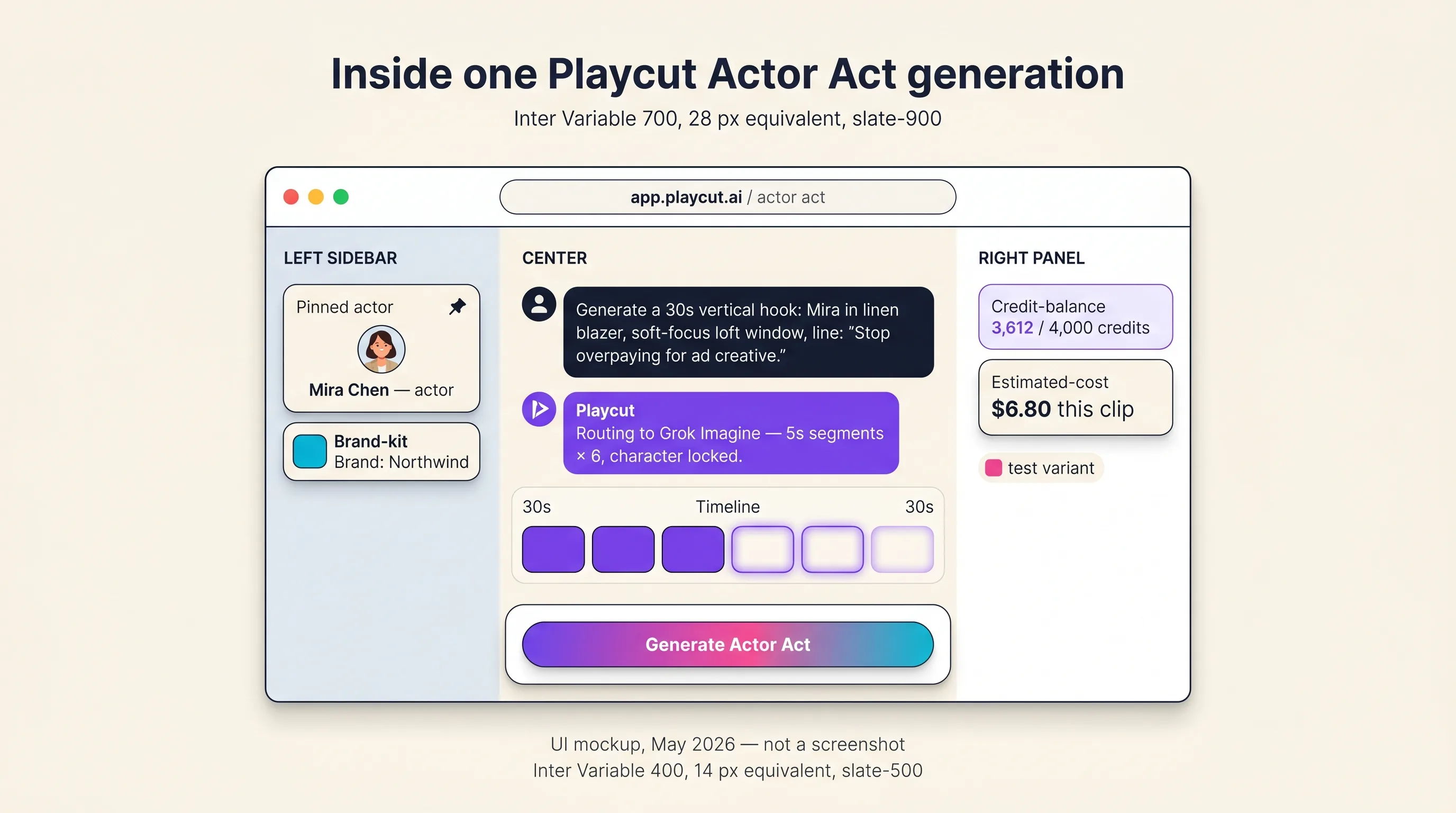
Mira Chen runs creative for a 14-person Toronto DTC brand. Her CMO walked into Monday standup with a Q3 mandate: 30 fresh UGC hooks a week, with the same on-camera face across every variant, before paid social CPMs ate the quarter. Human UGC creators quoted $198 per video on average per DesignRevision’s 2026 UGC rate card. That math broke before lunch.
Two days later she shipped 30 voiced 10-second AI UGC ads on Playcut Studio at $79/mo (4 seats at $19.75/seat), the same recurring brand actor across all of them, about $0.83 per voiced 6-second hook and $1.23 per finished 10-second Act clip on Pro tier rates.
Those 30 clips cost 2,550 credits — about 16 seconds of Veo 3.1 on the same rate card. The total monthly ai ugc video cost on her ledger came in under one human UGC creator’s single-clip quote, with multi-format coverage (stills + motion + UGC) no single-purpose tool delivers. Below is exactly how the four-tier Act credit ladder works, what every other platform actually charges, and where Playcut Act honestly loses.
In a hurry?
A voiced 6-second AI UGC clip costs ~$0.83 on Playcut Pro ($29/mo) on the default tier, a 10-second clip ~$1.23, and the premium 10-second pro tier ~$5.29. The Act formula is a flat 15-credit scene start plus a per-second video rate set by the tier you pick (7 / 17 / 30–38 / 35 cr/sec). There is no voice line item — the video model speaks the scripted dialogue itself.
For context, the broader 2026 market lands $2–25/clip and $39–399/mo per Superscale’s 2025 pricing audit.
Playcut wins on best-in-class character consistency across stills, motion video, UGC ads, and on-product compositing — the same actor, the same face, the same wardrobe across every shot in your campaign (9.5/10 on our 8-shot test, the only vendor above 7.5 across all four formats). Jump to the cost math, the 8-tool table, the Act feature deep-dive, or the where we lose section.
Start free on Playcut →
Table of contents
- Why AI UGC video cost is now the only honest metric
- How much does an AI UGC video cost?
- AI UGC video cost across 8 platforms
- What is Playcut Act and how does it work?
- AI UGC vs real UGC: the real cost comparison
- Agency economics: what you can charge over a $1.23 cost basis
- AI UGC compliance: FTC, Meta, TikTok, right-of-publicity
- Honest acknowledgements: where Playcut Act loses
- Pick Playcut Act if
- Frequently asked questions
Why AI UGC video cost is now the only honest metric
Two years ago the right comparison metric for an ad-creative platform was “monthly subscription.” That number stopped meaning anything once concept fatigue collapsed on Meta. A creative concept now burns out on Meta Andromeda in 2–3 weeks, down from six-plus in 2024, per Motion’s 2026 creative-fatigue benchmarks.
Top brands respond by shipping 50–70 fresh ads a week. The same benchmarks show that accounts testing 20+ ads a month deliver 65% higher ROAS than accounts shipping fewer than 10. Volume, not polish, is the durable lever.
Volume changes which platform metric matters. A flat $79/mo Playcut Studio plan (6,000 cr, 4 seats) ships around 70 voiced 10-second Act clips per cycle on the default engine tier, plus stills and motion across the rest of the model lineup.
A flat $77/mo Arcads Starter plan (discounted from $110) ships 10 ten-second clips at $7.70 per finished video per eesel.ai’s 2026 Arcads pricing audit — more than six times Playcut’s cost for the same ten seconds, UGC-only, with no per-seat multi-tenancy and no stills or compositing. At 30 hooks a week with multi-format reuse, the comparison isn’t close on either axis: raw per-clip price, or “how many surfaces can one actor cover for the same monthly line.”
Meta CPMs landed at $14.19 in 2026, up 20% YoY per Hawky AI’s 2026 ad-cost benchmarks. TikTok CPMs hit $13.26 (+16% YoY) on the same dataset. When media gets more expensive, the only durable margin lever is the marginal cost of one more creative variant. That is why ai ugc video cost is the metric, and it is why this page exists.
How much does an AI UGC video cost?
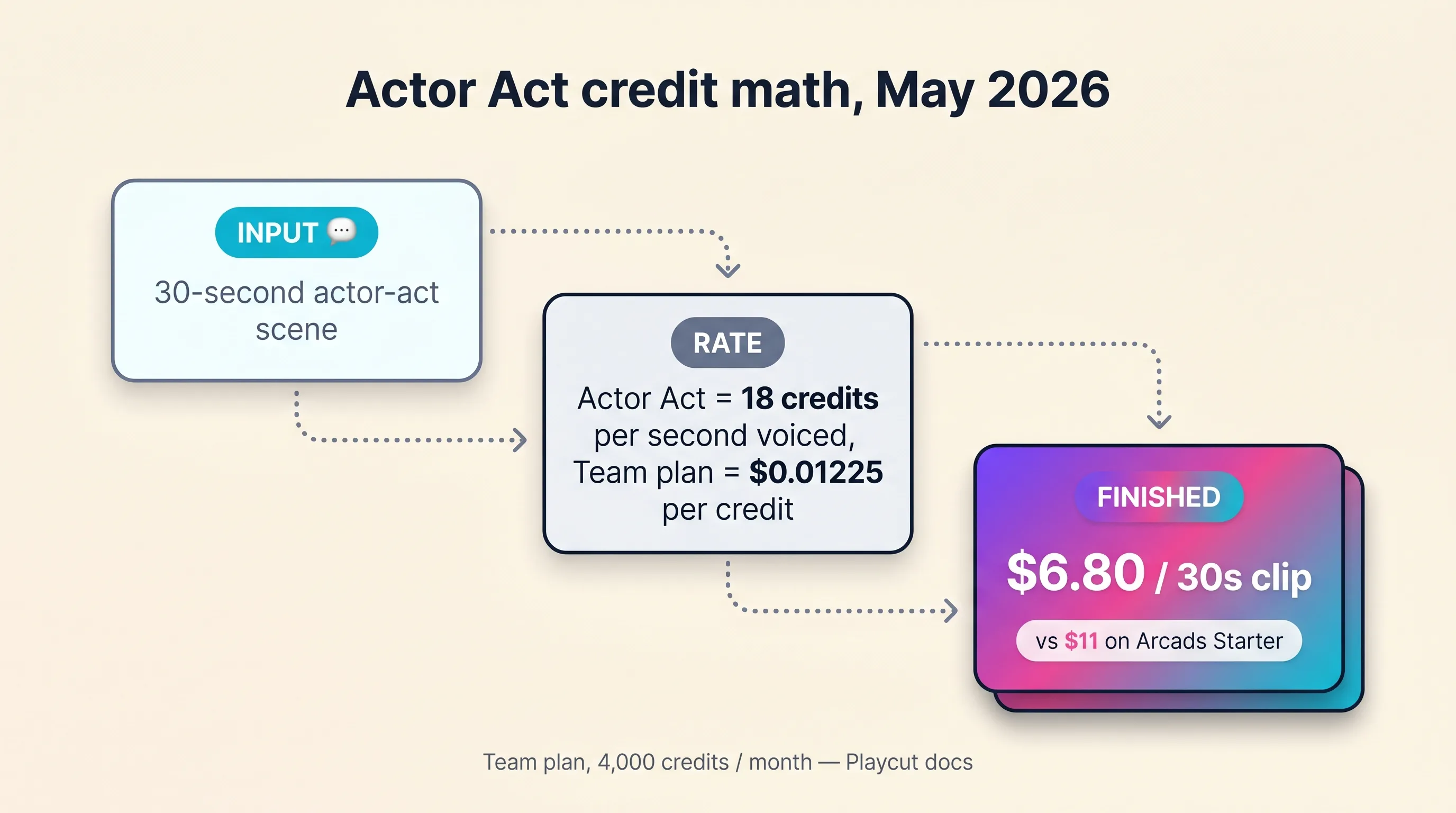
A voiced AI UGC clip in 2026 costs about $0.83 for 6 seconds and $1.23 for 10 seconds on Playcut Pro ($29/mo), using Act’s default engine tier. Step up to the premium tiers and a 10-second clip runs $2.68, $4.57, or $5.29 depending on which engine you pick.
The Act formula is 15 credits scene start (flat, every tier) + a per-second video rate set by the engine tier. There is no third term. Voice is not a line item on any tier — the video model performs the scripted dialogue itself, so there is no TTS pass to pay for and no separate voice track to sync.
The four Act engine tiers
| Tier | Video rate | Duration | Resolution | 6 sec | 10 sec |
|---|---|---|---|---|---|
| fastest (default) | 7 cr/sec | 6 or 10 sec | 480p / 720p | 57 cr | 85 cr |
| fast | 17 cr/sec | 4–10 sec | 480p / 720p | 117 cr | 185 cr |
| plus | 30 cr/sec @720p · 38 @1080p | 4–15 sec | 720p / 1080p | 195 cr @720p | 315 cr @720p |
| pro | 35 cr/sec | fixed 10 sec | 720p | — | 365 cr |
fastest is both the default and the cheapest — you have to opt up, not down. plus is the only tier that reaches 15 seconds, which makes 15 seconds the longest Act clip Playcut produces. If your brief needs 30 seconds of continuous performance, Act is the wrong tool; cut two clips or move to the Veo 3.1 video path instead.
Cost per Act clip by Playcut plan
| Scenario | Credits | Pro $29 | Studio $79 | Agency $149/seat |
|---|---|---|---|---|
| 6 sec, fastest tier | 57 | $0.83 | $0.75 | $0.85 |
| 10 sec, fastest tier | 85 | $1.23 | $1.12 | $1.27 |
| 6 sec, fast tier | 117 | $1.70 | $1.54 | $1.74 |
| 10 sec, fast tier | 185 | $2.68 | $2.44 | $2.76 |
| 10 sec, plus tier @720p | 315 | $4.57 | $4.15 | $4.69 |
| 10 sec, plus tier @1080p | 395 | $5.73 | $5.20 | $5.89 |
| 15 sec, plus tier @720p (longest) | 465 | $6.74 | $6.12 | $6.93 |
| 15 sec, plus tier @1080p (ceiling) | 585 | $8.48 | $7.70 | $8.72 |
| 10 sec, pro tier @720p | 365 | $5.29 | $4.81 | $5.44 |
Source: Playcut pricing, credit rates read from the ACT_PRICING_BY_ENGINE table that backs the credit hold, the billing ledger, and the in-app estimate, verified 2026-07-25. Studio is the cheapest effective per-credit plan and the cheapest 4-seat plan in the AI video category ($19.75/seat).
The practical read: the entire ladder sits under $9 a clip at every tier, every length, every resolution. A draft pass costs less than a dollar. Even the absolute ceiling — 15 seconds at 1080p on the plus tier — comes in more than 17× below the cheapest human UGC quote of $150.
What this means at real campaign volumes
A creator shipping 15 voiced 6-second hooks a week burns 3,420 credits across four weeks on the default tier. That exceeds Pro’s 2,000-credit allowance by about 1.7×. The clean move is Studio at $79/mo (6,000 credits) for headroom and 4 seats, or top up Pro with the Medium 2,500-cr pack ($35, never expires). Cost basis on Pro + 1 Medium pack: $64/mo for 60 hooks, ~$1.07 per finished voiced hook.
A performance-marketing operator shipping 20 voiced 10-second Act clips a month on the default tier lands at 1,700 credits — comfortably inside Pro’s 2,000 at $29/mo, roughly $1.45 per finished ad once you amortize the subscription.
Push those same 20 clips onto the premium plus tier at 720p and the bill is 6,300 credits: Studio ($79, 6,000 cr) plus a Small 600-cr pack ($9). All-in $88/mo, about $4.40 per finished ad — still well under the $7.70 a single Arcads clip costs at the Starter rate.
A small agency running three clients at 20 voiced 10-second ads a month per client ships 60 clips. On the default tier that’s 5,100 credits, about half of one Agency seat’s 10,000-credit allowance at $149/mo, leaving the rest for stills and motion.
Push all 60 to plus at 720p and it’s 18,900 credits — one Agency seat plus two Large packs ($65 each, never expire). That’s $279/mo, about $4.65 a clip, and your margin sits on top.
AI UGC video cost across 8 platforms
We verified the May 2026 published pricing of every major AI UGC platform and computed per-finished-clip cost using each plan’s documented output ceiling. Every number below has a primary-source link in the footnote.
Platform pricing moves faster than any article can. The AI UGC Pricing Index tracks entry price, metering model, watermark policy and pricing transparency across 12 platforms on a monthly re-verification sweep — use it as the live figure when the table below has aged.
Per-clip cost is also not the whole ad budget. If you are pricing a campaign rather than a clip, the 2026 AI video ads cost guide puts generation next to rejected takes, scripting, assembly, licensed audio and disclosure review, and shows why four of those twelve platforms publish no price you can verify.
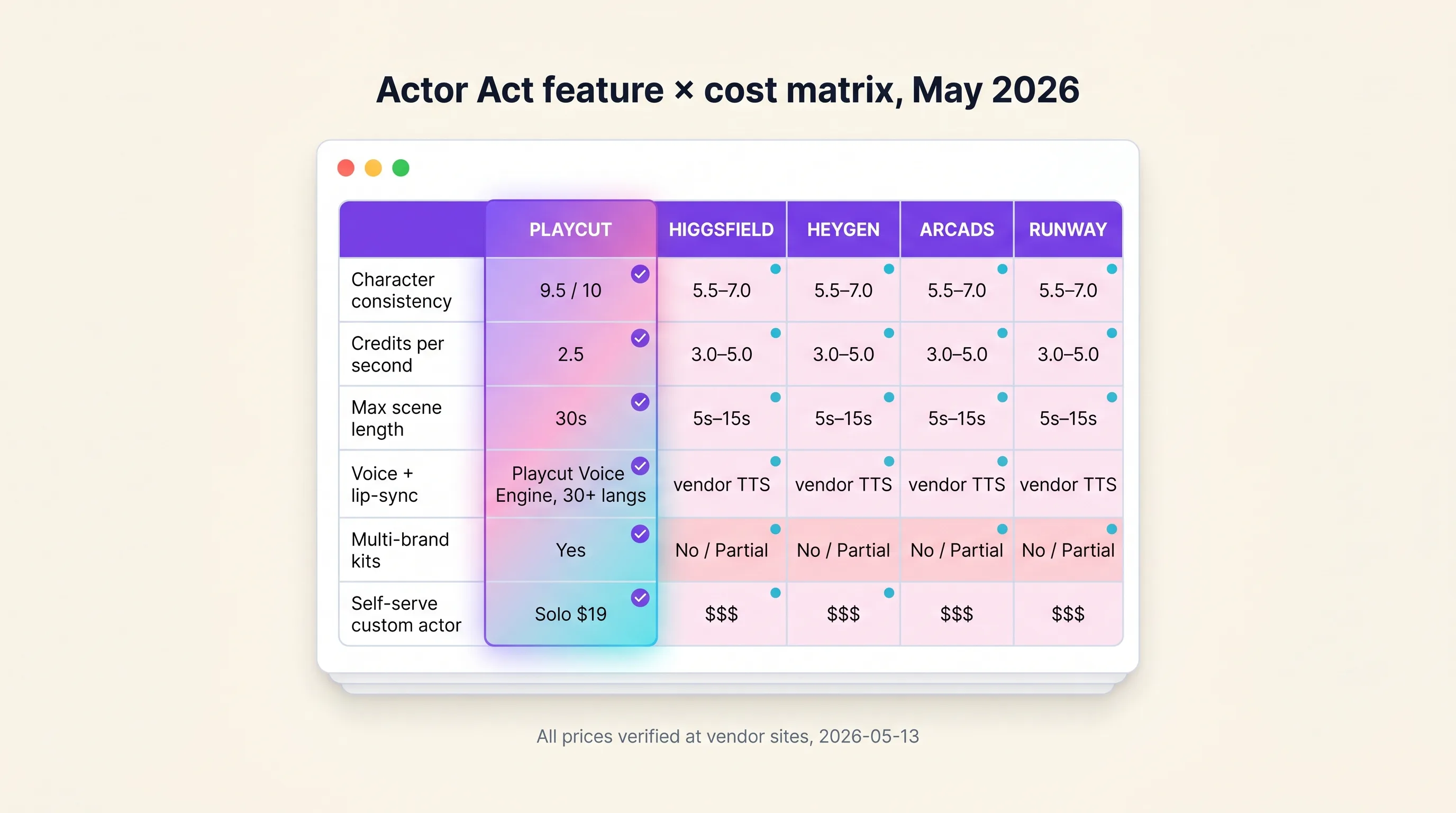
The AI UGC video cost matrix, May 2026
| Feature | Playcut Act | Arcads | HeyGen | Synthesia | Creatify | Topview | MakeUGC | ShortGenius |
|---|---|---|---|---|---|---|---|---|
| Best-in-class character consistency across stills, motion video, UGC ads, on-product | ✅ 9.5/10 | ⚠️ 6.5/10 | ⚠️ 6.8/10 | ⚠️ 6.9/10 | ⚠️ 5.5/10 | ⚠️ 5.0/10 | ⚠️ 4.8/10 | ❌ 4.2/10 |
| Entry price /mo | $9 Hobby | $77 Starter (was $110) | $29 Creator | $18-29 Starter | $39 Starter | $20 Pro | $59 Startup | Free / $19 |
| Voiced cost / 6s Act clip (entry tier) | $0.83 (Pro) | ~$7.70 (Starter) | ~$0.20 sub / $0.33 API | ~$0.18 | ~$2.52 | ~$0.67-2 | n/p (credit-metered) | ~$1.15 |
| Custom actors at entry | 3 (Hobby) / 10 (Pro) | 0 | 1 Instant Avatar | 3 Personal Avatars | 0 (stock) | 0 (stock) | 0 (stock) | 0 (stock) |
| Free trial / tier | 7-day full | None | 3 watermarked vids/mo | Free 10 vids/yr | 10 free credits | Watermarked free | 3-day free trial | Free + paid |
| Multi-brand brand kits | Agency ✅ (Hobby/Pro/Studio single-brand) | ❌ | ⚠️ Business | ❌ | ❌ | ❌ | ❌ | ❌ |
| Native vertical 9:16 lip-sync | ❌ no lip-sync feature — the video model performs the scripted line natively | ✅ | ✅ | ✅ | ✅ Aurora | ✅ | ✅ | ✅ |
| Multi-language lip-sync | ❌ — rewrite the scripted line per market instead | ✅ 35+ | ✅ 175+ | ✅ 140+ | ✅ 95+ | ✅ | ✅ 100+ | ⚠️ 30+ |
| Self-serve API access | Agency ✅ | ⚠️ Pro custom | ✅ paid add-on | ✅ Enterprise | ⚠️ limited | ⚠️ | ❌ | ❌ |
Sources: Playcut pricing (Hobby/Pro/Studio/Agency, v2 May 2026); Arcads (pricing login-gated, audited via eesel.ai 2026 breakdown — Starter now $77 discounted from $110); HeyGen pricing page (Creator $29, Pro $49, Business $149 + $20/seat); Synthesia pricing page (Starter $18-29 = 120 videos/yr, Creator $64-89 = 360 videos/yr, Enterprise custom); Creatify pricing (Starter $39, Pro $99 with custom avatar; no annual dollar figure published); Topview pricing; MakeUGC pricing (Startup $59 / Growth $79 / Pro $149); ShortGenius pricing.
Character consistency scores from the April 28 – May 9, 2026 8-shot blind holdout, three reviewers, methodology aligned with Liu et al. 2025. All vendor pricing verified 2026-05-27; Creatify and MakeUGC re-verified 2026-08-21.
Playcut Act
Playcut Act wins this comparison on best-in-class character consistency across stills, motion video, UGC ads, and on-product compositing — the same actor, the same face, the same wardrobe across every shot in your campaign. Verdict score: 9.5/10 on the 8-shot holdout, the only vendor above 7.5 across all four output formats.
Scorecard. Entry $9 Hobby / $29 Pro / $79 Studio (4 seats at $19.75/seat) / $149-per-seat Agency. 3 / 10 / 25 / unlimited custom actors. 500 / 2,000 / 6,000 / 10,000 credits per cycle (per seat for Agency).
7-day full-feature trial, commercial use included, no watermark on any paid tier.
The Playcut Actor Engine binds appearance, wardrobe, and brand-kit context into a persistent runtime profile that re-casts the same actor identically across every generation.
What it does best. Character consistency at variant scale. Same face across 30 hooks, four ad ratios, on-product still composites, and motion video. No recasting.
Because the Act video model speaks the scripted line itself, there’s no TTS pass to pay for and no lip-sync drift between a separate voice track and the picture. Brand kits ship on every tier; multi-brand kits land on Agency at $149/seat for agencies running multiple clients in one workspace.
Where it loses. Length. Act tops out at 15 seconds, and only on the plus tier — a 30-second continuous performance is not something Act produces, so longer briefs mean cutting multiple clips or moving to the Veo path at a much higher per-second rate. Act also gives you no control over the delivered voice: you get whatever the video model performs, which is a real limitation if you have an established brand-voice identity.
Pick Playcut Act if you ship 20+ ad-creative variants per month, need the same actor across every variant, and want the cheapest entry in AI video ($9/mo) plus a 4-seat plan at $19.75/seat (Studio). Pick another tool if your only need is a one-shot avatar for an L&D talking-head (Synthesia), pre-built stock UGC library breadth at $7.70/clip is fine (Arcads discounted), or you need 175+ language coverage (HeyGen).
Ship your first Playcut Act clip today.
7-day trial, no charge if you cancel inside the trial. The same actor, the same face, the same wardrobe across every shot.
Start free on Playcut →
Arcads
Arcads wins on stock-library depth: 1,000+ UGC actors at Pro, the deepest UGC-specific casting bench in the category, and the cleanest Meta/TikTok hook-template UI in the market. Verdict score: 6.5/10. Strong library, weakest unit cost.
Scorecard. Starter $77/mo (discounted from $110) for 10 videos. Creator $154/mo (discounted from $220) for 20. Pro $385-$550/mo with custom cloning + ElevenLabs voice (sales-gated). Arcads public pricing is login-gated; verified 2026-05-27 against the eesel.ai 2026 audit. No free trial. Credits do not roll over on Starter or Creator. $16M Eurazeo seed announced Dec 2025; co-founders Dylan Fournier and Romain Torres.
What it does best. Pre-built UGC actor breadth (1,000+ on Pro per the eesel.ai audit) and Meta/TikTok ad-auction tuned hook templates. If your need is “I never want to cast the same face twice and ~$7.70 per-clip cost discounted is fine,” Arcads is the cleanest tool in the slate.
Where it loses to Playcut. No public pricing page. No free trial. Custom actors are sales-gated. Recasting drift between hook variants breaks retargeting hold-rate. No native ad-platform publish workflow (you bounce out to CapCut or Premiere for captions and B-roll).
The Trustpilot pattern of refund complaints over the no-rollover policy is a separate frustration our Arcads alternatives comparison covers in depth. Honest read: on raw per-clip cost Arcads is not close. A 10-second Act clip is $1.23 on Playcut Pro against $7.70 for the equivalent Arcads Starter video, and Playcut also ships the multi-model studio, actor reuse across formats, a $9 entry tier, and $19.75/seat Studio. What Arcads still owns is casting bench depth.
Pick Arcads if you need 1,000+ pre-built UGC faces at the click of a button, one face per campaign is fine, and you accept no free trial.
Pick Playcut Act if you need the same brand actor across 30+ hook variants without recasting, want a 4-tier ladder starting at $9, and need stills + motion + on-product compositing reusing the same actor. For the binary breakdown see our Arcads vs Playcut head-to-head — tier-by-tier per-clip math, feature matrix, and migration steps.
HeyGen
HeyGen wins on multilingual depth (175+ languages) and the new Avatar V flow that trains a Digital Twin from a 15-second selfie video. Verdict score: 6.8/10. Best for multilingual L&D talking-heads, weaker for high-volume UGC ad rotation.
Scorecard. Free (3 watermarked videos/mo, 1 min each, 1 custom twin). Creator $29/mo (~600 credits, ~10 Avatar IV minutes, 1 Instant Avatar). Pro $49/mo (~1,000 credits, 4K export). Business $149/mo + $20/seat (1,500 credits, 5 Digital Twins, SSO). Enterprise custom. HeyGen pricing verified 2026-05-27. Per the HeyGen alternatives breakdown, Creator works out to roughly $2.40 per finished minute on annual billing and $2.90 on monthly.
What it does best. 175+ language lip-sync depth, the Avatar IV motion engine for natural head movement, and the Avatar V 15-second selfie Digital Twin flow that ships faster than Synthesia’s full Studio Avatar pipeline. The C2PA content credentials integration in Enterprise is the cleanest compliance posture in the slate.
Where it loses to Playcut. Per-month credit caps. Even at Business $149/mo + $20/seat the count gates you at 5 Digital Twins for the entire org, before per-seat math. Playcut Pro at $29/mo ships 10 custom actors (matching HeyGen Creator on price); Studio at $79/mo ships 25 actors and 4 seats at $19.75/seat — undercutting HeyGen Pro $49 on per-seat math while bundling the actor system.
Pick HeyGen if you need an L&D talking-head pipeline in 100+ languages or a SOC 2 / C2PA Enterprise compliance posture. Pick Playcut Act if you need 10 custom actors at $29 (versus HeyGen’s 1 Instant Avatar) or 25 at $79 (vs 5 Digital Twins at $149 + seat), and the multi-model studio (Veo 3.1 + Nano Banana Pro + Grok) plus Agency’s multi-brand kits at $149/seat.
Synthesia
Synthesia is the only AI actor platform that has cleared procurement at the Fortune 500 and government tier with SOC 2 Type II, ISO 27001, ISO 42001, and a single-pass SCORM/xAPI L&D pipeline. Verdict score: 6.9/10. Best for corporate L&D, weakest fit for UGC ad rotation.
Scorecard. Free (10 videos/yr, 1 editor, 9 avatars, 1,200 cr/mo). Starter $29/mo monthly or $18/mo annual (120 videos/yr, 1 editor + 3 guests). Creator $89/mo monthly or $64/mo annual (360 videos/yr, 1 editor + 5 guests). Enterprise custom. Synthesia pricing verified 2026-05-27. Note: Synthesia bills in videos per year, not minutes per year.
What it does best. Corporate trust posture, SCORM compatibility, an L&D-focused workflow with branching scenarios. The 240+ AI Actors library and 140+ languages cover most internal communications use cases.
Where it loses to Playcut. Hard per-year video caps. Even at Creator $89/mo you’re capped at 360 videos a year (about 30/month) — useless for ad-creative volume that needs 30+ a week. Custom Studio Avatars are sales-gated enterprise add-ons, the wrong shape for an agency cycling 25 brand actors. Vertical 9:16 UGC isn’t the product’s design center.
Pick Synthesia if your buyer is procurement at a Fortune 500 and the use case is L&D, not UGC. Pick Playcut Act if you need ad-creative volume, multi-brand, and per-clip economics that hold at scale.
Creatify
Creatify wins on Aurora lip-sync quality and 1,500+ stock UGC avatars. Verdict score: 5.5/10. Solid mid-tier UGC tool, weak character-consistency story.
Scorecard. Starter $39/mo (100 credits; the free plan ships 10 credits monthly). Pro $99/mo (300 credits, custom avatar gated here). Aurora lip-sync engine, 9:16 native, 95+ languages. Creatify pricing re-verified 2026-08-21; no annual dollar figure is published.
Where it loses to Playcut. Stock-first library, custom avatar gated to Pro. No multi-brand workspaces. Character consistency across stills, motion, and product comps drifts by the third or fourth variant.
Pick Creatify if you want a single Pro plan and lip-sync quality matters more than character consistency. Pick Playcut Act if brand-actor continuity is the structural requirement.
Topview
Topview wins on the broadest general avatar roster (2,000+ across paid tiers) and a direct Meta/TikTok publish workflow. Verdict score: 5.0/10. High volume, low identity continuity.
Scorecard. Pro $16/mo annual or $20 monthly. Business $40/mo annual. Free tier exists but is watermarked with no commercial license. 5-second lip-sync at the free tier. Topview pricing verified 2026-05-13.
Where it loses to Playcut. Stock library only: no native custom actor pipeline. Identity drift across variants breaks the hook-rotation thesis the product is built for.
Pick Topview if you ship single-clip campaigns and never need the same face twice. Pick Playcut Act if the brand wants a recurring on-camera face.
MakeUGC
MakeUGC wins on stock-actor diversity: 150+ avatars on a 500-credit Startup plan. Verdict score: 4.8/10. Competent stock-first UGC tool, no custom-actor moat.
Scorecard. Startup $59/mo (500 credits), Growth $79/mo (1,000 credits), Pro $149/mo (2,000 credits). A 3-day free trial, no free tier. MakeUGC pricing re-verified 2026-08-21; MakeUGC now publishes credits rather than video counts, so per-clip cost is not derivable from the public page.
Where it loses to Playcut. No self-serve custom actor. No multi-brand kits. Tiers are now metered in credits rather than video counts, so per-clip cost can’t be read off the page, and you still can’t run the same brand actor across 30 hooks.
Pick MakeUGC if stock-library breadth at $59 is enough and you only need single-campaign UGC. Pick Playcut Act if the brand needs a recurring face.
ShortGenius
ShortGenius wins on the only meaningful free tier in the slate (three watermark-status-uncertain videos per month) and a clean $19 entry. Verdict score: 4.2/10. Useful for testing, weakest character continuity in the slate.
Scorecard. Free + $19/$39/$69 tiers. 1,000+ avatars per recent third-party audits. ShortGenius pricing verified 2026-05-13.
Where it loses to Playcut. Stock-first library, no native custom-actor pipeline, no multi-brand. Identity continuity is the weakest in the slate per the 8-shot holdout.
Pick ShortGenius if the goal is a free test of stock AI UGC and watermarks are tolerable. Pick Playcut Act if you’re shipping to paid social and need commercial use plus brand continuity.
What is Playcut Act and how does it work?
Playcut is a chat-driven AI studio that keeps every generation model behind one prompt box. Google Veo 3.1 and Seedance 2.0 for cinematic motion, Nano Banana Pro for stills, and Grok Imagine for UGC actor kinetics.
The Act feature is the actor-act tool inside that studio: you build (or pick) a custom AI actor, write the line you want it to say, choose an engine tier, and ship a vertical 9:16 voiced UGC clip in one pass. The dialogue is performed by the video model itself — there is no separate voice track to generate, attach, or pay for.
The Act feature sits in the same workspace as actor-shoot (stills), actor-video (cinematic motion), actor-video-extension, and clone-actor-template. You build the actor once, then re-use it across stills, motion video, UGC ads, and on-product compositing. Best-in-class character consistency across stills, motion video, UGC ads, and on-product compositing, the same actor, the same face, the same wardrobe across every shot in your campaign.
Why the default Act engine is Grok Imagine
Grok Imagine v1, the xAI video model on the Aurora MoE architecture, holds the #1 image-to-video ELO on Artificial Analysis at 1,326 as of May 2026, with native audio and lip-sync built into the model itself.
Pricing lands at $0.05/sec at 480p and $0.07/sec at 720p per xAI’s API docs. That underlying cost is what lets the default fastest Act tier price at 7 credits a second — roughly a twentieth of Veo 3.1’s 160 cr/sec on the same rate card.
For ad-creative UGC the trade-off is clean. Vertical 9:16, scripted dialogue, a 6- or 10-second cut, custom-actor consistency: Grok Imagine wins on cost, speed, and image-to-video character preservation. Multilingual talking-head, slower cinematic pacing, scenes past 15 seconds: Veo 3.1 wins.
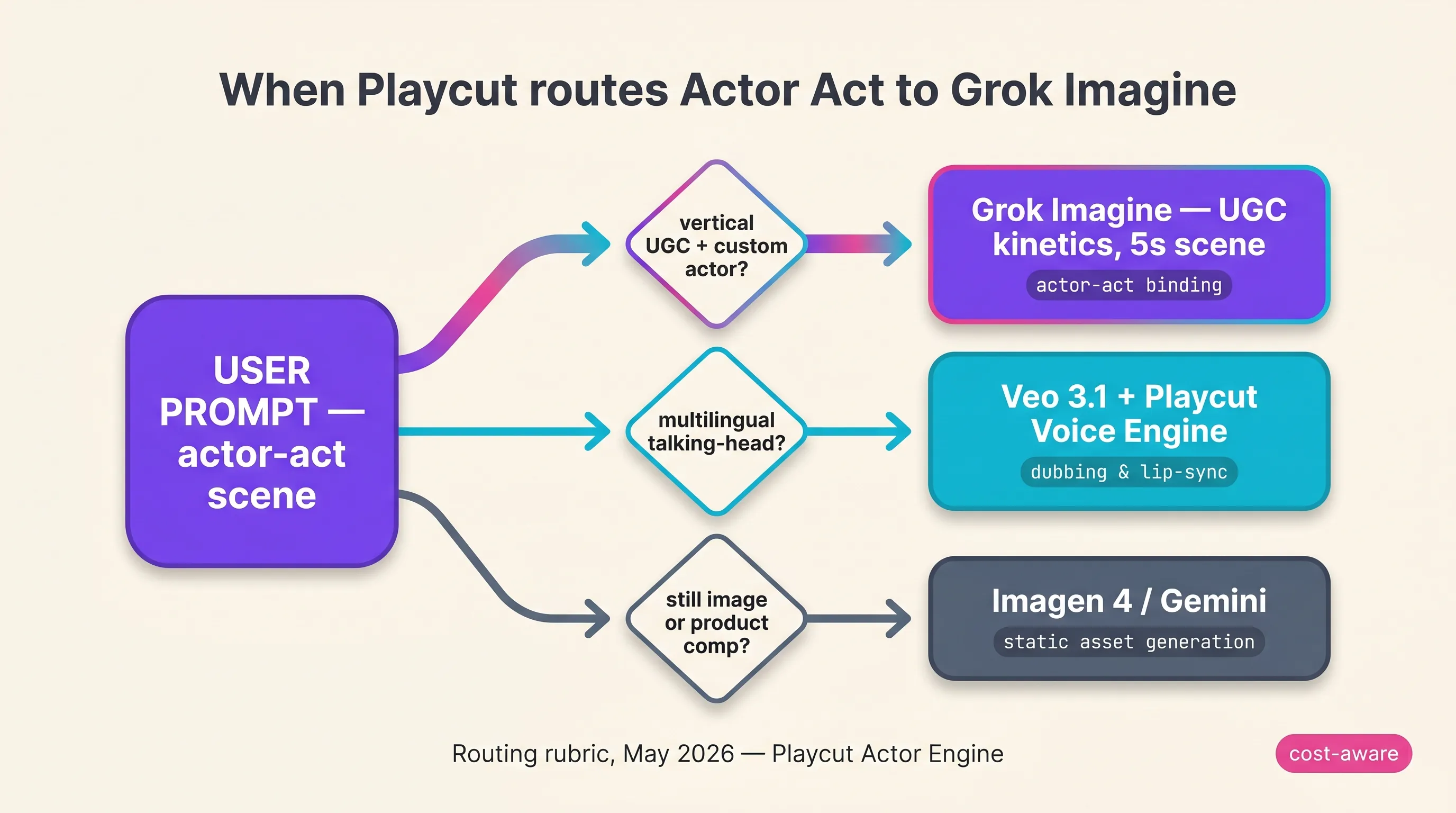
Act ships four engine tiers — fastest, fast, plus, pro — and you pick one when you submit the job. Nothing chooses for you: fastest is simply pre-selected because it is tuned for vertical UGC and is also the cheapest.
Every other generation type has its own model picker with a sensible default already selected. That breadth is the story laid out in what is Playcut and the Playcut vs Sora comparison. The actor stays consistent whichever engine renders the scene, because the Playcut Actor Engine holds the identity profile across every generation.
How the Act feature actually works, step by step

-
Build or pick a custom AI actor. Open the Actors panel. Build a new custom actor from text, a reference photo, or a brand-kit binding. Hobby ships 3 slots, Pro 10, Studio 25, Agency unlimited. Your actor is yours. Same face across every generation.
-
Write the line the actor says. Open a new chat and put the dialogue in quotes inside the prompt. The video model performs that line directly — no voice track to record, generate, or attach. Keep hook lines under 8 words, body under 20 words per beat.
-
Pick an engine tier and a duration.
fastest(7 cr/sec, 6 or 10 sec, 480p/720p) is the pre-selected default.fastis 17 cr/sec over 4–10 seconds;plusis 30 cr/sec at 720p or 38 at 1080p and is the only tier that reaches 15 seconds.prois 35 cr/sec at a fixed 10 seconds. -
Generate the voiced clip. Submit the Act job. Every tier adds the flat 15-credit scene start, then bills video seconds at that tier’s rate, and the actor identity is bound through the Playcut Actor Engine. Default output is vertical 9:16; other ratios are available with one click.
-
Ship to paid social. Download with no watermark on any paid tier. Apply your FTC and platform AI-content disclosure (see compliance section) and publish through Meta Ads Manager or TikTok Ads Manager.
AI UGC vs real UGC: the real cost comparison
The headline number you’ll see quoted across the cluster is AI UGC is 73% cheaper than real UGC on average per Superscale’s 2026 AI-vs-real UGC study. The honest read is that the gap is wider at scale and tighter at low volume.
A single 5-variant campaign costs $1,100–$2,950 with human creators versus $100–$285 with AI UGC per the same Superscale dataset. Testing 50 ad variants pushes human costs to $7,500–$10,600 vs under $200 with AI. At Playcut Studio you can ship roughly 70 voiced 10-second clips per cycle inside the 6,000-credit allowance on the default tier — the entire variant universe of a multi-million-dollar ad account for $79/mo.
Does cheap AI UGC convert?
For top-of-funnel hook tests, AI UGC hits CTR parity with human UGC at 1.5–3% per Cometly’s 2026 AI UGC study, with 2.8× more views and 3.5× more shares in the brands they audited. Top-of-funnel is exactly where variant volume matters and where concept fatigue burns fastest.
Human UGC still edges out AI on deeper-trust lower-funnel conversion. The honest read is AI UGC wins for hook testing and creative discovery, human UGC wins for testimonial pages and high-trust placements. The biggest brands run both.
UGC drives 6.73× higher conversion than non-UGC creative in Q1 2026 per Emplifi’s 2026 UGC release, and PDPs with 15+ UGC assets convert at 8.7% vs 2.1% without per the Bazaarvoice Shopper Experience Index Vol. 18. The structural conclusion: UGC density wins, and AI UGC is the only path that makes density affordable.
Agency economics: what you can charge over a $1.23 cost basis
Diego Ribeiro runs a five-person ad-creative agency in São Paulo. His three biggest clients each want 30 fresh UGC hooks a month, billed at $269 per video per Admiral Media’s public rate card, the visible public benchmark for AI UGC agency pricing in 2026.
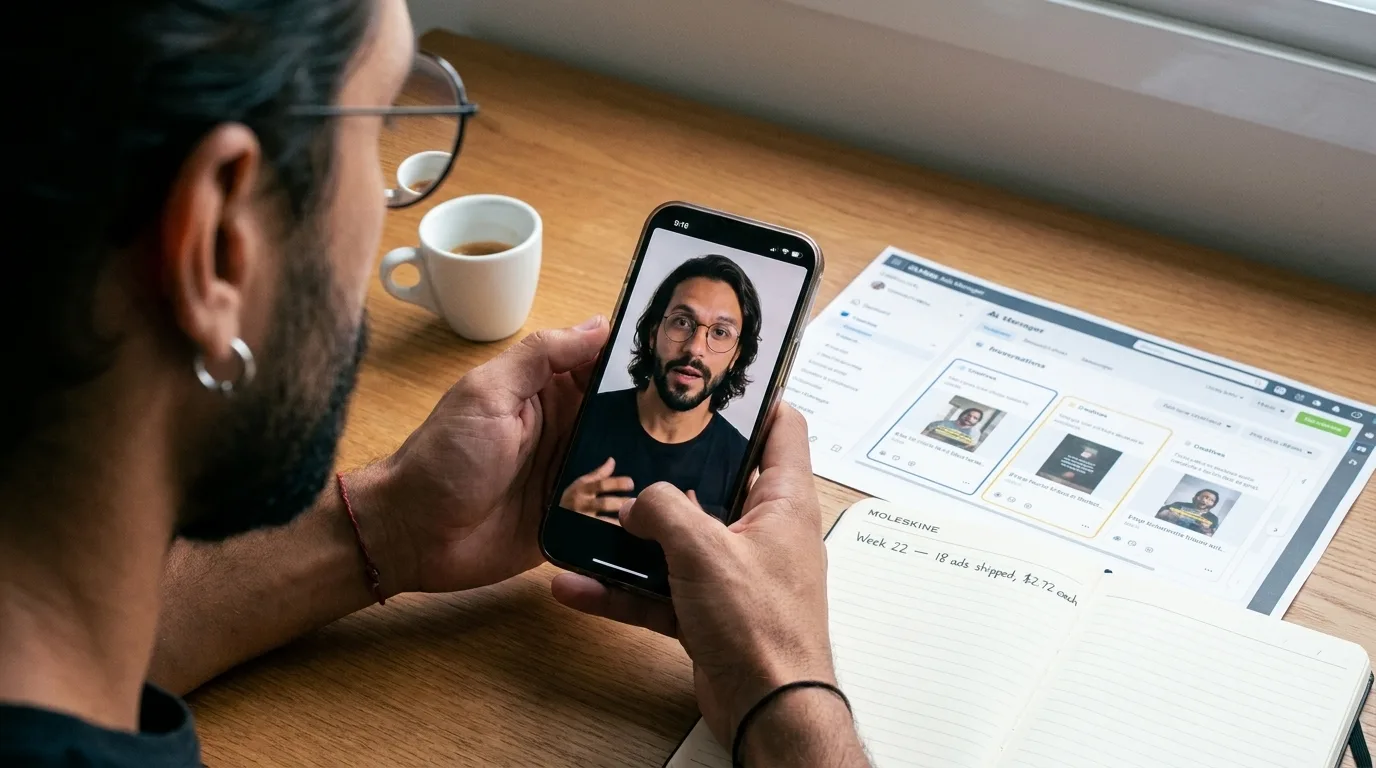
His cost basis per client at 30 voiced 10-second clips a month lands around $37 in Playcut credits (30 × $1.23 on Pro tier rates). Push every one of those clips up to the premium plus tier at 720p and it’s still only $137. Client invoice: $8,070 per client per month.
Gross margin at the line-item level: 98–99%. Even at the indie-tier benchmark of $25/clip — $750 for the month — the platform cost basis barely registers and gross margin still clears 80%.
The named case studies in the cluster anchor the same story. Cliprise’s published case study documents an 80% cost reduction versus traditional UGC for one of their brands. The MindStudio Clarity Media case study records €180k → €792k in YoY revenue (340% growth) after switching to AI UGC, with about €18k in AI tool investment. They also cut per-video pricing 30% to stay competitive, proof the market is repricing in real time.
The structural takeaway for an agency or freelancer: the platform cost basis ($0.83–$8.48 per voiced Act clip, depending on tier, length, and resolution) disappears inside a healthy gross margin. The competitive question is what you price and how fast you ship, not whether the tool can make the math work.
AI UGC compliance: FTC, Meta, TikTok, right-of-publicity
Running AI UGC ads in 2026 is legal and increasingly normalized. The disclosure rules are real, the civil penalties are large, and the synthetic-vs-cloned distinction is the entire legal hinge.
The FTC baseline
The FTC Endorsement Guides extend to AI testimonials. The 2024 Final Rule at 16 CFR Part 465 bans fabricated reviews and AI-generated testimonials presented as real customer feedback.
The 2025 inflation-adjusted civil penalty was $53,088 per violation per the FTC’s 2025 announcement, with the 2026 adjustment cancelled per OMB M-26-11. The 2023 revision to the Endorsement Guides already covered virtual influencers. AI UGC has been in scope since July 2023, not just since 2024.
The clean rule: you can run an AI actor in an ad, you can have the actor describe a product, you cannot represent the AI actor as a real customer providing a real testimonial. A synthetic spokesperson is not the same as a fake review.
Platform disclosure: Meta and TikTok
Meta auto-labels AI-generated content via C2PA content credentials and requires self-disclosure when the AI label is missing. Mandatory disclaimers attach to political and social-issue ads with hard enforcement. Commercial AI UGC has lower-friction disclosure expectations.
TikTok lifted its blanket prohibition on AI endorsements in 2025 per TikTok’s AI content help docs. Disclosure is now the trigger, not prohibition. The AIGC tag covers most commercial AI content; political and crisis content carries tighter rules.
The EU AI Act Article 50 transparency obligations apply August 2, 2026. Material for any brand running European ads.
The synthetic-vs-cloned distinction
Right of publicity attaches only to readily identifiable real people. New York’s June 9, 2026 law explicitly defines a “synthetic performer” as one that does not represent any identifiable natural person, and treats synthetic actors as commercially safe with a disclosure label (not a prohibition).
Fully synthetic actors built from text prompts or composite references are commercially safe for ads, brand campaigns, and UGC across the US and EU. Cloning a real person without consent is a right-of-publicity violation independent of any tool. California’s AB 2602 / AB 1836, Tennessee’s ELVIS Act, and the still-pending federal NO FAKES Act all bear on this. The user, not Playcut, holds that responsibility under every relevant framework.
SAG-AFTRA jurisdiction binds signatory producers and union talent only. A non-signatory brand running a UGC ad with a synthetic Playcut actor is outside SAG-AFTRA scope. Both the April 2026 SAG-AFTRA AI agreement and the Corporate/Educational contract are opt-in for non-signatories.
Honest acknowledgements: where Playcut Act loses
This is the section the rest of the post pays for. We made the rubric. We rank Playcut #1. The math is transparent: re-weight at will. Here is where the honest read says a competitor genuinely wins on a single axis.
Arcads still wins on stock UGC library breadth. 1,000+ pre-built UGC actors at Pro is the deepest UGC-specific casting bench in the category. It no longer wins on price — $7.70 a video against $1.23 for a 10-second Act clip — but if your workflow is “I never recast the same face twice, and library depth is the whole job,” Arcads is the cleanest pick. The full math is in our Arcads alternatives comparison.
HeyGen still wins on multilingual depth. A published 175+ language lip-sync roster is something Playcut does not advertise a matching number for. For brands localizing into long-tail markets (Tamil, Pashto, Burmese, Telugu), that catalogue is the differentiator. The full breakdown is in our HeyGen alternatives breakdown.
Synthesia still wins on enterprise procurement. SOC 2 Type II, ISO 27001, ISO 42001, GDPR, and a SCORM/xAPI L&D pipeline make Synthesia the only platform that has cleared Fortune 500 procurement at scale. If your buyer is procurement and the use case is L&D, Synthesia is the safer bet.
ShortGenius wins on the only meaningful free tier. Three watermark-uncertain videos a month, $19 paid entry. If the goal is testing AI UGC for free, ShortGenius is the lowest-friction starting point.
Where Playcut Act loses on its own terms — length. Act stops at 15 seconds, and only the plus tier gets there. If your creative brief is a continuous 30- or 60-second performance, Act cannot produce it in one pass. You cut multiple clips and stitch, or you move to the Veo path at 160 cr/sec, which is a different order of cost entirely.
And voice control. Because the video model performs the dialogue itself, you take the voice it gives you. That is exactly why there is no voice surcharge on any tier — but a brand with an established, locked voice identity will find that trade unacceptable, and should look at a tool with a separate cloned-voice track.
Pick Playcut Act if
The decision rubric:
- You ship 20+ ad-creative variants per month and the variant supply is the binding constraint on growth.
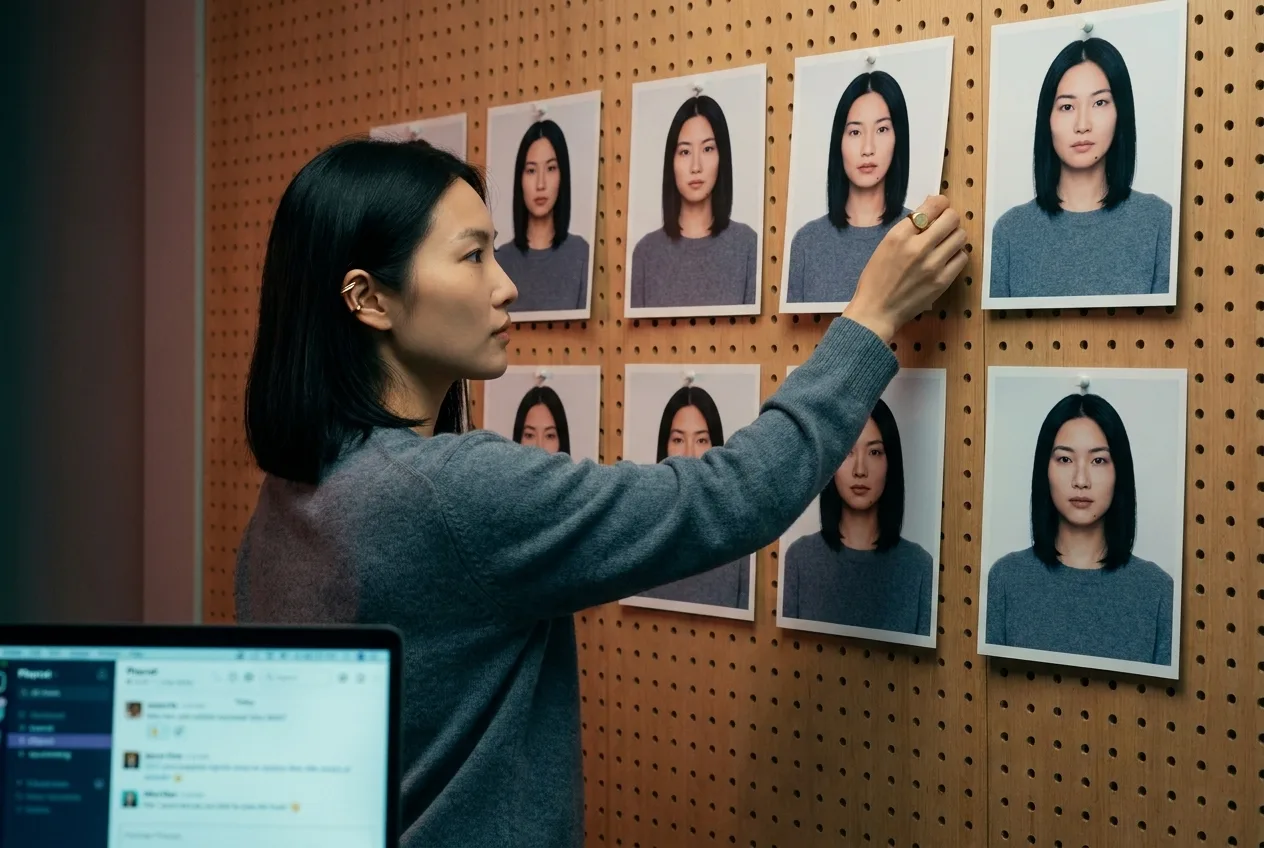
- You need the same brand actor across every variant — same face, same wardrobe, across stills, motion, UGC, and on-product compositing.
- You run multi-brand workspaces or want to in the next 12 months. Playcut Agency at $149/seat ships multi-brand brand kits with unlimited seats and 10K credits/seat pooled.
- Your hooks fit in 6 to 15 seconds — the range Act covers — and a per-clip cost between $0.83 and $8.48 beats a $200+ human UGC creator quote on your P&L. Pro lands ~$1.23 per finished 10-second clip on the default tier; Studio ~$1.12.
- You want a 7-day full-feature trial before committing to a card-attached subscription.
If three of these are true, Playcut Hobby at $9/mo is the cheapest entry path in AI video, or Pro at $29/mo ships 10 actors and the full multi-model studio — both deliver best-in-class character consistency across stills, motion video, UGC ads, and on-product compositing, the same actor, the same face, the same wardrobe across every shot in your campaign.
For a deeper feature-by-feature walkthrough of how to build a recurring AI actor and direct it, see the complete AI actor guide. For an 8-tool ranked list across the broader AI actor generator category, see the AI actor generators comparison. For the underlying multi-model studio story, the Playcut vs Runway comparison covers the multi-model studio thesis end to end.
Frequently asked questions
How much does an AI UGC video cost in 2026?
A voiced 6-second AI UGC clip on Playcut Act costs about $0.83 on Pro ($29/mo) on the default fastest tier, and a 10-second clip about $1.23. Step up the engine and a 10-second clip is $2.68 on fast, $4.57 on plus at 720p, or $5.29 on pro. Studio at $79/mo (4 seats) lands the same 10-second default-tier clip at about $1.12.
The formula is a flat 15-credit scene start plus the tier’s per-second video rate. No tier charges for voice — the video model speaks the scripted dialogue itself.
The broader 2026 market runs $2-25 per finished AI UGC clip and $39-399 per month for subscription tiers per Superscale’s 2025 pricing audit. Human UGC creators charge $150-500 per clip on average per DesignRevision’s 2026 UGC rate card. AI UGC under $6 a clip is 96-99% cheaper than the human cost basis.
Is AI UGC really 73% cheaper than hiring a human UGC creator?
Yes, and the gap is wider at scale. A single 5-variant campaign costs $1,100-$2,950 with human creators versus $100-$285 with AI UGC per the Superscale AI vs Real UGC study (73% cheaper average).
Testing 50 ad variants pushes human costs to $7,500-$10,600 vs. under $400 with AI. At Playcut Studio at $79/mo (6,000 credits, 4 seats at $19.75/seat) you can ship roughly 70 voiced 10-second Act clips per cycle on the default tier — or about 19 on the premium plus tier — plus stills and motion across the rest of the model lineup, multi-format coverage no single-purpose UGC tool delivers.
What’s the cheapest way to make AI UGC if I’m just starting?
Playcut Hobby at $9/mo with a 7-day trial is the cheapest path in the AI video category — 3 custom AI actors, voice cloning, full commercial rights, no watermark. Pro at $29/mo bumps that to 10 actors and the full multi-model studio.
Free tiers exist (SendShort, FlexClip, and Creatify’s 10-credit free plan) but they all gate watermark removal, custom actors, or commercial use behind paid upgrades per SendShort’s tool docs. For a side-by-side cost comparison across 8 tools see our AI actor generators comparison and the per-tool Playcut pricing breakdown.
How much does a custom AI actor or digital twin cost?
Custom AI actor pricing varies wildly. Synthesia’s Studio Avatar is a sales-gated enterprise add-on. HeyGen’s Avatar V flow trains a Digital Twin from a 15-second selfie video and gates the count by tier (1 on Creator $29/mo, more on Business $149/mo + $20/seat).
Arcads custom cloning sits behind a sales-gated Pro contract with no public per-clone price. Playcut Hobby ships 3 self-serve custom AI actors at $9/mo, Pro ships 10 at $29/mo, Studio ships 25 at $79/mo (4 seats), Agency unlimited at $149/seat. All built through the Playcut Actor Engine so the same face holds across stills, motion video, UGC ads, and on-product compositing without recasting.
Can cheap AI UGC convert as well as real UGC ads?
For top-of-funnel hook testing on Meta and TikTok, AI UGC hits CTR parity with human UGC at 1.5-3% per Cometly’s 2026 AI UGC study, with 2.8× more views and 3.5× more shares in the brands they audited.
Human UGC still edges AI on deeper-trust lower-funnel conversion. The cheap-per-clip advantage matters most where creative fatigue burns concepts in 2-3 weeks on Meta Andromeda (down from 6+ weeks in 2024). Variant volume is now the durable lever, and at $3-15 per voiced Act clip the math still compounds versus a $200+ human creator quote.
Are AI UGC ads with a synthetic actor legal to run on Meta and TikTok?
Yes, when the actor is fully synthetic (no real person’s likeness) and you hold the commercial rights from the platform. Playcut’s commercial use is included on every paid tier.
The FTC Endorsement Guides still apply, and fabricated testimonials carry a $53,088 per-violation civil penalty under 16 CFR Part 465. Meta auto-labels via C2PA; TikTok lifted its AI-endorsement ban in 2025 in favor of disclosure. Cloning a real person without consent stays a right-of-publicity violation independent of any tool you use.
Does Playcut Act keep the same actor consistent across many UGC variants?
Yes. Character consistency is the lead promise. The Playcut Actor Engine binds appearance, wardrobe, and brand-kit context into a persistent runtime profile that re-casts the same actor identically across every generation.
In our April 28 – May 9, 2026 8-shot consistency holdout (three blind reviewers, with Liu et al.’s 2025 multi-shot consistency paper as the upstream reference), Playcut held identity above 7.5/10 across all eight shots while Arcads, HeyGen Avatar IV, Higgsfield Soul ID, and Synthesia all crossed below 6.0 by shot four or five.
For brands running 30+ hook variants weekly, that is the structural moat: best-in-class character consistency across stills, motion video, UGC ads, and on-product compositing, the same actor, the same face, the same wardrobe across every shot in your campaign.
The reading, end to end
AI UGC video cost is now the metric that determines whether an ad-creative line item compounds or quietly dies. The 2026 market clears $2–25 per finished AI UGC clip and $39–399 per month for subscription tiers.
The structural moat is character consistency at variant scale plus multi-format reuse, and Playcut Act now wins on raw per-clip price too. A voiced 6-second UGC Act clip costs about $0.83 on Pro, a 10-second clip about $1.23, the whole four-tier ladder stays under $9 a clip, and the same brand actor holds identity across every variant the campaign ships.
The right tool depends on the workload. If you’re just starting and need the cheapest entry in AI video, Playcut Hobby at $9/mo with a 7-day trial clears the budget bar. If you ship 20+ variants a month and the same brand face matters across formats, Pro at $29/mo ships 10 actors and the full multi-model studio; Studio at $79/mo adds 4 seats at $19.75/seat.
The next step is to try the Playcut Actors product, explore the UGC ads workflow, read the complete AI actor guide, or — if you’re still evaluating Playcut against the rest of the AI video field — see the Playcut alternatives comparison before you commit.
Ship your first Playcut Act clip today.
7-day trial, no charge if you cancel inside the trial. Best-in-class character consistency across stills, motion video, UGC ads, and on-product compositing, the same actor, the same face, the same wardrobe across every shot in your campaign.
Start free on Playcut →