
Playcut Alternatives: 8 AI Video Studios Compared for 2026
If you’re scoring Playcut alternatives in 2026, the right answer depends on which job you’re hiring the studio to do — single-shot cinematic ceiling, daily-refreshing free credits, multilingual talking-head, or multi-brand agency workflow.
This refresh ranks the eight studios most worth considering — Runway, Pika, Kling, Sora (RIP), Luma, Higgsfield, Arcads, HeyGen — head-to-head against the cinematic AI video and image studio Playcut for buyers evaluating in May 2026.
Multi-model breadth + persistent AI actors + multi-brand brand kits — the three primitives no single-model competitor ships together. Every claim in the matrix below is sourced to a primary doc, and every per-brand section names what each tool genuinely wins at before the trade-offs.
In a hurry?
Eight Playcut alternatives ranked head-to-head, May 2026. Multi-model breadth, persistent AI actors, and multi-brand brand kits remain the wedge no single-model competitor has closed.
Runway wins single-model cinematic ceiling (Pro $28). Kling wins cheapest paid plus daily-refreshing free credits. HeyGen wins multilingual talking-head. Arcads wins UGC stock library — but at $77/mo (was $110) versus Playcut Hobby $9 or Pro $29.
Sora is dead. OpenAI shut the app April 26, 2026; the API follows September 24. The post-Sora consensus is multi-model — exactly what Playcut puts in one chat.
Jump to the 8-tool matrix, the Sora migration playbook, or the 5-rule decision framework.
Start your 7-day Playcut trial →
Table of contents
Who wins each round (the quick verdicts)
Front-loaded verdicts for the buyer who only has 60 seconds. Every claim links to its primary source below.
- Cheapest paid plan with commercial use: Kling AI Standard at $6.99/mo first month ($8.80 on renewal), 660 credits, 1080p, full commercial license.
- Best free tier (sustained): Kling AI — 66 credits per day that refresh, watermarked and non-commercial but the most generous floor in the category.
- Longest single clip: HeyGen Avatar V at up to 60 minutes per render on Business — but that is talking-head, not cinematic motion.
- Highest cinematic resolution today: Luma Ray3 ships 4K HDR up-res with 16-bit EXR export; Kling 3.0 Ultra ships native 4K on the Ultra tier.
- Most models behind one surface: Playcut ships Veo 3.1, Seedance 2.0, Nano Banana Pro, Nano Banana 2, and Grok Imagine, the cheap end of both the image and video picker on one credit balance — see the full multi-model AI stack.
- Best UGC stock library: Arcads at 1,000+ AI actors on Pro — at $77/mo Starter (discounted from $110) with no free trial.
- Best talking-head avatar: HeyGen Avatar V — 175+ languages, SOC 2 Type II + ISO 27001 + HIPAA + FedRamp.
- Best single cinematic shot quality: Runway Gen-4.5 — #1 Artificial Analysis text-to-video Elo at 1,247 as of March 2026.
- Most prominently discontinued: Sora — web/app offline April 26, 2026; API maintenance mode sunsets September 24, 2026.
Why people search for Playcut alternatives
Buyer intent for playcut alternative searches concentrates around five recurring complaints across Reddit, Trustpilot, and the post-Sora migration threads. None of them mean a tool is bad — they mean the buyer hit a structural ceiling and is shopping for the next one.
Credit-system burnout
Per-second credit pricing on Runway Gen-4.5 (12 credits/sec) and Veo 3.1 (40 credits/sec with audio) makes an honest iteration cycle cost-prohibitive. Credits don’t roll over on Runway. Buyers running 30+ variants a week price this in immediately — see ngram’s Beyond Runway roundup for the documented complaint pattern.
Flat-tier subscriptions like Playcut Hobby $9, Pro $29, Studio $79 (4 seats), and Agency $149/seat reset this math at the workspace level rather than the second level. The credit budget is monthly, predictable, and bound to the seat.
Billing and refund trust
Caimera’s Higgsfield trust-collapse case study and the BBB San Francisco complaint file document the failure mode: annual-disguised checkout flow, unused-credit forfeit on refund, ignored cancellation requests. The same pattern shows up on Arcads Trustpilot reviews — refund article forfeits unused credits, French law jurisdiction, 72-hour cancellation window.
Buyers running paid client work treat billing transparency as a procurement gate. A tool that fails the gate gets dropped regardless of model quality.
Model lock-in
Per allaboutai’s Veo 3 review, the same prompt that lands cleanly on Veo 3.1 fails on Kling and the inverse — physics on Kling 3.0 holds against handoffs that Veo blurs. Single-model tools force buyers to leave the studio when the model is wrong for the shot.
The post-Sora migration is the cleanest signal here: Reddit, TechCrunch, and Bloomberg all converge on “use whichever model wins the shot, not whichever model your subscription locks you to.”
Character and brand consistency drift
Per Wei Zhang’s DEV.to analysis, every single-model tool drifts on cross-shot identity by shot four or five. Runway Frames Worlds, Pika Pikascenes, and Kling 3.0 Visual DNA all attempt cross-shot consistency via reference uploads.
None of them store a named actor object the way a persistent Playcut AI Actor Library does. For agency UGC pipelines where the same brand spokesperson appears across 30 ads a quarter, this is the structural gap — see the AI actor guide for the full character-consistency rubric.
Output caps (length, audio, resolution)
Per the allaboutai Veo 3 review, Veo 3.1’s 8-second base length, Kling 3.0’s 5-to-15-second range, and Runway Gen-4.5’s ~10-second ceiling all push buyers toward extension and interpolation workflows. Audio support is uneven: Veo and Seedance ship native audio; Kling and Runway don’t.
Resolution caps split similarly. Luma Ray3 ships 4K HDR; Kling 3.0 Ultra ships native 4K; most other paid tiers cap at 1080p. The buyer’s workflow either fits inside the cap or it doesn’t.

The 8-tool comparison matrix
Every value below is sourced to a primary doc verified on 2026-05-13 or earlier; footnotes follow the table. Where a vendor states two different prices on different pages, we cite the cheaper of the two and note the gap. Render the table on desktop; on mobile each row becomes its own card with the tool name sticky.

| Tool | Starting price | Free tier | Models powering it | Max length | Max res | Brand kit / AI actors | Best for |
|---|---|---|---|---|---|---|---|
| Playcut | $9/mo (Hobby) · $29/mo (Pro) · $79/mo (Studio, 4 seats = $19.75/seat) · $149/seat/mo (Agency, ∞ seats) | Paid-only (7-day full-feature trial on Hobby) | Multi-model studio: Veo 3.1 + Seedance 2.0 + Nano Banana Pro + Nano Banana 2 + Grok Imagine | Veo 3.1 8s base, extendable via interpolation | 1080p native, 4K via upscale | Yes — multi-brand brand kits (Agency) + persistent AI actor library | Multi-brand agencies and teams needing one studio for video + image + actors |
| Runway | $12/user/mo Standard (annual, up to 5 users) | Yes — 125 one-time credits, watermarked | Gen-4.5 + Gen-4 Turbo + Aleph + Veo/Kling/Seedance resale on paid tiers | ~10s per gen on Gen-4.5 | 1080p native, 4K via upscale | No brand kit; reference-image character control only | Filmmakers chasing the single-model cinematic ceiling |
| Pika | $8/mo Standard annual | Yes — 80 credits/mo at 480p | Pika 2.5 + Pikaformance (proprietary, single-model) | 5–8s standard, up to 25s via chained Pikaframes | 1080p (paid only) | No | Solo creators making viral social effects and stylized clips |
| Kling | $6.99/mo first / $8.80 renewal | Yes — 66 credits/day refresh, 720p, watermarked | Kling 3.0 / Kling 3.0 Omni (proprietary, single-model) | 5–15s per gen depending on model + tier | 4K Ultra on Ultra tier; 1080p on Standard/Pro/Premier | Element Library character references; no brand kit | Photorealistic motion and cinematic image-to-video at the lowest paid floor |
| No | OpenAI Sora 2 (proprietary, single-model) | Was 20–25s on Pro | n/a | No | DISCONTINUED — OpenAI shut Sora 2026-03-24; web app closed 2026-04-26; Sora 2 API sunsets 2026-09-24 | ||
| Luma Dream Machine | $30/mo Plus (lowest paid tier — no $10 Standard) | Yes — ~1 720p draft/day | Luma Ray3 / Ray3.14 + Photon image; Veo 3.1 + Kling 3.0 resold on paid tiers | ~18s native, up to ~30s with chained Extends | 1080p native, 4K HDR up-res, 16-bit EXR export on Ray3 | No brand kit; Ray3 “Character Reference” only | HDR / EXR colorist pipelines, keyframe-controlled cinematic shots |
| Higgsfield | $15/mo Starter · $49/mo Plus · $129/mo Ultra · $89/seat Business | No (free tier removed late 2025) | Aggregator: Veo 3.1 + Kling 3.0 + Seedance + Wan + Hailuo + Higgsfield proprietary (Soul, DOP, Cinema Studio 3.5) — Sora removed post-discontinuation | Inherits model limits (Veo 8s, Kling up to 15s) | 1080p+ depending on model; 4K on Cinema Studio 3.5 | Soul ID character consistency; no formal brand kit | Cinematic camera presets and marketer-aware app library (with trust caveats — see section) |
| Arcads | $77/mo Starter (was $110) | No free trial — paid plans only | Proprietary UGC-actor library; backends include Seedream + Kling + Nano Banana (Sora 2 retired post-discontinuation) | UGC ad length: 30–90s scripted (lip-sync drift past 60s) | 1080p | 300+ AI actors on Starter / 1,000+ on Pro; no brand kit | Direct-response UGC talking-head ads at scale |
| HeyGen | Free · $29/mo Creator · $49/mo Pro · $149/mo + $20/seat Business | Yes — 3 free videos/mo, watermarked, ≤1 min | Proprietary Avatar IV / Avatar V + Voice Director + Seedance 2.0 + Veo 3 access on Premium Credits | Up to 30 min Creator / 60 min Business | 4K Pro/Business, 1080p Creator | 500+ stock avatars Free / 700+ Creator+; 1 Custom Digital Twin Creator+, 5 on Business; no multi-brand kit | Talking-head video at scale: training, sales, multilingual dubbing |
Sources by vendor.
- Playcut — flat-tier pricing — Hobby $9, Pro $29, Studio $79 (4 seats), Agency $149/seat (unlimited seats, multi-brand kits) — v2 launched 2026-05-27.
- Runway — runwayml.com/pricing and the Runway API pricing docs.
- Pika — pika.art/pricing.
- Kling — klingai.com/global/pricing and Magic Hour Kling pricing.
- Sora — OpenAI discontinuation help center and The Decoder’s two-stage shutdown coverage.
- Luma — lumalabs.ai/pricing and the Luma video models guide.
- Higgsfield — higgsfield.ai/pricing, imagine.art Higgsfield audit, and the yangsweb Higgsfield review.
- Arcads — eesel.ai Arcads pricing 2026 and Arcads Terms.
- HeyGen — heygen.com/pricing and the HeyGen pricing help center.
Runway — best for filmmakers chasing the single-model ceiling
Runway is the strongest single-vendor cinematic pick in 2026. Gen-4.5 holds the #1 spot on the Artificial Analysis text-to-video leaderboard at 1,247 Elo as of March 2026, and Aleph is a genuinely novel in-context video-to-video editor with no direct equivalent at any competitor.
The studio reads like a creative tool, not a chat surface. Motion brush, masks, video-to-video, and a timeline editor are first-class features per the AI Tool Analysis Runway review. The Lionsgate × Runway deal ratifies the filmmaker positioning at the studio level.
Strengths.
- Gen-4.5 cinematic quality — first-place Elo, strongest 5-to-10-second shot polish in the category per Artificial Analysis.
- Aleph in-context editing — relight, restyle, and re-light an existing clip from a prompt; no other vendor ships this.
- Resold Veo/Kling/Seedance on paid tiers — Runway is one of the few non-Playcut studios that route multiple model families on paid plans.
- Filmmaker-grade editor — motion brush, masks, and a real timeline beat every chat-only surface in the slate.
Weaknesses.
- Credit math — 12 credits/sec on Gen-4.5, 40 credits/sec on Veo 3.1 with audio per Runway API pricing docs. No rollover.
- Zero agency tooling — no brand kits, no persistent actor library, SSO only on Enterprise tier.
- No native audio on Gen-4.5 — audio adds credit cost via Veo routing.
- No free-tier rollover — the 125-credit allowance is one-shot.
Where Playcut wins vs Runway
Runway Pro is now $28/mo (down from $35) and Standard is $12/user/mo for up to 5 seats — within a dollar of Playcut Pro $29.
The wedge is no longer headline price: Playcut puts Veo 3.1 and Seedance 2.0 behind a flat Hobby $9 / Pro $29 / Studio $79 (4-seat = $19.75/seat) / Agency $149-per-seat ladder, with the full multi-model AI stack plus the agency primitives Runway hasn’t shipped: persistent AI actors, multi-brand brand kits (Agency tier), and shared/private workspace folders.
Choose Runway over Playcut if your daily job is single-shot cinematic polish and you live in a timeline editor — see the Playcut vs Runway: Full Comparison for 2026 for the head-to-head.
Pika — best for viral social effects and stylized clips
Pika is the viral-social specialist. Pika 2.5 ships Pikaffects (one-prompt VFX), Pikascenes (reference characters across scenes), and Pikaframes (chained 5-second extensions up to ~25 seconds) per the Pika 2.5 launch coverage on Pikartai.
The price floor is the second-cheapest in this slate at $8/mo Standard on annual prepay per pika.art/pricing. The funding posture is healthy — VentureBeat covered the Pika 2.0 launch and Maginative documented the $80M Series B.
Strengths.
- Pikaffects — one-prompt VFX library (cake-ify, explode, melt) that lands clean for TikTok content.
- Pikascenes — reference your own characters, objects, or scenes into generations.
- $8/mo Standard — second-cheapest paid tier in the slate; Pro $28, Fancy (Unlimited) $76.
- 80 free credits/mo at 480p — sustained free access on the perpetual free tier.
Weaknesses.
- No team tier — solo and creator tiers only; no brand kit, no shared workspace.
- 1080p ceiling — no 4K, no HDR.
- 5–8s standard length — chained Pikaframes get to ~25 seconds at extra credit cost.
- Single-model architecture — Pika 2.5 only; no Veo/Kling/Seedance access.
Where Playcut wins vs Pika
Pika is a single-model solo tool. Playcut runs the same effect-style prompts on Veo 3.1, Seedance 2.0, Nano Banana Pro, or Grok Imagine — your pick per shot — plus the Playcut AI Actor Library keeps the same face across every viral variant — Pika’s Pikascenes attempt this via reference uploads but identity isn’t stored as a reusable object.
Choose Pika over Playcut if you’re a solo creator and Pikaffects is the entire reason you’re shopping — the $8/mo tier is honest and the effect library is the deepest in the category.
Kling AI — best for cinematic motion and image-to-video at low cost
Kling AI is the cheapest serious paid option in the slate and the post-Sora migration’s most-cited cinematic-motion winner. Kling 3.0 launched February 7, 2026 per Kuaishou’s IR release, and four of the top ten slots on the Artificial Analysis text-to-video leaderboard are Kling variants.
Standard is $6.99/mo first month, $8.80/mo on renewal per the Magic Hour Kling pricing audit, with 660 monthly credits and a 1080p ceiling. The free tier is the most generous in the slate at 66 daily credits that refresh per vo3ai’s Kling 2026 audit.
Strengths.
- Cinematic motion and physics — Kling 3.0 is the post-Sora consensus pick for handoffs and complex action per Bloomberg’s migration coverage.
- Cheapest paid plan with commercial use — $6.99/$8.80 Standard beats every paid tier in this slate.
- 66 free credits/day refresh — most generous sustained free tier in the category.
- 4K Ultra HD on Ultra tier — only Kling and Luma ship native 4K in the slate.
- Element Library character references — cross-shot identity via uploaded references.
Weaknesses.
- Chinese data jurisdiction — Kuaishou is PRC-domiciled; agencies in regulated sectors price this in.
- Opaque moderation — per Eesel’s Kling reviews aggregation, prompts flagged for moderation aren’t explained.
- Weak team tooling — no brand kits, no multi-seat workspaces with role-based access.
- Customer support black hole — Eesel documents long response times and untracked tickets.
Where Playcut wins vs Kling
Playcut answers Kling-grade cinematic motion with Veo 3.1 and Seedance 2.0, alongside Nano Banana Pro and Grok Imagine via the full multi-model AI stack — and the workspace ships brand kits, role-based seats, and persistent actors. Kling wins on raw price; Playcut wins on agency-grade workflow.
Choose Kling over Playcut if your only output is cinematic motion clips, you run solo or as a duo, and $6.99/mo for the model floor is the entire decision — see the Playcut vs Kling head-to-head for the full breakdown.
Sora — RIP April 2026 (migration playbook, not a comparison)
This is not a feature comparison. Sora’s servers are off. The section below is a migration playbook for the buyer who arrived here searching sora alternative or sora 2 replacement.
What happened
OpenAI announced Sora’s shutdown on March 24, 2026 per CNN Business coverage. The web and app experiences went dark April 26, 2026, and the Sora 2 API enters maintenance mode through September 24, 2026 per The Decoder’s two-stage shutdown reporting.
TechCrunch’s analysis names the operational cost — WSJ pinned the run-rate at $1M/day — alongside a strategic compute reallocation toward Claude Code competition. NBC News documented the engagement collapse: $2.1M lifetime revenue against downloads that never recovered after the November 2025 launch peak.
What Sora was best at
Photorealism and atmospheric long shots. Sora 2’s strength was the 20-second narrative pan with consistent lighting and atmospheric depth — the shot type that Veo and Kling still split between physics and photorealism.
Cameos. Sora’s cameo system let creators inject themselves into generations with consented likeness training — a feature no current generalist video model fully replicates.
Long-duration generations. Up to 20–25 seconds on Pro was longer than any other paid tier in the 2025 slate.
The migration playbook
| What you used Sora for | Where to go now | Why |
|---|---|---|
| Photorealistic 8–20s shots | Veo 3.1 (via Playcut chat or Google AI Studio) | Veo 3.1’s photorealism + native audio is the closest 1:1 swap; allaboutai’s Veo 3 review covers the handoff. |
| Cinematic motion and physics | Kling 3.0 (direct or via fal.ai) | Four of the top ten Artificial Analysis Elo slots are Kling; Bloomberg’s post-Sora migration coverage names Kling as the consensus pick. |
| Unified audio + video | Seedance 2.0 (in Playcut, or direct via BytePlus) | Seedance is the only post-Sora model shipping native audio + video without a second pass. |
| Long-form narrative (20s+) | Veo 3.1 + interpolation | Native length is 8s on Veo 3.1; chain via interpolation for narrative continuity. |
| Cameos / personal likeness | Playcut AI Actor Library | Persistent named actor with appearance + outfit variants — closest replacement for the Sora cameo workflow. |
Why a multi-model platform beats any single Sora replacement
Sora’s lesson is that no single model survives a multi-quarter product cycle without a parallel hedge. The post-Sora consensus across TechCrunch, Bloomberg, and Reddit’s r/aivideo migration threads is multi-model.
Veo 3.1 wins photorealism + audio; Kling 3.0 wins cinematic motion + physics; Seedance 2.0 wins unified audio-video. Playcut ships Veo 3.1 and Seedance 2.0 alongside Nano Banana Pro and Grok Imagine in one chat — operationalizing the consensus rather than re-betting on a single successor. For the deeper head-to-head we wrote pre-shutdown, see Playcut vs Sora: Studio Workflow vs Headline Model.
Luma Dream Machine — best for HDR/EXR colorist pipelines
Luma is the only competitor in this slate that combines native cinematic generation with a real colorist pipeline. Ray3 ships native 1080p plus 4K HDR up-res and 16-bit EXR export — the kind of output a downstream Resolve or Baselight session can actually grade.
The model resale is meaningful. Per the Luma video models guide, Plus and higher tiers resell Veo 3.1 and Kling 3.0 alongside Luma’s own Ray3.14. The CNBC Series C coverage ratifies the funding posture — $900M led by HUMAIN — but the GoEnhance hands-on review documents identity-drift complaints on multi-shot work.
Strengths.
- Ray3 HDR + 16-bit EXR export — the only generation tool in the slate that produces a real colorist deliverable.
- Keyframe interpolation — set start/end frames and Luma fills the motion path.
- Veo 3.1 + Kling 3.0 resold on paid tiers — closest to Playcut on multi-model architecture.
- ~18s native generations — among the longest single-pass clip lengths in the slate.
Weaknesses.
- Team plan “coming soon” — no team workspaces ship today — solo Plus, Pro ($90), and Ultra ($300) tiers only.
- $30/mo Plus floor — Luma’s lowest paid tier is Plus $30 (the rumored “$10 Standard” has never existed), higher entry than Kling, Pika, or Runway annual.
- Two parallel pricing pages — Plus/Pro/Ultra sit on one page, API on another; documented gap.
- Identity drift on multi-shot work — Ray3 “Character Reference” attempts cross-shot identity but doesn’t store a named actor object.
Where Playcut wins vs Luma
Luma is the closest competitor on multi-model resale — honest acknowledgment. Playcut wins on the agency primitives Luma hasn’t shipped yet: multi-brand brand kits, shared and private workspace folders, and the Playcut AI Actor Library with persistent appearance + wardrobe + outfit variants. If Luma ships a Team plan that closes the workspace gap, this becomes a sharper comparison.
Choose Luma over Playcut if your downstream pipeline is a Resolve grade and you need 16-bit EXR export today — no other tool in the slate ships that.
Higgsfield — factual contrast with crisis facts, no FUD
Higgsfield is a real product in active reputational crisis. Cinema Studio 3.5, Soul ID character consistency, and the DOP cinematic camera library are genuine strengths. The trust posture is the wedge.
The crisis facts are documented and cited to named primary sources below — not asserted as opinion.
The product strengths are real. Cinema Studio 3.5 ships 4K output. Soul ID trains a single named identity per user from photo references. The DOP camera presets cover Crash Zoom, Bullet Time, FPV Drone, and ~50 other named moves with their own SEO landing pages. As an aggregator surface, Higgsfield exposes Veo 3.1, Kling 3.0, Seedance, Wan, Hailuo, and proprietary models behind a single dropdown (Sora 2 was removed post-OpenAI discontinuation 2026-03-24).
The trust posture is documented. The Register reported the “ended 20 creative jobs” brag post and its deletion in February 2026. Times of Central Asia documented additional content-moderation incidents. Caimera’s trust-collapse case study tracked the X-account suspension on February 9, 2026 over alleged platform-manipulation.
The billing complaints are documented. The BBB San Francisco profile records complaints across annual-disguised checkout flow, credit-forfeit refund policy, and ignored cancellation requests. The imagine.art audit and yangsweb’s review confirm the perpetual free tier was removed late 2025 — paid plans are required to generate. The current tier ladder is Starter $15, Plus $49, Ultra $129 (3,000 cr ≈ 51 Veo 3 videos or 136 Veo Fast 8s clips), Business $89/seat.
The CEO’s own admission. Alex Mashrabov said publicly on February 11, 2026: “our internal processes and external communications did not always keep pace with our values, and we made mistakes,” per Piunikaweb’s coverage of the post-X-suspension statement.
Strengths.
- Cinema Studio 3.5 + Soul ID + DOP cameras — genuine cinematic differentiation; Soul ID is the closest competitor to a persistent actor object in this slate.
- Aggregator architecture — 5+ models behind one dropdown (Sora 2 removed post-discontinuation).
- 4K on Cinema Studio 3.5 — competitive with Luma Ray3 and Kling Ultra.
- $15/mo Starter — competitive entry price; Plus $49, Ultra $129, Business $89/seat.
Weaknesses.
- Documented trust crisis — X-account suspension, BBB complaints, CEO public admission of “mistakes.”
- Annual-disguised checkout flow — monthly sticker rate runs roughly 58% above the annual billed rate per the imagine.art audit.
- Credit-forfeit refund policy — generating any output forfeits refund eligibility per documented Trustpilot complaints.
- No formal brand kit — Soul ID covers character; nothing covers colors/typography/logo at the workspace level.
Where Playcut wins vs Higgsfield
Higgsfield’s product is real; the wedge is trust, billing transparency, and the workspace architecture. Playcut ships flat monthly billing (no annual-disguised checkout), a Playcut AI Actor Library with persistent appearance + wardrobe + outfit variants beyond Higgsfield’s single-identity Soul ID, and multi-brand brand kits the Higgsfield workspace doesn’t ship — see the deeper Higgsfield Alternatives: 7 Better Studios for 2026 roundup for the full breakdown.
Choose Higgsfield over Playcut only if your entire workflow is a specific named camera preset and you’ve evaluated and accepted the billing/refund posture for client work.
Arcads — best for UGC talking-head ad library, but $77 vs $9–$29
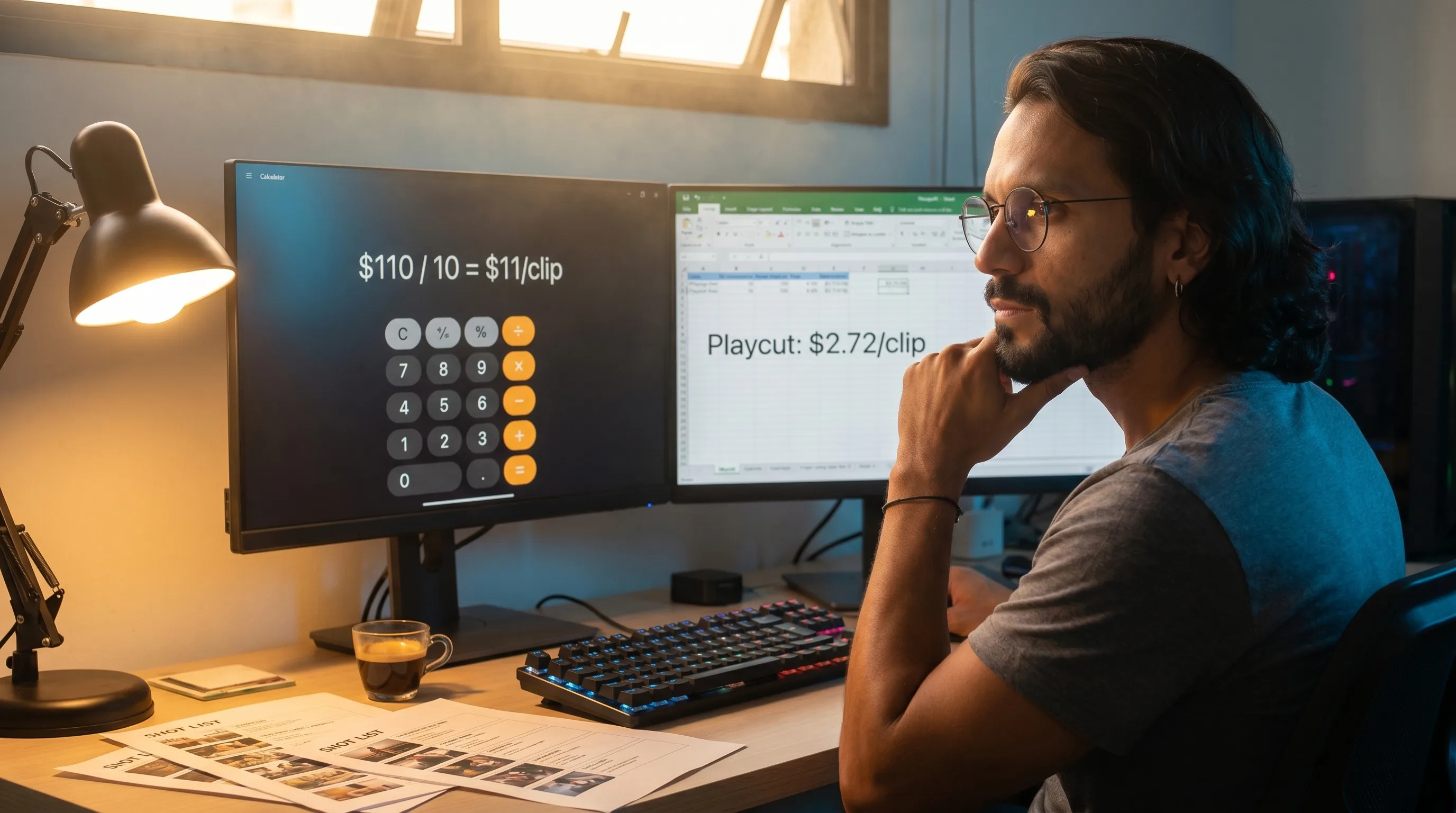
Arcads starts at $77/mo Starter (discounted from $110) with no free trial — 8.6× Playcut Hobby $9 or 2.7× Playcut Pro $29. That’s the headline. Arcads is the deepest UGC-specific stock library in the category (1,000+ AI actors on Pro, 300+ on Starter and Creator per the eesel.ai Arcads pricing 2026 audit) and ships Meta/TikTok auction-tuned hook templates that no other tool in the slate matches.
The funding posture is real — PR Newswire documented the $16M seed led by Eurazeo. The trust posture is mixed: Arcads Terms places jurisdiction under French law with a 72-hour cancellation window. The refund article confirms unused credits do not roll over. Trustpilot reviews include $339 pre-trial-end-charge complaints.
Strengths.
- 1,000+ UGC actors on Pro — deepest stock library in the slate.
- Meta/TikTok auction-tuned hooks — preset library tuned to direct-response ad signals.
- Real funding posture — $16M Eurazeo seed; serious operator team.
- CSV bulk variant generation — Pro tier supports CSV-driven batch creation Playcut doesn’t ship today.
Weaknesses.
- $77/mo Starter (was $110), no free trial — among the highest entry prices in the slate.
- UGC-only output — no text overlays, no B-roll, no still images, no on-product compositing.
- Lip-sync drift past 60 seconds — documented on the Superscale Arcads pricing breakdown.
- Credit-forfeit refund policy — unused credits don’t roll, French law jurisdiction.
Where Playcut wins vs Arcads
Arcads ships UGC talking-head video only. Playcut covers the full campaign asset graph — UGC plus stills plus product compositing plus cinematic video — via the multi-model AI stack plus the UGC Ads workflow, at Hobby $9 / Pro $29 / Studio $79 / Agency $149-per-seat instead of $77+.
On Pro $29 the per-clip math undercuts Arcads’s ~$7.70 on Starter on equivalent UGC volume — see AI UGC Video Cost in 2026 with Playcut Act for the full math, and Playcut’s flat-tier pricing — Hobby $9, Pro $29, Studio $79, Agency $149/seat.
Choose Arcads over Playcut if your only output is UGC talking-head ads, you run direct-response at scale, and you’ve priced in the $77 floor — see the deeper Arcads Alternatives: 8 Better AI UGC Studios for 2026 roundup.
HeyGen — best for talking-head, training, and multilingual dubbing
HeyGen is the talking-head category leader and the honest recommendation if a person-talking-to-camera is your entire job-to-be-done. Avatar V shipped in the April 2026 release with 175+ language coverage and the strongest mouth-shape fidelity in the slate per the HeyGen Avatar IV complete guide.
The enterprise procurement stack is unmatched in this slate. HeyGen’s privacy and security standards document SOC 2 Type II, ISO 27001, HIPAA, and FedRamp. The Sacra revenue snapshot confirms the funded posture. Frame HeyGen as complementary, not replaceable — the category-leader avatar plus Playcut for everything around it.
Strengths.
- Avatar V mouth-shape fidelity — best-in-class talking-head per the HeyGen April 2026 release notes.
- 175+ languages with voice cloning — widest dubbing pipeline in the category.
- Enterprise compliance — SOC 2 Type II + ISO 27001 + HIPAA + FedRamp signed off today.
- 60-minute generations on Business — longest single-render length in the slate (talking-head).
Weaknesses.
- Not built for cinematic ad creative — Avatar V is a talking head, not a cinematic action shot.
- Custom Digital Twins capped at 1 Creator / 5 Business — additional twins are $29/mo per slot.
- No multi-brand brand kit — single-workspace branding; agencies running multiple clients hit the gap.
- Premium Credits math — Veo 3 and Seedance access burn Premium Credits faster than base Avatar V renders per the HeyGen pricing help center.
Where Playcut wins vs HeyGen
Different lanes. HeyGen wins talking-head video; Playcut wins cinematic ad creative, generative image work, multi-brand agency workflow, and the UGC Ads workflow. The Playcut AI Actor Library ships persistent appearance + wardrobe + outfit variants where HeyGen Custom Digital Twins cap at 1 Creator / 5 Business plus $29/mo per added twin. Most teams running both pick HeyGen for the avatar and Playcut for everything else.
Choose HeyGen over Playcut if your output is corporate sales video, training, customer success, or multilingual dubbing — see the deeper HeyGen Alternatives: 8 Better AI Avatar Studios for 2026 roundup.
Confused Playcut with Pixelcut? They sound similar but serve different jobs — see the dedicated Pixelcut AI vs Playcut AI comparison for the mobile-prosumer-vs-brand-studio breakdown.
How to choose the right AI video tool (decision framework)
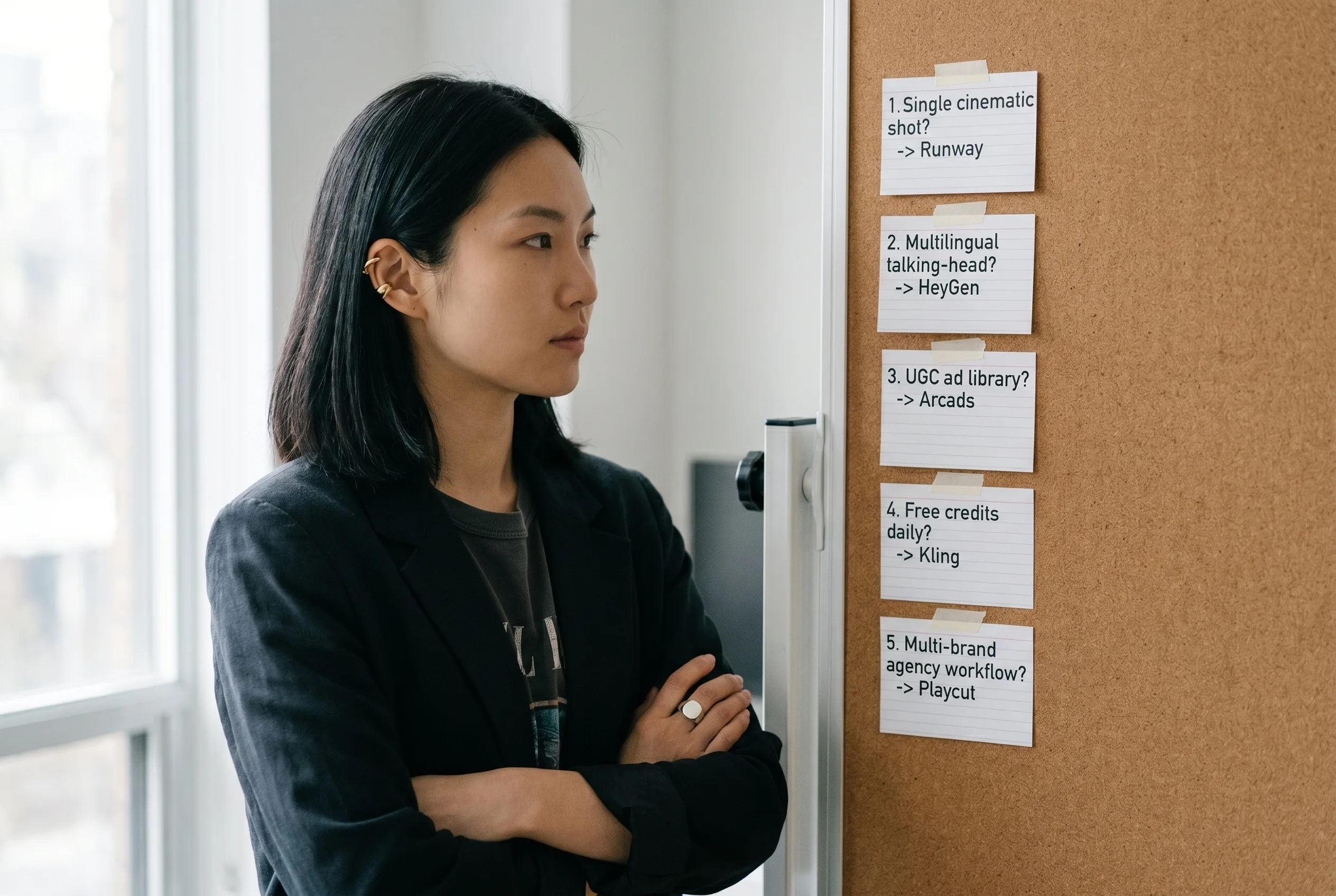
Five rules in order. Apply Q1 first; if it answers your case, stop.
-
Do you need one single cinematic shot at maximum polish? Choose Runway Gen-4.5 — #1 Artificial Analysis Elo, the timeline editor, Aleph for in-context edits. Skip the rest of the decision tree.
-
Do you need multilingual talking-head video? Choose HeyGen Avatar V — 175+ languages, SOC 2 + ISO 27001 + HIPAA + FedRamp, the unambiguous category leader. Pair with Playcut for everything around the avatar.
-
Do you need a deep UGC stock library and run direct-response only? Choose Arcads — 1,000+ stock actors on Pro, Meta/TikTok hook templates. Price in the $77/mo Starter floor (was $110) and credit-forfeit policy.
-
Do you need 4K HDR with an EXR colorist pipeline? Choose Luma Ray3 — only tool in the slate shipping 16-bit EXR. No team plan ships today; price in the workspace gap.
-
Are you a multi-brand agency or team that needs video + image + actors + brand kits from one workspace? Choose Playcut — Veo 3.1, Seedance 2.0, Nano Banana Pro, and Grok Imagine on one credit balance; persistent AI actors with outfit and wardrobe variants; multi-brand brand kits (Agency tier); shared and private folders; flat Hobby $9 / Pro $29 / Studio $79 (4 seats = $19.75/seat) / Agency $149-per-seat (unlimited seats) pricing.
The free Playcut creator tools at /tools ship Veo Prompt Builder, Imagen Prompt Builder, Aspect Ratio Calculator, Storyboard Frame Counter, and Color Palette Extractor at no charge.
If none of Q1–Q4 cleanly fits the brief, Q5 is the default for any team operating across more than one format or more than one brand. The five-question filter resolves roughly 90% of the buyer cases we’ve seen at Playcut over the past two quarters.
One job the slate above doesn’t cover: repurposing long-form footage into shorts. That’s a clipping category, not a generation category — the Opus Clip alternatives breakdown prices it tool by tool with real cost-per-clip math.
Why a multi-model studio beats any single-model competitor
Sora’s shutdown is the cleanest 2026 case study for why model concentration is fragile. OpenAI’s app went dark April 26 and the API follows September 24, and the post-Sora consensus across Bloomberg and AI Video Bootcamp’s 2026 ranking is unanimous: use the model that wins the specific shot, don’t bind the workflow to a single vendor.
The architectural argument is straightforward. Veo 3.1 wins photorealism and audio; Kling 3.0 wins cinematic motion and physics; Seedance 2.0 wins unified audio-video without a second pass; Nano Banana Pro wins editorial stills.
Each model is the right answer to a different question. A single-model studio forces the buyer to leave the workspace when the model is wrong for the shot, or to live with a worse output to stay inside the subscription.
Playcut’s multi-model studio keeps that choice one click away — take the default or pick the model per shot, on one credit balance. Add the Playcut AI Actor Library and multi-brand brand kits and the operational picture is: one chat surface, every best-in-class backend, persistent agency primitives.
That’s the post-Sora consensus, operationalized — and the wedge per aitooldiscovery’s Reddit-aggregated 2026 picks no single-model competitor has closed.
Frequently asked questions
What is the best Playcut alternative in 2026?
There is no single best Playcut alternative because the right answer depends on the job. For a single-model cinematic ceiling, Runway Gen-4.5 holds the #1 Artificial Analysis text-to-video Elo at 1,247 as of March 2026.
For the cheapest serious paid plan with a daily-refreshing free tier, Kling AI Standard at $6.99/mo with 66 free credits per day. For corporate talking-head video in 175+ languages, HeyGen Avatar V is the category leader.
Playcut wins when you want all of those models in one chat on one credit balance, plus persistent AI actors and multi-brand brand kits — the structural moat single-model competitors haven’t closed.
Is there a free alternative to Playcut?
Yes — every major alternative ships some free access, but the terms vary. Kling AI gives 66 daily credits that refresh and is the most generous sustained free tier in the category per Magic Hour’s 2026 pricing audit.
Pika gives 80 video credits per month at 480p. Runway gives a one-time 125-credit allowance — once spent, the free tier is effectively read-only. Luma free is roughly one 720p draft video per day.
Arcads has no free tier and no trial — the entry was $110/mo, now discounted to $77/mo. Playcut is deliberately paid-only in v2 (anti-abuse + quality of service) but runs a 7-day full-feature trial on its $9 Hobby plan at app.playcut.ai; the cheapest entry is Hobby $9/mo.
What happened to Sora and where should I migrate?
OpenAI announced Sora’s shutdown on March 24, 2026; the Sora web and app experiences went offline on April 26, 2026; the Sora 2 API enters maintenance mode and terminates on September 24, 2026, per OpenAI’s discontinuation help center and CNN Business coverage.
The post-Sora consensus across Reddit, TechCrunch, and Bloomberg is multi-model: Veo 3.1 for photorealism and audio, Kling 3.0 for cinematic motion and physics, Seedance 2.0 for unified audio-video. Playcut ships Veo 3.1 and Seedance 2.0 alongside Nano Banana Pro and Grok in one chat on one credit balance — exactly the migration path Sora refugees are converging on.
How does Playcut compare to Runway?
Runway is the filmmaker’s pick: Gen-4.5 is the highest-rated single video model in 2026 and Aleph is a genuinely novel in-context video-to-video editor.
The trade-offs are credit math (12 credits/sec on Gen-4.5, 40 credits/sec on Veo 3.1 with audio, no rollover) and zero agency tooling — no brand kits, no persistent actor library, SSO only on Enterprise.
Playcut puts Veo 3.1 and Seedance 2.0 behind a flat Hobby $9 / Pro $29 / Studio $79 / Agency $149-per-seat ladder with the agency primitives Runway hasn’t shipped. Runway Pro is now $28/mo (down from $35) — within a dollar of Playcut Pro — so the wedge is multi-model breadth, the AI Actor system, and Studio’s 4-seat workspace at $19.75/seat. The full comparison lives in our Playcut vs Runway breakdown.
How does Playcut compare to HeyGen?
HeyGen is the talking-head category leader and the honest pick if your job-to-be-done is corporate sales video, training, customer-success, or multilingual dubbing — Avatar V is state-of-the-art, language coverage is 175+, and the enterprise stack ships SOC 2 Type II, ISO 27001, HIPAA, and FedRamp.
HeyGen is not built for cinematic ad creative, multi-brand agency workflows, or generative image work — those are Playcut’s lanes. Most teams running both pick HeyGen for the avatar and Playcut for everything else.
Do any Playcut alternatives offer persistent AI actors with appearance and outfit variants?
No competitor in this list ships a fully persistent named actor object with appearance + outfit variants the way Playcut does.
The closest are Higgsfield Soul ID — a single trained identity per user, no voice profile bundled — and HeyGen Custom Digital Twins, capped at 1 on Creator and 5 on Business plus $29/mo per additional twin slot.
Runway’s Frames Worlds, Pika’s Pikascenes, and Kling 3.0 Visual DNA all attempt cross-shot consistency via reference uploads, but identity is not stored as a reusable object across sessions.
What is the cheapest Playcut alternative for a creator who needs commercial use?
Kling AI Standard at $6.99/mo for the first month ($8.80/mo on renewal) is the cheapest paid tier in this comparison and includes commercial license, 1080p output, and 660 monthly credits.
Pika Standard is $8/mo on annual billing. Runway Standard is $12/user/mo (annual, up to 5 seats). Luma Plus is $30/mo (the rumored $10 Standard does not exist). Arcads starts at $77/mo (was $110) with no trial.
Playcut Hobby at $9/mo is the cheapest full-studio entry tier in the AI video category and ships every model in the picker, every generation type, brand kit, 3 actors, no watermark, and a 7-day full-feature trial (Hobby is the one tier with a trial) — the only one of these that bundles all of that. Pro $29/mo (10 actors, 2,000 credits) matches Runway Pro and Pika Pro on price while covering every model in the picker.
Are Playcut alternatives like Higgsfield safe to use for paid client work?
Higgsfield’s product is real but the company is in active reputational crisis. The Higgsfield X account was suspended February 9, 2026 over alleged platform-manipulation, and The Register reported the ‘ended 20 creative jobs’ brag post and deletion.
The BBB San Francisco profile documents complaints about annual-disguised checkout flow, credit-forfeit refund policy, and ignored cancellation requests. CEO Alex Mashrabov publicly admitted “we made mistakes” in a February 11, 2026 statement covered by Piunikaweb.
For client work where billing transparency, refund recourse, and content moderation matter, evaluate the trust posture as carefully as the model quality.
Try the multi-model studio
One chat. Every best-in-class model. Persistent actors. Multi-brand kits.
The wedge no single-model competitor has closed: Veo 3.1, Seedance 2.0, Nano Banana Pro, and Grok Imagine on one credit balance — with reusable AI actors and multi-brand brand kits built in. If you’ve picked Playcut from this comparison, jump to the step-by-step Playcut getting-started guide. 7-day full-feature trial on signup.