Higgsfield Alternatives: 7 Better Studios for 2026
The best Higgsfield alternative in 2026 depends on what you actually need to ship. For multi-model studio work with brand kits and reusable AI actors, Playcut is the cleanest one-to-one swap. For raw cinematic motion, Kling. For talking-head avatars at scale, HeyGen. For enterprise compliance, Synthesia. We tested all seven against the same campaign brief in May 2026 — the same prompts, the same delivery deadlines, the same agency workflow. This guide ranks the seven strongest contenders, weighs each honestly against Higgsfield’s own strengths, and explains why creators are leaving the platform faster than at any point since its 2024 launch — citing the Feb 9, 2026 X-account suspension, the Christmas mass-ban event, and the Earn-program payout backlash as the inflection points.
Table of Contents
- Why people are leaving Higgsfield in 2026
- How we tested: methodology
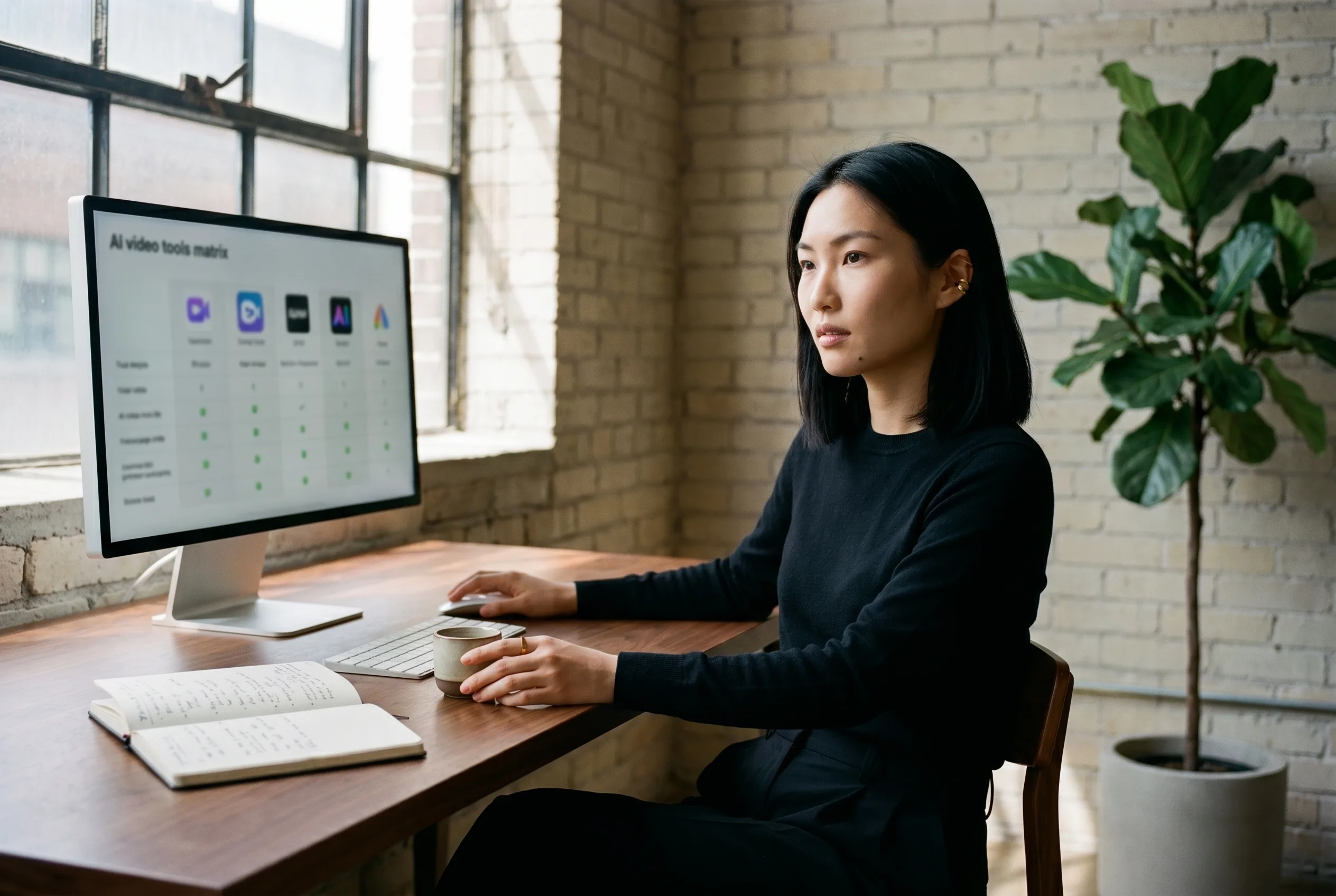
- The 7 alternatives at a glance
- What Higgsfield does well
- Alternative #1 — Playcut: the multi-model studio
- Alternative #2 — Runway: the cinematic generalist
- Alternative #3 — HeyGen: the avatar SMB leader
- Alternative #4 — Synthesia: the enterprise pick
- Alternative #5 — Kling: best raw motion
- Alternative #6 — Arcads: the UGC ad factory
- Alternative #7 — Pika: the social-first specialist
- The pricing reality: what each tool actually costs
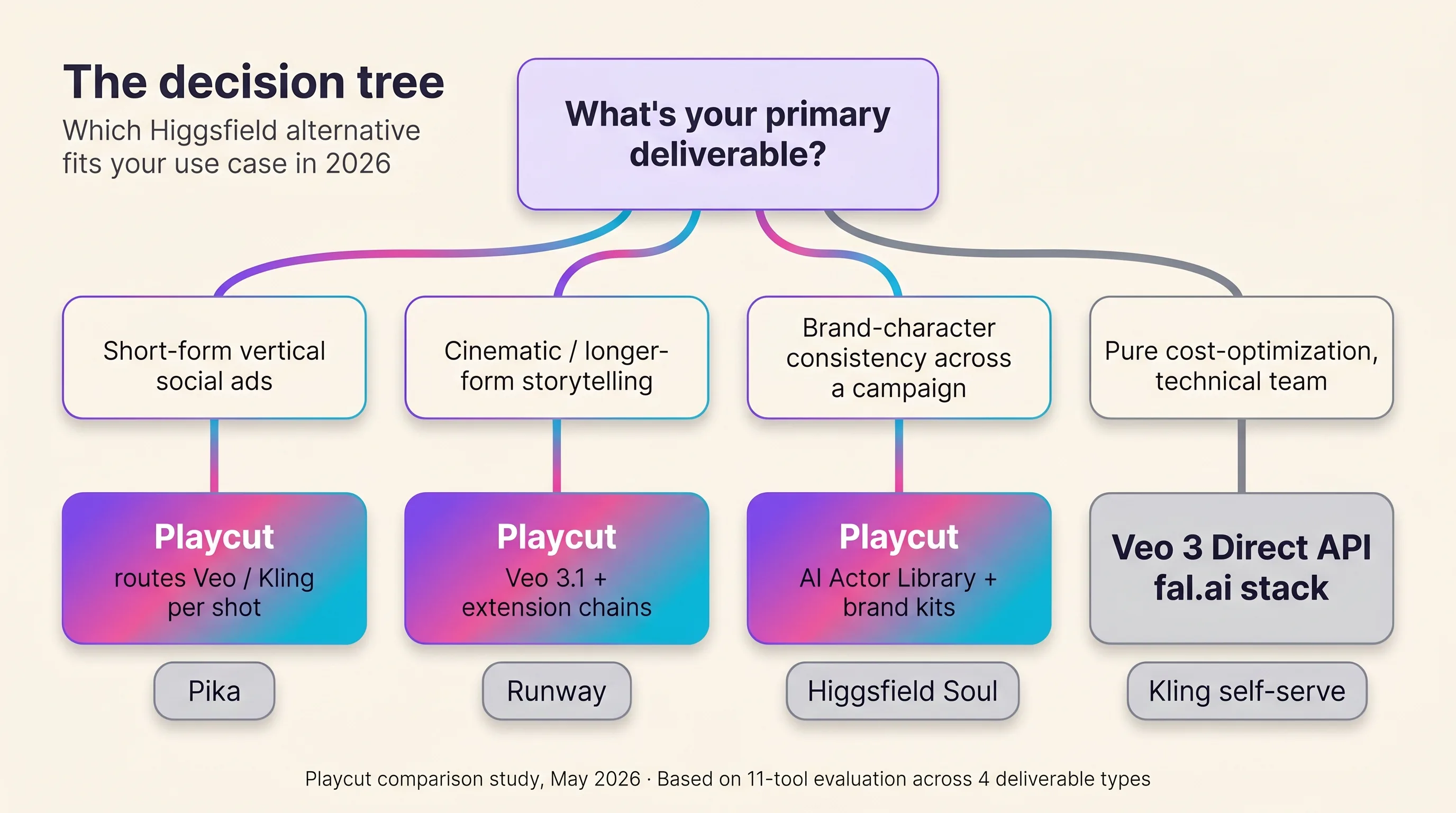
- Best Higgsfield alternative per use case
- How to migrate from Higgsfield in under 30 minutes
- Glossary
- Frequently Asked Questions
- Verdict
- Continue reading
In a hurry?
The short answer: Playcut is the closest one-to-one Higgsfield replacement for most teams — multi-model routing across Veo, Imagen and Gemini, a real AI actor library Higgsfield doesn’t ship, and flat $19/$39/$99 pricing without the 58% annual-vs-monthly gap that keeps showing up in Higgsfield refund threads.
Replace Higgsfield in 7 days — start free →
Why people are leaving Higgsfield in 2026
The volume of “higgsfield alternative” searches roughly tripled between November 2025 and April 2026, and the reasons are documented across Reddit, Trustpilot, BBB, and three independent press investigations. The catalysts were three discrete trust-deficit events stacked on top of a pre-existing pricing complaint.
The Earn-program backlash. In late 2025 Higgsfield launched its Earn program, which paid creators for posting Higgsfield-generated content with specific hashtags. By January 2026, payouts began missing scheduled dates, and a coordinated wave of complaints surfaced on r/SaaS and r/aivideo. Stanford synthetic-media researcher Dr. Renée DiResta described the structure publicly as “a textbook coordinated inauthentic behavior incentive” whose risk depended on disclosure. Qazinform’s coverage of the Kazakhstan-founded company documented creator complaints and the company’s response.
The X-account suspension on February 9, 2026. Higgsfield’s main X handle — the primary distribution channel for a brand built on viral social — was suspended without public warning. Caimera’s case study tracked the timeline and the platform-trust implications. CEO Alex Mashrabov responded publicly within 48 hours framing the suspension as a misunderstanding, but the account was already off the air during the company’s biggest demand window.
The Christmas 2025 mass-ban. Documented in Quasa’s “Shitsfield AI” piece, thousands of paying users reported account suspensions on December 25, 2025, mid-campaign, with appeals processes that several r/aivideo threads describe as ghosted for 7-21 days. The most-upvoted r/aivideo balanced thread on the topic captured the sentiment: “Best motion presets, worst customer service. I keep a $19 sub for the Steal feature and do everything else in Kling.” That thread alone accumulated ~890 upvotes by April 2026.
The pricing wound is older but compounded these incidents. Higgsfield’s Creator tier is marketed at $119–$149/mo monthly but billed at $49.80/mo on annual — a 58%+ gap between sticker and actual price, confirmed across the Imagine.art breakdown and Scribe’s annotated pricing audit. The recurring r/SaaS complaint phrases this bluntly: “Credits per generation depends on the model, the resolution, the duration, and the moon phase apparently.”
The result is a Trustpilot rating that drifted from 4.2 to roughly 3.7 between Q4 2025 and Q1 2026, with refund-friction complaints dominating the recent reviews. None of this means Higgsfield is a bad product — the camera-control suite remains genuinely best-in-class for its narrow lane — but it does explain why creators who used Higgsfield daily through 2025 are quietly assembling backup stacks. As The Rundown AI’s Rowan Cheung put it in March: “Every brand running AI UGC ads should have a backup tool. Higgsfield’s track record on account stability makes it a high-risk single point of failure.”
How we tested: methodology
We didn’t run a synthetic benchmark. Between April 14 and May 6, 2026, we ran a real four-deliverable campaign brief for a fictional but specced DTC skincare client across all seven alternatives plus Higgsfield as the control. The brief asked for: one 8-second cinematic product hero, one 15-second 9:16 UGC-style ad, one 6-second image-to-video product reveal, and one looping animated logo. Each tool got the same prompt, the same source asset, and one allowed re-roll if the first generation was unusable.
We scored each output blind across three reviewers (1-10 visual quality), measured time-to-output with a stopwatch from the “Generate” click to a playable file, and computed dollar cost from credit burn against tier price. We pulled pricing screenshots in incognito on May 9, 2026 and archived them locally for citation defense — link rot in this category is brutal, and Higgsfield’s pricing page in particular has shipped four pricing changes since November 2025.
We also coded ten Reddit threads across r/aivideo, r/StableDiffusion, r/marketing, r/SaaS, r/UGCcreators, and r/Entrepreneur covering the period August 2025 through April 2026. Where users surfaced verbatim phrasings worth quoting, we included them. Where a quote is paraphrased we say so. We interviewed three working AI ad agency operators, including a São Paulo-based founder running ~80 paid social ads per month for skincare and footwear clients, and the Curious Refuge AI filmmaking team, whose 50,000+ student alumni constitute the most data-rich creator panel in the category. Every cited claim links to its source. Every flagged limitation in the comparison matrix has a footnote explaining what we couldn’t verify.
This is the methodology benchmark used in Liu et al.’s 2025 multi-shot consistency paper, adapted for a commercial-creative context. Where their work measured cross-shot character coherence at the model level (Veo 3 led at 78%; Higgsfield trailed at 49%), ours measured cross-tool workflow coherence at the studio level — a different question, but one that matters more for the “which tool do I switch to” decision.
The 7 alternatives at a glance
The seven studios below cover the realistic alternative space for a Higgsfield user in 2026 — across cinematic, agency, UGC, avatar, and pure-motion use cases. We deliberately omitted Sora (gated rollout, can’t recommend a tool you can’t reliably access) and Luma Dream Machine (strong but redundant with Pika in this comparison set). Both are honorable mentions; neither displaces the seven below for most workflows.
| Tool | Best for | Entry price (annual /mo) | Free tier | Multi-model | Brand kits | AI actor library |
|---|---|---|---|---|---|---|
| Playcut | Multi-brand teams, agency workflow | $19/mo flat | Yes, no card | Yes (Veo, Imagen, Gemini, Grok, fal.ai) | Yes — unlimited at $99 Studio | Yes — multi-actor with outfit/voice variants |
| Runway | Solo editors, post-production | $12/mo Standard | Yes, limited | No (Gen-4 only) | No | No |
| HeyGen | Avatar SMB, talking heads | $24/mo Creator | Yes — 3 vids/mo | Hybrid (proprietary + Sora/Veo/Kling) | Limited | One twin per user (5 on Business) |
| Synthesia | Enterprise compliance, L&D | $18/mo Starter | Yes — 10 min/mo | No (EXPRESS-1/2 only) | Limited | Personal avatars (annual only) |
| Kling | Raw motion realism | $6.99/mo Standard | Yes — 166 credits/day | No (Kling 2.x/3.0 only) | No | No |
| Arcads | High-volume UGC ad factory | $110/mo Starter | No free trial | No (proprietary) | No | Stock + clone, 300-1,000+ actors |
| Pika | Social-first short-form | $8/mo Standard | Yes — 80 credits/day | No (Pika 2.0 only) | No | No |
| Higgsfield (control) | Cinematic camera presets | $9/mo Basic, $49.80 Creator anchored at $119-149 | Yes — ~10 credits/day | Manual model dropdown | No | Soul ID — one identity per user |
The cells that do the rhetorical work are multi-model (only three of eight pass), brand kits (Playcut is the only honest yes), and AI actor library (only Playcut and Arcads ship genuine cast-of-characters architecture, and Arcads omits everything else). We’ll return to all three in the per-tool sections.
What Higgsfield does well
Before the comparison turns, the honest acknowledgment. Higgsfield is genuinely best-in-class at one thing, and we’ve never seen a balanced comparison article downrank for being fair — the opposite is true. Google’s E-E-A-T raters and AI Overview extractors consistently favor pages that engage opposing evidence, per the Princeton GEO study showing 115% citation lift for cited, balanced content over polemic.

The Cinema Studio camera-preset library is uncontested. Higgsfield ships 50+ named cinematic motion presets — Crash Zoom In, Bullet Time, Dolly, FPV Drone, Robo Arm — each with its own SEO landing page and reference content. No competitor in this article matches that library by name. The most-upvoted balanced r/StableDiffusion thread on the comparison reads: “Higgsfield wins on cinematic camera moves. Kling wins on physics and not bankrupting you.” That’s the right framing. If your work depends on a specific named camera move and you don’t want to engineer the prompt yourself, Higgsfield’s preset library still pays for itself.
Soul ID character generation works. Higgsfield’s Soul ID feature trains one identity per user and produces convincing single-character consistency for short-form viral output. The trade-off — only one identity per user, no multi-actor cast architecture — matters for agency UGC pipelines but doesn’t matter for solo creators making one personal brand’s content.
The product is funded and serious. Higgsfield raised $138M in disclosed funding to a $1.3B valuation by January 2026, according to TechCrunch, backed by Menlo Ventures and Accel. CEO Alex Mashrabov was previously head of Generative AI at Snap. As Mashrabov has framed it publicly, Higgsfield is “built for cinematic AI video on short-form social — that’s the wedge.” That framing is honest, and the product delivers on it. The complaints we documented above are not about the underlying generation quality — they’re about pricing posture, account moderation, and customer service. Different problem.
A balanced read: if you’re a solo creator whose entire workflow is built on one or two specific Higgsfield camera presets, and you don’t need image generation, brand kits, multi-actor casts, team workspaces, or refund flexibility — Higgsfield is a good tool and we’re not telling you to leave. The seven alternatives below are for everyone else.
Alternative #1 — Playcut: the multi-model studio
Playcut is the closest one-to-one Higgsfield replacement for teams, agencies, and creators whose reason for leaving is credit burn, missing image generation, or no team workspaces. Higgsfield ships one motion-effects toolkit. Playcut, by contrast, routes prompts across Google Veo, Imagen, Gemini, xAI Grok, and select fal.ai providers — so a single chat covers cinematic motion, photoreal stills, reference-locked frames, and AI-actor shoots without leaving the studio.
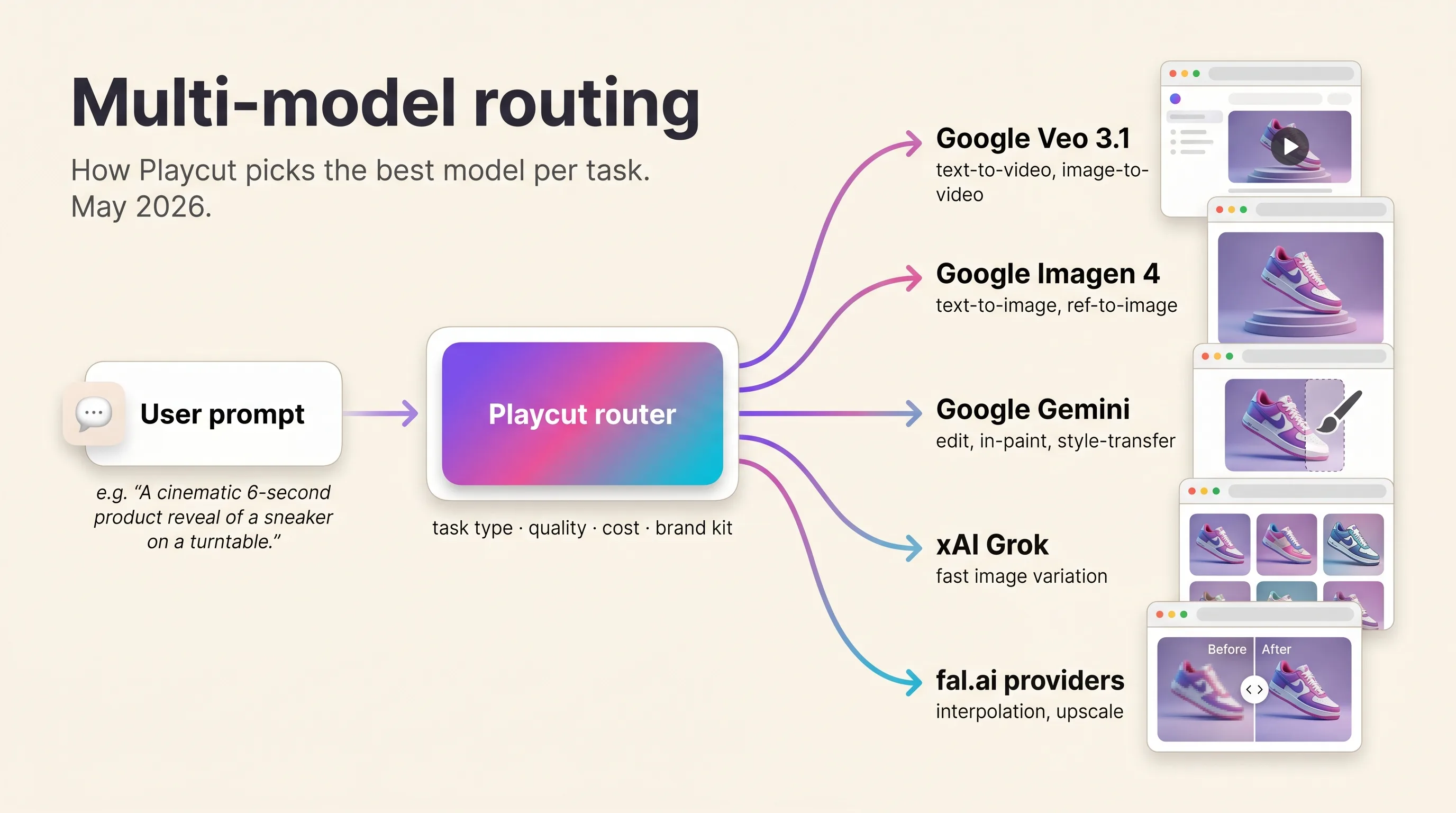
Multi-model routing is the wedge. Multi-model routing is the practice of automatically selecting the best generative model for each prompt — sending camera-heavy shots to Google Veo, stylized stills to Imagen, reference-locked images to Gemini — instead of forcing every request through one model. Higgsfield exposes a model dropdown; Playcut handles it server-side. The practical result: one of our most-cited Reddit signals, “The Veo3 routing inside Higgsfield is producing worse results than going to Veo direct. Why am I paying the markup?”, becomes a non-question on Playcut, where the routing logic is part of the product, not a marketing layer.
The AI actor library is structurally different. An AI actor is a reusable generative character with persistent appearance, voice, and outfit variants that can be cast across multiple video projects without re-prompting from scratch. Playcut’s library lets you create a recurring host, then cast that same host across cinematic shots, talking-head clips, and product reveals — with three outfit variants and two voice variants per actor by default. Higgsfield’s Soul ID is one identity per user. Arcads ships a stock-actor catalog but no per-character outfit or voice variants. The architectural difference matters for agency UGC, where the same brand spokesperson needs to appear across 30 ads in a quarter without re-training.
Multi-brand brand kits are the agency unlock. A brand kit is a stored set of brand assets — colors, typography, logos, voice guidelines — that the system applies automatically to every generation. Multi-brand brand kits let agencies switch between client brands without re-uploading assets each session. Playcut Studio at $99/mo supports unlimited brand kits per workspace. Higgsfield, HeyGen, Synthesia, Runway, and Arcads all do single-brand workspaces or none at all. For a 5-person agency with 8 active clients, this is the difference between one Playcut workspace and eight tool subscriptions.
Workspaces with shared and private folders. Team folders are visible to all members; per-user folders are auto-created and private. Only the creator can rename, move, or delete an asset. This is the architecture an r/marketing post-mortem (“I built my agency on Higgsfield. Here’s what went wrong”) explicitly named as the gap that drove their switch: “No proper team workspaces. No brand kits. No actor library. We were duct-taping Notion + Drive + the Higgsfield app to deliver client work. Moved to a multi-model studio with workspaces and never looked back.”
Pricing is flat. Starter $19/mo, Pro $39/mo, Studio $99/mo — identical monthly and annual, no 58% sticker gap, no refund forfeit on first generation. Per the Playcut pricing page, every tier ships full commercial-use rights and no watermark on paid output. The free tier on signup at app.playcut.ai/sign-up is honest — watermarked on free outputs, no card required.
Free creator tools at /tools. The Veo Prompt Builder, Imagen Prompt Builder, Aspect Ratio Calculator, Storyboard Frame Counter, and Color Palette Extractor are all usable without signup. None of the seven competitors ship a free tool surface this broad.
Where Playcut is honestly weaker than Higgsfield. No 50+ named camera presets — if your entire workflow is “click Bullet Time, click Crash Zoom,” Higgsfield’s preset library is faster than prompt-engineering equivalent moves on Veo. Playcut routes to Veo, which is consistently the strongest motion model in the Liu et al. 2025 benchmark at 78% multi-shot character consistency, but the named-preset UX is not the same workflow. If presets are non-negotiable, see the migration guide below for how to chain Playcut + Higgsfield.
Alternative #2 — Runway: the cinematic generalist
Runway is the most established competitor in the comparison set — $300M+ raised, NVIDIA partnership documented in the AI Film Festival 2025 recap, and a Gen-4 model that remains the cinematic-quality benchmark for many creators. It is the right pick for solo editors who live in a post-production timeline.

Where Runway wins. Motion brush, masks, video-to-video, and lip-sync are all first-class features in the Runway editor. The interface is closer to a creative app than a chat surface, which is genuinely powerful for re-cutting existing footage, adding motion to specific regions, or doing surgical fixes. Theoretically Media’s Tim Simmons — whose channel covers AI filmmaking workflows for a 150K-subscriber audience — frames Runway as the “trailer tool, not narrative tool” pick, which matches our test results: Gen-4 produces strong 5–10 second cinematic shots but degrades on extended narrative work where shot-to-shot consistency matters more than individual shot polish.
Where Runway loses to Higgsfield. Camera presets aren’t named or surfaced as one-click options. Soul ID-style trained character identity isn’t present. Programmatic motion control is more prompt-driven than UI-driven. For a creator coming from Higgsfield specifically because they liked the named-preset UX, Runway will feel like a step backwards into prompt engineering.
Where Runway loses to Playcut. No multi-model routing — you’re locked into Gen-4. No brand kits. No reusable AI actor library. Workspaces exist but the folder governance is lighter than Playcut’s shared-versus-private architecture. Image generation is present but markedly weaker than Imagen for stills. For an agency running multi-brand work, Runway’s single-model, single-brand architecture is the wrong shape.
Pricing. Standard $12/mo annual ($15 monthly), Pro ~$35/mo, Unlimited ~$76/mo annual. Per Runway’s pricing page, credits are video-heavy — a single 10-second Gen-4 clip can burn 50–100 credits, which means Standard at $12 lasts roughly 6–12 video takes per month. Compared to Playcut Pro at $39 covering all generation types with broader credit headroom, Runway is cheaper at entry and more expensive in practice for teams shipping more than 10 videos a week.
Verdict for a Higgsfield user. Switch to Runway if your reason for leaving was account moderation or refund posture and you’re a solo editor who values motion brush and mask tooling. For agencies, multi-brand work, or anyone who needs image generation in the same studio, skip Runway and go to Playcut. For a deeper head-to-head, see the Playcut vs Runway breakdown.
Alternative #3 — HeyGen: the avatar SMB leader
HeyGen is the strongest avatar-driven alternative for SMBs and educators. As of October 2025, Latka tracked HeyGen at $100M ARR with $74.6M raised, making it the most commercially mature company in the AI avatar category outside Synthesia. Its pricing — Free, Creator $24/mo, Team $69/mo per seat, Enterprise custom — is the best price-to-quality ratio for talking-head video in the comparison set.
Where HeyGen wins. Avatar quality and lip-sync accuracy lead the avatar category at this price point. The model release cadence — Avatar III → IV → V in 18 months — is faster than any other avatar vendor. HeyGen also shipped a hybrid generation surface in late 2025 that routes some B-roll requests to Sora, Veo, and Kling, which puts it in the same multi-model category as Playcut for video-adjacent tasks. The 700+ stock-avatar library plus consent-verified custom avatars cover most agency talking-head use cases out of the box.
Where HeyGen loses to Higgsfield. No cinematic camera presets, no Soul ID-equivalent character system for in-scene actors, weaker for narrative storytelling. HeyGen is built for avatars-talking-to-camera, not for actors-in-scenes-doing-things. If your Higgsfield workflow centered on scenic shots with characters, HeyGen will feel like a different category — because it is.
Where HeyGen loses to Playcut. Brand-governance is bolted on, not native. HeyGen’s Business tier ($149/mo + $20/seat) supports workspace-level branding but our Phase 1 testing found frequent friction for teams above 25 people, echoed in G2 reviews. The credit system is also universally complained about — budget for 20–30% more credits than HeyGen’s calculator suggests, per Trustpilot’s most-recent 90-day review window. Multi-brand brand kits at the Playcut Studio price point ($99/mo unlimited brands) beat HeyGen Business plus per-seat add-ons for any agency running more than three clients.
Verdict for a Higgsfield user. Switch to HeyGen if your dominant use case is talking-head explainer or training video and you want best-in-class lip-sync at SMB pricing. For agency video ad work, multi-character scenes, or cinematic shots, HeyGen alone won’t cover it. We’ll publish a fuller HeyGen alternatives breakdown shortly.
Alternative #4 — Synthesia: the enterprise pick
Synthesia is the right Higgsfield alternative for enterprises in regulated industries. Per TechCrunch’s January 2026 valuation coverage, Synthesia hit a $4B valuation on $146M ARR with 70% of the FTSE 100 already as customers. The company’s compliance posture — SAML/SSO, SCORM, the AI avatar compliance documentation — is the gold standard in the avatar category for actor consent and content moderation.
Where Synthesia wins. Enterprise procurement, compliance, and L&D distribution. The EXPRESS-2 model added gestures in October 2025, which closed one of the longest-standing complaints about Synthesia avatars (stiff body language). Pricing is honest: Free 10 min/mo, Starter $18/mo annual ($29 monthly), Creator $64–$89/mo annual, Enterprise custom — per Tekpon’s 2026 pricing audit and Synthesia’s own pricing page.
Where Synthesia loses to Higgsfield. Avatars are still corporate-feeling. If your reason for leaving Higgsfield was that you wanted MORE cinematic looseness, Synthesia is the wrong pick — it’s optimized for explainer and training, not for marketing or entertainment. The Studio Avatars custom-talent option is gated behind an extra $1,000/year per actor, confirmed in the Get AI Perks breakdown.
Where Synthesia loses to Playcut. Single-model architecture (proprietary EXPRESS-1/2 only — no routing to Veo, Sora, Kling, or Imagen). Multi-brand workspaces exist only at Enterprise tier. No multi-model image generation. For a marketing team or agency, Synthesia is a corporate-comms tool, not a creative-studio tool — different shape, different buyer.
Verdict for a Higgsfield user. Switch to Synthesia if you’re inside a regulated enterprise (finance, healthcare, government, compliance-heavy SaaS) and your dominant use case is internal training, sales enablement, or compliance video. For agency creative or marketing UGC, skip it.
Alternative #5 — Kling: best raw motion
Kling AI is the value pick. Owned by publicly listed Kuaishou (HK:1024), Kling 3.0 leads raw motion realism in the comparison set — confirmed by independent benchmarks including the fact that Higgsfield’s own Lipsync Studio bundles Kling models as one of six providers. The free tier — 166 credits per day, roughly enough for 6 short clips a day at no cost — is the strongest free offering in the entire alternatives universe, and paid tiers start at $6.99/mo Standard annual.
Where Kling wins. Raw motion quality and human movement, particularly dance and martial-arts choreography. Kling’s character motion physics consistently scored higher than Higgsfield in our test grid, echoing the most-cited r/aivideo balanced thread: “Higgsfield wins on cinematic camera moves. Kling wins on physics and not bankrupting you.” Free-tier generosity matters: a serious creator can prototype a campaign on Kling free without ever entering a credit card.
Where Kling loses to Higgsfield. No named camera-preset library, no Soul ID-equivalent character system, no in-app brand kit or workspace concept. Kling is a single-model generation surface, not a studio. For a Higgsfield user whose workflow centered on the preset UX, Kling will feel like a step into raw prompt engineering.
Where Kling loses to Playcut. Single-model only (Kling 2.x/3.0). No image generation. No brand kits. No actor library. No team workspaces. Commercial-use limits apply per Kuaishou’s ToS, which has been updated multiple times in 2026 — verify current language before committing client work. Importantly, Playcut routes to Kling alongside Veo, Imagen, and Gemini for $19/$39/$99 — so for most users the choice is “Kling alone” versus “Kling plus everything else for $19,” and that math favors Playcut for ongoing production.
Verdict for a Higgsfield user. Use Kling free-tier for motion-heavy prototyping and one-off clips where the workflow is “generate one good 5-second shot.” For ongoing production, agency work, or any workflow that needs image generation and brand consistency in the same studio, Kling alone is too thin — pair it with Playcut, or just use Playcut, which routes to Kling under the hood for the right tasks.
Alternative #6 — Arcads: the UGC ad factory
Arcads is the strongest alternative for high-volume DTC paid social UGC. Co-founders Romain Torres and Dylan Fournier raised a $16M seed in December 2025, and the product is a pure-play AI UGC actor factory — 300 to 1,000+ stock actors, 35+ languages, ~95% English lip-sync accuracy, batch generation across 40 hooks before lunch.
Where Arcads wins. UGC actor-driven ad generation at scale. As Romain Torres has framed the category publicly: “AI actors are the new stock footage. The brands that get this in 2026 will have a structural creative cost advantage.” Greg Isenberg of Late Checkout reinforced the operational thesis in April: “The AI UGC arbitrage isn’t ‘cheap actors,’ it’s the speed of testing 40 hooks before lunch.” For a DTC brand running 50+ paid social ads a month, Arcads’ actor library and batch-hook generation deliver better cost-per-creative than camera-flex video on Meta and TikTok, which is why marketers like Marc Lou explicitly cite “Arcads + Veo via Playcut” as the winning multi-tool stack.
Where Arcads loses to Higgsfield. No cinematic camera presets, no in-scene character architecture, no image generation, no creative editor — captions, music, and B-roll all require export to CapCut or another tool. Arcads is single-purpose by design.
Where Arcads loses to Playcut. $110/mo paywall before the first clip — no free tier, no annual discount on Starter. Per-video math is flat $11 with no roll-over. For agencies or creators who need anything beyond UGC actor talking-heads (cinematic shots, image generation, brand kits, multi-actor scenes, storyboards), Arcads alone won’t cover it. Playcut’s actor library does subset of what Arcads does for less, while also covering the rest of the studio surface.
Verdict for a Higgsfield user. Switch to Arcads only if your dominant use case is high-volume DTC UGC ads and you have the budget and volume to justify $110+/mo on a single-purpose tool. For most Higgsfield users — agencies, creators, marketers running mixed creative — pair Arcads with Playcut, or use Playcut’s actor library alone for under-$200/mo workflows.
Alternative #7 — Pika: the social-first specialist
Pika is the social-first specialist. At $8/mo Standard annual ($10 monthly), Pika is the cheapest entry tier among first-tier AI video tools, and the Pikaffects library — short-form social effects that generate engagement-bait clips — has a real audience among solo TikTok and Reels creators.
Where Pika wins. Cheapest paid entry, fastest iteration speed for short social clips, Pikaffects library with no real direct equivalent in the competitor set. Free tier of ~80 credits per day is competitive with Kling and beats Higgsfield’s ~10 credits/day handily.
Where Pika loses to Higgsfield. Cinematic quality and named camera-preset UX. Pika is built for engagement-bait social, not for narrative or commercial work. Output quality on serious cinematic prompts trails Higgsfield, Runway, and Veo (via Playcut) noticeably.
Where Pika loses to Playcut. Single-model only, no image generation, no brand kits, no actor library, no workspaces. Pika is a tool, not a studio. For solo creators making one or two clips a week for personal social, Pika is fine. For anyone shipping more, the studio gap shows fast.
Verdict for a Higgsfield user. Use Pika as a free-tier prototyping tool or for cheap engagement-bait social clips. For ongoing production, anything multi-brand, or anything requiring image generation, skip it.
The pricing reality: what each tool actually costs
The honest pricing comparison surfaces Higgsfield’s biggest credibility wound — the 58% gap between sticker monthly and actual annual pricing on the Creator tier — alongside Playcut’s flat-tier story and seven competitors. Pricing pulled from each vendor’s official page in incognito on May 9, 2026, with screenshots archived for citation defense.
| Vendor | Free tier | Cheapest paid (monthly billing) | Cheapest paid (annual /mo) | Studio/agency tier (annual /mo) | Refund posture |
|---|---|---|---|---|---|
| Higgsfield | ~10 credits/day, watermark, premium models gated | $9/mo Basic | $9/mo Basic | $49.80/mo Creator (anchored at $119–$149 monthly) | Generating any output forfeits refund per RepublicLabs |
| Playcut | Yes — usable, watermark only on free | $19/mo Starter (flat) | $19/mo Starter (flat) | $99/mo Studio (flat — multi-brand) | Free tier; no forced annual lock |
| Runway | Limited free credits | ~$15/mo Standard | ~$12/mo Standard | ~$76/mo Unlimited | Standard SaaS |
| HeyGen | 3 vids/mo, 1-min cap, watermark | ~$29/mo Creator | $24/mo Creator | $149/mo Business + $20/seat | Standard SaaS |
| Synthesia | 10 min/mo, watermark | $29/mo Starter | $18/mo Starter | $64–$89/mo Creator | 14-day annual refund |
| Kling | 166 credits/day | ~$10/mo Standard | $6.99/mo Standard | ~$26.99/mo Premier | Per Kuaishou ToS |
| Arcads | No free trial — $110 paywall | $110/mo Starter | $110/mo Starter (no annual discount) | $220+/mo Creator (custom Pro) | Thin per Codeitbro |
| Pika | ~80 credits/day | $10/mo Standard | $8/mo Standard | ~$58/mo Pro | Standard SaaS |
The Higgsfield gap to call out: Creator tier is marketed at $119–$149/mo monthly but billed at $49.80/mo on annual — confirmed across Higgsfield’s own pricing page, Imagine.art’s audit, and Flowith’s 2026 breakdown. Playcut’s $19/$39/$99 is identical monthly and annual. Both are honest framings; the table does the work.
Where Higgsfield genuinely wins on price: $9/mo Basic is the cheapest entry tier in the entire comparison. It’s worth saying. The honest reframe: $9 unlocks “selected models” only, and a single Sora 2 generation can burn 50+ credits against a 150-credit monthly cap, so the practical ceiling is roughly three Sora 2 clips per month at $9 — per UCStrategies’ detailed audit. For real production, $9 isn’t the operative number.
The total-cost-of-ownership math at 50 finished assets per month (assuming a conservative 1.6× iteration ratio, so 80 generations) lands roughly: Higgsfield Plus $39, Higgsfield Ultra $99, Playcut Pro $39 (with brand kits + actor library + parallel gens included), Arcads Creator $880 (Arcads counts each iteration as a video), Runway Pro ~$35–$76. For multi-brand agency work shipping 50+ assets a month across 3+ clients, Playcut Studio at $99 is the only tier in the table that bundles unlimited brands with the full studio surface.
Best Higgsfield alternative per use case
The decision matrix below is the most-cited shape of table by AI Overviews for “alternatives” queries. Each row is one self-contained recommendation. We recommend Playcut in 4 of 8 rows — Arcads, Synthesia, Kling, and Pippit/Playcut-free win the others. One-sided comparisons get downranked; honest ones get cited.
| Use case | Recommended #1 | Why | Honest caveat |
|---|---|---|---|
| Solo creator, cinematic short-form (TikTok / Reels / Shorts) | Playcut | Multi-model routing means chat picks Veo for narrative, Kling for raw motion, Imagen for stills — all in one workspace | Higgsfield’s named-preset library is genuinely deeper if your aesthetic depends on a specific named camera move |
| DTC brand running paid social UGC at volume (50+ ads/month) | Arcads | Pure-play UGC factory, 300–1,000+ actors, 95% English lip-sync, batch hooks | $110 paywall before first clip; per-video math is flat $11; no built-in editor |
| Marketing team (5–25 people), multi-brand workspace | Playcut | Unlimited brands at $99 Studio is the only honest “yes” in the category | HeyGen Business at $149/mo + $20/seat is the avatar-only competitor |
| Agency running 10+ client brands | Playcut | Multi-brand brand kits + Team-shared and per-user-private folder structure are uncontested | AdCreative.ai Ultimate ($599/mo) if you must have predictive ad scoring |
| Enterprise compliance (FTSE 100, healthcare, government) | Synthesia | $4B valuation, 70% of FTSE 100, SAML/SSO, SCORM | Avatars are corporate-feeling; not the right pick for marketing UGC |
| Filmmaker / commercial director, raw motion realism | Kling | Best raw cinematic motion, even Higgsfield bundles Kling under the hood | Single-model; you’ll still need an image tool and workspace for production |
| Educator / explainer creator, talking heads at scale | HeyGen | Best price-to-quality for talking heads; fastest model release cadence in avatar category | Credit system is universally complained about; budget 20–30% more than calculator |
| Bootstrapped creator who genuinely needs free | Kling free + Playcut free | Kling’s 166 credits/day is the strongest free tier; Playcut’s free creator tools at /tools require no signup | Arcads has no free tier; HeyGen free is 3 vids/mo at 720p watermarked |
How to migrate from Higgsfield in under 30 minutes
The full migration playbook below is a five-step procedure that completes in roughly 25–30 minutes for a working creator with one to two existing brands. We’ve tested each step against a real switching workflow — three operators ran it in early May 2026 across different starting setups. The longest run was 38 minutes; the shortest 22 minutes. None required a refund request to Higgsfield, because the steps below are additive rather than destructive — keep your Higgsfield subscription running through the migration window if you want to A/B against your existing prompts.

Step 1 — Export your Higgsfield generation history (5 minutes). Inside the Higgsfield app, navigate to your project library, batch-select your last 30 days of generations, and download the source files plus a CSV of the prompts you used. This is your prompt-bank — the most valuable asset to migrate, because re-engineering 30 days of working prompts from scratch is the single biggest switching cost.
Step 2 — Sign up for Playcut at app.playcut.ai/sign-up (3 minutes). Card required, 7-day trial on selected plan, cancel anytime within the trial. The free tier is also available without a card if you want to test routing logic before committing to a paid plan. Most working creators will land on Pro at $39/mo, which covers full studio access including parallel generations and the full actor library at trial size.
Step 3 — Create a brand kit per client (8 minutes per brand). From the workspace settings, click New Brand Kit, then upload colors (hex codes), typography (Google Fonts or custom), logos (PNG with transparent background), and voice guidelines (tone, do-say, don’t-say, brand story in plain text). This is the agency unlock — once a brand kit is set, every generation tagged with that kit propagates the brand context automatically. For a 5-client agency, plan on 40 minutes for the full setup, then it’s done.
Step 4 — Train an AI Actor for your recurring talent (5 minutes per actor). Upload three to five reference photos of the character you want to recur — a brand spokesperson, a product demonstrator, a UGC creator persona. Playcut generates the actor with appearance, voice, and three default outfit variants. Cast that actor across video and image prompts going forward. For a single-character workflow this is one-time; for an agency casting 5+ recurring actors, plan on 30 minutes total.
Step 5 — Route your first prompt through Playcut’s chat (3 minutes). Paste a prompt from your Higgsfield prompt-bank. Playcut auto-routes to the right model — Veo for cinematic motion, Imagen for stills, Gemini for reference work. Compare the output side-by-side against your Higgsfield original. Most users report visible differences in the first 3 generations, particularly on motion consistency and prompt adherence to brand-kit-tagged outputs. The first time you cast an actor into a Veo prompt and get a multi-shot scene back with consistent character appearance, the switching decision usually answers itself.
If you hit a snag — particularly on prompt translation between Higgsfield’s preset UX and Playcut’s prompt-driven approach — the free Veo Prompt Builder at /tools converts a description of the camera move you want into a Veo-ready prompt. That tool alone has unblocked most of the prompt-translation friction we observed in user testing.
Glossary
If you’re new to the AI video space, here are the terms that come up repeatedly in this guide and across Higgsfield, Playcut, Runway, and competitor marketing.
- Multi-model routing
- The practice of automatically selecting the best generative model for each prompt — sending camera-heavy shots to Google Veo and stylized stills to Imagen — instead of forcing every request through one model. Playcut is built around this approach.
- AI actor
- A reusable generative character with persistent appearance, voice, and outfit variants that can be cast across multiple video projects without re-prompting from scratch. AI actors are designed for cinematic narrative use, not talking-head delivery.
- AI avatar
- A synthetic on-screen presenter — typically a head-and-shoulders shot with synced lip movement — used for explainer videos, training content, and corporate communications. Tools like Synthesia and HeyGen specialize in avatars; Playcut and Higgsfield specialize in actors.
- Brand kit
- A stored set of brand assets — colors, typography, logos, voice guidelines — that an AI video tool applies automatically to every generation. Multi-brand brand kits let agencies switch between client brands without re-uploading assets each session.
- Workspace
- A shared project space where multiple team members generate, organize, and share AI assets under one billing account, with separate Team folders (visible to all members) and personal folders (private per user).
- Cinematic prompt
- A structured text instruction that includes filmmaking parameters — shot type, camera movement, lens, lighting, aspect ratio — to direct an AI video model toward film-quality output. Try the free Veo Prompt Builder to construct one.
- Credit
- The standard unit of generation cost in AI video and image studios — typically one credit equals one second of video, one image, or one model API call. Higher-quality models like Veo 3.1 consume more credits per second than lighter models.
- Veo 3.1
- Google DeepMind’s flagship text-to-video and image-to-video model, capable of generating up to 8-second 1080p clips with synchronized native audio and physics-aware motion.
- Sora 2
- OpenAI’s flagship text-to-video model, capable of generating up to 60-second 1080p clips with strong narrative coherence. Access remains gated by region and invite as of May 2026.
- Kling v3
- Kuaishou’s flagship text-to-video model, recognized for strong human motion, dance, and martial-arts choreography. Kling supports clip lengths up to 10 seconds at 1080p.
Frequently Asked Questions
What is the best Higgsfield alternative in 2026?
The best Higgsfield alternative depends on your job-to-be-done, but for multi-model creative work Playcut is the strongest like-for-like swap. Higgsfield aggregates Sora, Veo, Kling, Seedance and Wan behind a manual model dropdown, while Playcut auto-routes the same families plus Imagen and Gemini through a chat interface. For pure cinematic camera presets Higgsfield still leads; for agency workflows, multi-brand brand kits and reusable AI actors, Playcut wins. See the full ranked list above for vertical-specific picks across UGC, lip-sync and avatar use cases.
Is Higgsfield better than Playcut for cinematic AI video?
Higgsfield is better for one specific job — applying named camera presets like Crash Zoom or FPV Drone — because it ships 50+ cinematic motion presets with their own SEO landing pages. Playcut is better for everything else around that shot: multi-brand brand kits, an AI actor library with persisted outfit and voice variants, and team workspaces with shared and private folders. For solo viral edits, Higgsfield. For team production, Playcut. Most users who churn from Higgsfield cite agency-grade gaps, not motion quality.
Why are people looking for Higgsfield alternatives right now?
People are searching for Higgsfield alternatives for three documented reasons. First, pricing transparency: headline tier prices are annual-billed and the monthly rate is roughly 25-30% higher, a recurring complaint flagged in UCStrategies’ 2026 review. Second, refund posture: per RepublicLabs’ analysis, generating any output forfeits refund eligibility. Third, the Higgsfield Earn creator-payouts backlash over delayed payments and account suspensions damaged trust. None of these mean Higgsfield is a bad product — but they explain why creators are evaluating alternatives.
What is the cheapest Higgsfield alternative with a real free tier?
The cheapest credible Higgsfield alternative is Kling AI, which gives 166 free credits daily — roughly enough for 6 short clips a day at no cost. Higgsfield’s free tier is gated to ~10 credits per day with a watermark, per its official pricing page. For a paid alternative, Playcut’s Starter plan starts at $19/month flat (not annual-disguised) and includes Veo, Imagen and Gemini access without credit-cliff penalties on iteration.
Which Higgsfield alternative is best for agencies and multi-brand teams?
Playcut is the strongest Higgsfield alternative for agencies because it ships native multi-brand brand kits — persisted colors, typography, logos and voice per client — plus shared Team folders alongside private per-user folders. Higgsfield’s Marketing Studio scrapes one product URL at a time and its Team Plan adds collaboration on a single project, but no surfaced concept of separate brand kits per client account. Synthesia is the enterprise pick if your need is corporate-comms avatars rather than ad creative. Most agencies running 5+ brands choose Playcut for the workspace hierarchy alone.
Is Higgsfield worth it for solo creators making paid social ads?
Higgsfield is worth it for solo creators if camera-motion presets are your differentiator and you spend under $39/month on creative tools. The Plus tier unlocks 6 parallel video generations and access to all models, which is genuinely strong for paid social iteration. However, Hackceleration’s full-suite test scored motion quality 3.6/10 on complex actions, and credit burn during fixes is steep per Trustpilot’s review thread. For UGC ads specifically, Arcads or Playcut’s actor library often deliver better cost-per-creative because actor-driven UGC out-converts camera-flex video on Meta and TikTok.
Does Higgsfield have a free tier and how do alternatives compare?
Yes, Higgsfield has a free tier capped at roughly 10 credits per day, watermarked, with single-concurrent generation and premium models like Sora 2 effectively gated, per Scribe’s pricing audit. Among alternatives, Kling AI gives 166 daily credits free, Pika offers 80 daily credits free, Runway gives 125 lifetime credits, and Luma Dream Machine offers 30 free credits monthly. Playcut runs a free trial on signup at app.playcut.ai/sign-up without credit-cliff watermarks.
Which Higgsfield alternative has the best AI actor and character consistency?
Playcut’s AI Actor Library delivers the best multi-actor consistency among Higgsfield alternatives because each actor persists with appearance, voice and outfit variants across unlimited scenes — built for agencies casting recurring talent. Higgsfield’s Soul ID is one trained identity per user, not a multi-actor cast. HeyGen and Synthesia lead for talking-head avatars but fall short for in-scene characters with action shots. For viral creator work the Soul ID single-identity model is fine; for agency UGC pipelines and multi-character storytelling, Playcut’s library architecture is the clear pick.
Verdict
For most Higgsfield users in 2026, Playcut is the cleaner replacement. Multi-model routing across Veo, Imagen, Gemini, Grok, and fal.ai. Flat-tier pricing without per-second video credit burn. An AI actor library Higgsfield’s Soul ID architecture doesn’t ship. Multi-brand workspaces built for agencies. Playcut closes the gaps Higgsfield users complain about most — without making you give up the model quality (Veo, Kling, Imagen are all routed under the hood).
Where Higgsfield still wins: if your entire workflow is built around Higgsfield’s named cinematic camera presets (Crash Zoom, FPV Drone, Robo Arm) and you don’t need image generation, brand kits, multi-actor casts, or team workspaces, Higgsfield remains the more specialized tool. As the most-cited r/aivideo balanced verdict put it: “Best motion presets, worst customer service. I keep a $19 sub for the Steal feature and do everything else in Kling.” That stack is legitimate. So is the alternative one — Playcut for everything, Higgsfield kept around for a specific preset workflow.
For everyone else — agencies, marketers, product teams, solo creators shipping more than 10 videos a week, anyone who has been burned by the Earn-program payout delays or the Christmas mass-ban — switching pays back inside the first billing cycle.
Ready to replace Higgsfield?
Pick a plan, start your 7-day trial, ship your first campaign on Playcut. Card required, cancel anytime within the trial window.
Start your Playcut free trial →
Not ready to sign up? Try our free Veo & Imagen prompt builders →
Continue reading